
Do you realize that there can be different issues with the eyes at various ages? These include nearsightedness (myopia), farsightedness (hyperopia), or astigmatism that begins at an early age. There are even greater risks to the vision particularly as one stares at a mobile device too frequently.
For those in the working age group, spending a lot of time in front of computer or mobile device screens can cause the eyes to become dry and feel fatigued. Outside activities, too, pose the risks of pinguecula and pterygium that is triggered by the UV from sunlight.
For people in the older age groups, they generally experience farsightedness that comes with age. But they may also have a greater risk of, for example, glaucoma, cataract, or macular degeneration, etc.
However, many people do not realize they are experiencing problems with their vision. So, we would like to encourage everyone to begin some basic eye tests, to determine the potential risk to your vision so that, if an irregularity is detected, you would be able to have your eyes properly examined and treated accordingly.

Normal Vision
If your vision is clear both the foreground and the back like in this picture, it means you have normal vision. That is, light comes through your cornea and lens, and focuses properly onto the retina. This enables us to see clearly and sharply. However, it still is recommended that you have your eyes examined, to ensure that you are not at risk of some vision ailments – such as dry eyes, cataract, etc.

Myopia or Nearsightedness
If you normally see everything just as in this picture – i.e., the further objects are blurred but nearer ones are clearer – this is a warning sign for nearsightedness or myopia. This occurs when the eye’s lens and shape are mismatched such that light is focused in front of the retina, making distance objects blurry while nearer ones appear sharper. This has to be corrected by concave lenses that will focus light appropriately onto the retina.

Astigmatism
When your vision is not clear nor sharp and is distorted, you may be suffering from astigmatism. This occurs because the surface of the eye, instead of curving like a perfectly round ball, is egg-shaped like a rugby ball which causes light entering the eye from different angles to miss the same focal point. The condition is generally found in myopia or presbyopia, making the vision blurry with distortion.

Hyperopia or Farsightedness
If your near vision is blurry but you can always see distant object more clearly, you may have mild-hyperopia. Or if neither your near nor far visions are very clear, you could be suffering from a more severe case of hyperopia. This is because the cornea is too flat or the depth of the eyeball is too shallow, causing light to be focused behind the retina and making more distant objects appear clearer. This is the opposite of myopia. Convex lenses can be used to correct this condition, such that light is properly focused onto the retina.

Presbyopia
This condition is found among people 40 years old and more, when it is difficult for you to focus on an object near to your eyes and you have to hold it further away. However, your distant vision still remains as clear as usual. This is the case of presbyopia or farsightedness that comes with age. Your eyes cannot focus on nearer object as well as before. This can be corrected by convex lenses as in the case of hyperopia, but the eyeglasses are needed only for looking at something up close.

Vitreous Degeneration
If your vision is similar to this picture – i.e., seeing dark shadows, or black spots or specks that float around and follow your vision as you roll your eyes – and sometime you see flashes of light or what appears like lightning, it is probable that you might be suffering from vitreous degeneration. This occurs when the gel-like substance in the eyeball, known as vitreous, has deteriorated and partially liquified. Some will condense into small specks or lines, and peel off the surface of the retina and become floaters. The condition is generally found in people 50 years and older, or among people with myopia. If left untreated, the retina could become torn or detached which could lead to the permanent loss of eyesight.

Cataract
If your vision becomes gradually fuzzy – foggy or as if it was covered by a veil, or you see double vision, or light is scattered in shades of yellow, or colors you see are distorted, or your vision changes rapidly and you need to change the eyeglasses often – you may be at a risk of cataract. This happens when the lens in your eye has become cloudy, which reduces the amount of light that focuses onto the retina. Thus, your vision is progressively worsened. The condition is found among older people – mostly in the 50 – 60 age group – as the lenses of the eyes deteriorate with age. However, it can happen to people in other age groups as well.
Macular Degeneration
If you cannot see the middle of the picture clearly – as if it was covered by something, or the picture is distorted or appears to be rippled – you may be suffering from macular degeneration. The condition is found among people 40 – 50 years old, and it is increasingly common in older people; especial those 60 – 70 years or older.

Glaucoma
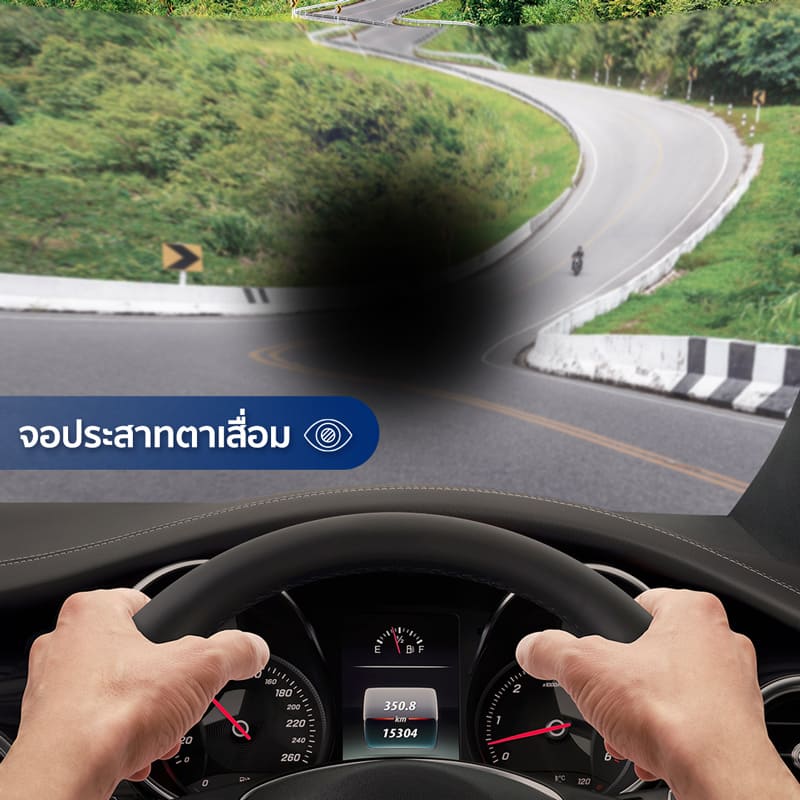
If you experience any of the following conditions – foggy vision, seeing halo around a light source, eyestrain, teary eyes, headache, feeling nauseous and vomit – you may be suffering from acute glaucoma with high pressure in your eyes. However, like a silence peril, some cases of glaucoma do not exhibit any noticeable sign and when the disorder has reached an advanced stage, the field of vision already becomes narrow as if you were in a tunnel – as depicted in the picture. Glaucoma is often found among people 40 years and older who tend to have high pressure in the eyes. It is caused by a deterioration of the optic nerve and, if left untreated, can lead to permanent blindness.
Nowadays, glaucoma has becoming increasingly common in younger people. As sometimes the symptoms are not particularly obvious but the pressure in the eyes rises gradually causing damage the optic nerve, it is therefore important to have your eyes examined by an eye doctor regularly.

Diabetic Retinopathy
Diabetes is a common disease that affects the eyes also. Initially, it may not cause blurry vision, but in a more advanced stage it can impair your eyesight. Examinations may reveal bleeding on the retina or irregular blood vessels. Sometimes there is swelling on the retina which interferes with the middle part of your field of vision. On occasions, diabetic retinopathy symptoms are not noticeable and a diabetic patient may ignore eyes examinations until the disease has become advanced. In such a case, treatment could be too late as there might be bleeding in the eyes or the retina could become detached. This could lead to permanent blindness in the end.
Therefore, it is recommended that diabetes sufferers have their eyes examined regularly – at least once a year or as recommended by the doctor – as well as keeping diabetic conditions well under control. This will reduce the risk to the vision and other organs as well.