


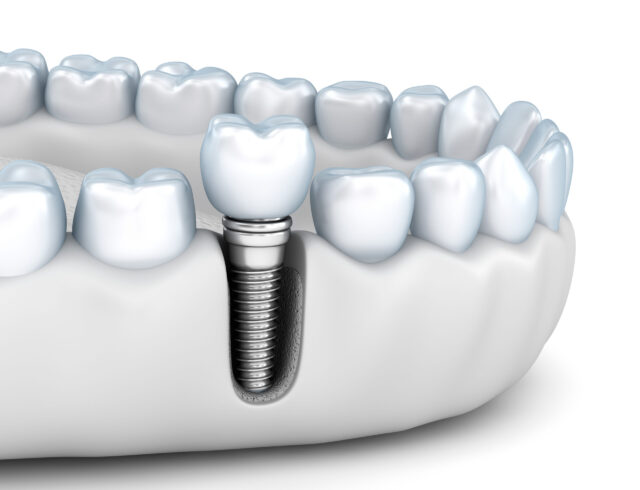
When a patient has a tooth extracted and needs a replacement denture, some may feel unsure, fearing it might fall out or affect their personality. This is no longer a problem because nowadays there are methods that help reduce insecurity and allow patients who have lost a tooth to resume normal function with implants or dentures.
What is an “implant”?
An implant is a material, possibly titanium or ceramic, created to replace tooth roots. It resembles a screw placed into the jawbone to serve as a base for crowns, bridges, or removable dentures to replace lost teeth.
The purpose of an implant is to replace lost teeth by using implants to secure crowns or bridges as permanently fixed teeth in the mouth or to hold removable dentures more securely, preventing them from easily loosening or falling out.
Dental implant treatment takes approximately 3 to 6 months, depending on factors such as the amount and quality of jawbone and the number of teeth needing implants.
For implants to restore lost teeth, placing them in the correct position is crucial. The usual method involves taking mouth impressions and using X-rays to plan the implant location, relying on the dentist’s experience and expertise.

Understanding Computer Guided Implant Surgery
Today, there is technology that helps place implants more accurately, called Computer Guided Implant Surgery. It utilizes computer programs to integrate X-ray images and oral photographs or dental mold photos to determine implant positions. This enables dentists to see detailed implant sites, aligning closely with reality, allowing the transfer of planned positions from a computer screen to real implant sites with greater precision.
Computer Guided Implant Surgery involves using computer programs in conjunction with 3D X-ray imaging technology (Cone-Beam CT) to plan and determine implant positions. The program combines oral images or dental mold photos with 3D X-ray images to show relationships of bone, teeth positions, and other critical structures like nerves and sinuses, allowing better size and position choices for replacements.

Treatment Steps for Computer Guided Implant Surgery
Treatment steps begin by assessing oral condition suitability for implants with 3D X-ray imaging and planning treatment. Appropriate root size, number, and length are chosen, considering factors like bone volume, number of missing teeth, and informing the patient of the treatment plan. Typically, planned implant positions require a wait for bone integration with the implants, about 2 to 6 months.
For implant placement, after thoroughly examining the oral condition, dentists use positioning devices to assist, significantly reducing surgery time. After implanting, 2-3 months later, the dentist proceeds with crowns or dentures on the implants, considering bone quality and volume, taking 1 week to 1 month depending on treatment complexity.
Advantages of Computer Guided Implant Surgery
The main advantage of Computer Guided Implant Surgery is it enables precise planning, reducing implant surgery time due to pre-determined positions, increasing speed, and minimizing errors. Patients with adequate bone strength can receive implants immediately or within a week. Additionally, it aids in maintenance post-crown placement, allowing replacement creation from stored files without retaking data, saving time and effort.
Furthermore, implants offer natural-looking aesthetics by allowing appropriate tooth sizing. However, after implantation, patients must maintain oral hygiene, like thorough brushing, flossing, avoiding excessively hard foods, and visiting a dentist every 3 to 6 months as scheduled.