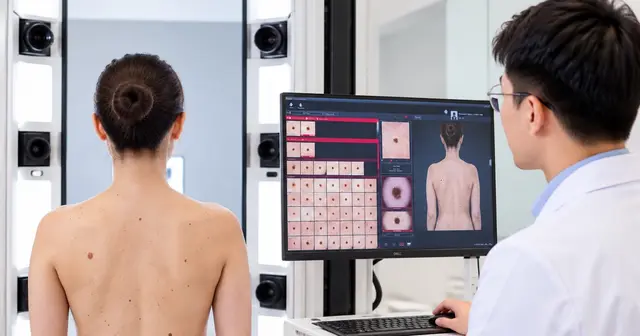
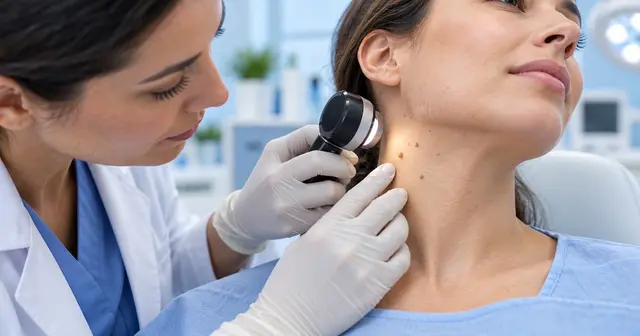
Skin tags are common, harmless skin growths that frequently develop around the neck, underarms, eyelids, groin and other skin folds. They usually do not require treatment, but people may choose removal when skin tags repeatedly catch on clothing or jewelry, become irritated, bleed after friction, or are cosmetically bothersome. American Academy of Dermatology
CO₂ laser is one option for removing selected skin tags, particularly smaller lesions. Other appropriate treatments can include snip removal, electrosurgery and cryotherapy. The best method depends on the size, number, location and appearance of the lesions rather than assuming that laser is appropriate for every skin growth. NCBI
Most importantly, a growth should be correctly identified before it is destroyed. A wart, mole, seborrheic keratosis and, rarely, a more concerning skin lesion can sometimes be mistaken for a skin tag. NCBI
Diagnosis first, treatment second.
What Is a Skin Tag?
A skin tag is a benign, soft growth of skin, medically known as an acrochordon.
A typical skin tag is:
- soft;
- skin-colored, pinkish or brown;
- smooth or slightly wrinkled;
- often attached to the skin by a narrow stalk; and
- usually painless.
They are particularly common in areas where skin rubs against skin, clothing or jewelry, including the neck, underarms and groin. They can also occur around the eyelids and underneath the breasts. American Academy of Dermatology
Skin tags themselves are harmless.
Treatment is therefore usually performed because the lesion causes irritation or discomfort, repeatedly catches on something, affects function in certain locations, or because the patient would prefer to have it removed. American Academy of Dermatology
Why Do Skin Tags Develop?
There is no single cause.
Skin tags commonly develop in areas exposed to repeated friction. They are also more common with increasing age and are associated with factors including obesity, pregnancy, diabetes, insulin resistance and metabolic syndrome. Family tendency may also play a role. NCBI
Having one or several ordinary skin tags does not automatically mean that you have diabetes or another underlying disease.
However, patients who suddenly develop numerous lesions or have other relevant health concerns may benefit from medical assessment rather than simply having every growth removed. The American Academy of Dermatology similarly recommends evaluation when many skin tags suddenly appear. American Academy of Dermatology
Is It Really a Skin Tag?
This is the most important question before CO₂ laser treatment.
Many skin tags have a characteristic appearance and can be diagnosed during a clinical examination.
However, not every small raised growth is a skin tag.
Conditions that can sometimes resemble one include:
- viral warts;
- seborrheic keratoses;
- certain moles;
- neurofibromas;
- molluscum contagiosum; and
- other benign skin growths.
Rarely, a more significant skin lesion can also have a polyp-like or raised appearance. NCBI
This matters because CO₂ laser destroys the treated tissue. If there is uncertainty about the diagnosis and microscopic examination may be necessary, destroying the entire lesion can remove tissue that could otherwise have been sent for pathology.
When Should a Growth Be Examined Before Laser Removal?
A dermatologist should assess the lesion before destructive treatment if it:
- has an uncertain diagnosis;
- has unusual or multiple colors;
- has changed significantly;
- is growing rapidly;
- repeatedly bleeds without obvious trauma;
- becomes ulcerated or develops a persistent wound;
- is unusually firm;
- looks different from the patient’s other skin tags; or
- has other features that raise diagnostic concern.
This does not mean that such a lesion is necessarily cancer.
It means that confirming the diagnosis is more important than immediately removing it with a destructive treatment.
How Does CO₂ Laser Remove Skin Tags?
A CO₂ laser delivers energy that is strongly absorbed by water in tissue. In dermatologic procedures, this allows the operator to precisely vaporize or cut selected superficial tissue.
For an appropriate skin tag, the laser can be used to remove the projecting lesion while treating its attachment to the skin.
CO₂ laser is recognized as one method that can be used for smaller skin tags, although it is only one of several available removal techniques. NCBI
The goal is to remove the unwanted growth while limiting unnecessary injury to surrounding normal skin.
What Happens During CO₂ Laser Skin Tag Removal?
Treatment begins with an examination.
The doctor first determines whether the lesion appears consistent with a benign skin tag and whether laser treatment is appropriate.
Depending on the number, size and location of the lesions, pain control may involve a topical numbing medicine, local anesthetic injection or another approach considered appropriate for the procedure. Local anesthesia is sometimes used during skin-tag removal. NCBI
The skin is then prepared and the selected lesions are treated individually.
After removal, each treated area usually looks like a small superficial wound rather than normal skin immediately.
That is expected.
The skin then repairs itself during the healing process.
Does CO₂ Laser Skin Tag Removal Hurt?
Some discomfort is possible.
How much a patient feels depends on factors such as:
- size of the lesion;
- number being treated;
- location;
- laser settings;
- method of anesthesia; and
- individual pain sensitivity.
Patients may feel heat, stinging or tenderness associated with treatment.
For larger lesions or sensitive areas, local anesthesia may be considered to make the procedure more comfortable.
Which Areas Can Develop Skin Tags?
Neck
The neck is one of the most common locations.
Skin tags here may repeatedly catch on necklaces, shirt collars or during shaving.
When numerous small lesions are present, treatment planning should consider both the number of lesions and the likelihood of temporary visible marks while they heal.
Underarms
Skin tags commonly develop in the underarms because of skin-to-skin friction.
After treatment, sweat, friction and shaving can irritate healing skin, so aftercare is particularly important.
Groin
The groin is another common site because of friction and skin folds.
Not every growth in this area is a skin tag, however. Warts and other genital or groin lesions can have a similar appearance, making diagnosis particularly important before laser treatment.
Eyelids
Skin tags can occur around the eyelids. American Academy of Dermatology
Treatment close to the eye requires appropriate assessment and eye-safety precautions. Depending on the exact location and lesion, another removal technique may be preferable.
What Does the Skin Look Like After CO₂ Laser Treatment?
Immediately after treatment, the area may look:
- red;
- slightly swollen;
- superficially raw; or
- like a small abrasion.
A crust or scab may subsequently develop as the skin heals.
The appearance depends considerably on how large and deep the treated lesion was. Removing a tiny skin tag leaves a different wound from treating a broad or thick lesion.
It is therefore more accurate to think of CO₂ laser removal as creating a controlled superficial wound that needs time to heal, rather than expecting the skin to look normal immediately after treatment.
How Long Does Recovery Take?
Healing time varies.
Small superficial treatment areas generally heal more quickly than larger or deeper areas. Location also matters: friction, moisture, sweating and repeated movement can influence healing.
There is therefore no single recovery time that applies to every CO₂ laser skin-tag procedure.
Patients should receive wound-care instructions based on the actual treatment performed.
This is especially relevant for tourists who may be planning swimming, diving, prolonged sun exposure or other outdoor activities in Phuket shortly after treatment.
Aftercare Following CO₂ Laser Skin Tag Removal
Good wound care helps the treated skin heal and reduces avoidable complications.
Follow the instructions provided by the treating medical team, because wound care may differ depending on the procedure and location.
Common principles include:
Keep the area clean
Clean the treated area according to the instructions you receive. Avoid aggressive scrubbing.
Do not pick the wound
Allow crusting or scabbing to separate naturally.
Picking can reopen the wound and may increase the chance of bleeding, infection, prolonged redness or visible pigment changes.
Reduce friction
Avoid unnecessary rubbing from clothing, jewelry or shaving while the area is healing.
This is particularly relevant to the neck, underarms and groin.
Follow instructions regarding topical medication or dressings
Not every wound needs the same dressing or topical treatment. Use only what has been recommended for your procedure.
Protect healing skin from excessive sun exposure
Once the wound has closed sufficiently for sunscreen to be used, sun protection can be particularly important because newly healed skin may be more noticeable if pigmentation develops.
Can I Swim After CO₂ Laser Skin Tag Removal?
Phuket patients frequently ask this question.
Swimming exposes a fresh wound to prolonged moisture and potentially irritating or contaminated water. A newly treated area should generally be allowed to establish an adequate skin barrier before swimming.
However, the appropriate timing depends on the size and location of the wound and how it is healing.
If you are visiting Phuket specifically for a beach or diving holiday, tell the doctor about your plans before treatment. In some circumstances, scheduling the procedure later in the trip—or after water activities—may be more practical.
Can I Exercise After Treatment?
This also depends on the treatment location.
Exercise itself does not necessarily affect a small treated area, but sweating, friction and repeated movement can irritate fresh wounds, particularly around the neck, underarms, groin or areas covered by tight sportswear.
Your doctor can advise you based on where and how extensively you have been treated.
Will CO₂ Laser Leave a Scar?
Any procedure that removes or destroys skin has the potential to leave a visible change.
With appropriately selected small superficial lesions, the resulting wound may be small. However, it is not medically accurate to promise “no scar.”
The final appearance can depend on:
- size of the skin tag;
- depth of treatment;
- body location;
- individual healing tendency;
- wound care;
- infection or trauma during healing; and
- previous tendency to form raised scars.
If you have a history of thick or raised scars, tell your doctor before treatment.
Can CO₂ Laser Cause Dark Marks?
Yes.
Post-inflammatory hyperpigmentation means that skin becomes darker after inflammation or injury.
It can occur after many dermatologic procedures, including procedures that create superficial wounds.
The likelihood varies according to skin type, treatment depth, location, sun exposure and individual response.
This is particularly relevant in Thailand, where ultraviolet exposure can be substantial throughout the year.
Patients should therefore understand that although the skin tag can be removed, the treated area may temporarily remain visible because of redness or pigmentation during healing.
Can the Treated Area Become Lighter?
Temporary or persistent lighter pigmentation is also possible after destructive treatment.
The risk generally relates to the degree of tissue injury and the individual’s pigment response.
For this reason, treatment should be sufficiently controlled to remove the lesion without unnecessarily treating surrounding normal skin.
What Are the Possible Side Effects?
Potential effects following skin-tag removal can include:
- temporary pain or tenderness;
- redness;
- swelling;
- crusting;
- bleeding;
- delayed wound healing;
- infection;
- darker pigmentation;
- lighter pigmentation; and
- scarring.
Skin-tag removal is generally a minor dermatologic procedure, but bleeding and, less commonly, postoperative infection can occur. NCBI
Patients taking medicines or supplements that affect bleeding should tell their doctor before a procedure.
CO₂ Laser vs Cryotherapy for Skin Tags
Cryotherapy destroys a lesion by freezing it, commonly with liquid nitrogen.
It is an established method for removing selected skin tags. American Academy of Dermatology
However, freezing can also affect surrounding normal skin, and pigmentary changes can occur. NCBI
CO₂ laser instead removes tissue using laser energy.
Neither method is automatically better.
The choice depends on factors including:
Lesion type → Size → Location → Number → Skin type → Patient preference → Clinician assessment
CO₂ Laser vs Snip Removal
A stalk-like skin tag can also be removed using sterile surgical scissors or a blade.
This can be a straightforward option for appropriately shaped lesions and allows rapid physical removal. Dermatologists commonly use snip removal as one of the standard techniques for skin tags. American Academy of Dermatology
Bleeding may need to be controlled after removal.
CO₂ laser may be useful for selected smaller lesions, including multiple lesions where precise tissue ablation is desired. NCBI
Again, the shape of the lesion often matters more than simply choosing the most technologically advanced treatment.
CO₂ Laser vs Electrosurgery
Electrosurgery uses electrical energy to destroy or remove tissue and is another established method for skin tags. DermNet®
Both techniques can be useful in dermatologic practice.
Treatment selection depends on the characteristics of the lesion, anatomical site, equipment available and clinical judgment.
There is no need for every skin tag to be removed using the same technique.
When Is Biopsy Better Than CO₂ Laser?
This distinction is particularly important.
For a classic benign skin tag, microscopic examination is often unnecessary.
But when the diagnosis is uncertain, the priority may change.
Instead of destroying the lesion with CO₂ laser, the doctor may recommend removing tissue in a way that allows it to be sent to a laboratory for histopathological examination.
This may be preferable when a lesion has atypical features or when another diagnosis needs to be excluded.
A destructive procedure should not take priority over obtaining a diagnosis.
If it looks benign and the diagnosis is clear → removal can be considered.
If the diagnosis is uncertain → investigate first.
Can Skin Tags Grow Back?
A skin tag that has been completely removed is physically gone, but this does not prevent new skin tags from developing elsewhere.
Patients who are prone to skin tags may therefore notice new lesions over time, particularly in areas of friction.
The appearance of another skin tag does not necessarily mean that the original treatment failed.
Should I Remove Skin Tags Myself?
Home removal is not recommended.
Cutting a skin tag yourself can cause bleeding, infection and injury. The American Academy of Dermatology also advises against products marketed for home skin-tag removal. American Academy of Dermatology
Another problem is diagnosis.
If the growth is not actually a skin tag, destroying it at home may delay recognition of another condition.
Similarly, wart-removal medication should not be applied to a presumed skin tag. Wart treatments can injure the surrounding skin and are not designed to treat skin tags. American Academy of Dermatology
Skin Tag Removal for Tourists and International Patients in Phuket
Skin-tag removal is often a relatively small procedure, but travel plans still matter.
If you are visiting Phuket, tell the doctor if you plan to:
- swim;
- scuba dive or snorkel;
- spend significant time at the beach;
- have substantial sun exposure;
- fly home shortly after treatment; or
- continue wound care in another country.
For patients having multiple lesions treated, it may sometimes be more practical to plan treatment around holiday activities rather than immediately before swimming or prolonged sun exposure.
International patients who have previously been told that a lesion is unusual should also bring any previous photographs or pathology reports if available.
What to Expect During a Dermatology Consultation
A skin-tag consultation should involve more than simply counting how many lesions need to be lasered.
The first step is determining what the lesions actually are.
The doctor may assess:
- appearance;
- size;
- color;
- location;
- number of lesions;
- whether they are changing;
- symptoms such as irritation or bleeding;
- previous treatments;
- tendency to develop pigmentation or raised scars;
- relevant medications; and
- relevant medical history.
After examination, the doctor can determine whether the lesions are consistent with ordinary skin tags and discuss the most appropriate removal technique.
Some may be suitable for CO₂ laser.
Some may be easier to remove by another method.
And occasionally, a lesion should be biopsied rather than destroyed.
That distinction is an important part of safe dermatologic treatment.
When Should You See a Dermatologist?
Arrange an examination if you have a presumed skin tag that:
- changes rapidly;
- develops irregular pigmentation;
- bleeds repeatedly without obvious trauma;
- becomes persistently painful;
- ulcerates;
- becomes unusually firm;
- looks substantially different from your other lesions; or
- has an uncertain diagnosis.
You should also consider medical assessment if many new lesions appear unexpectedly.
Most skin tags are harmless. The purpose of assessment is not to make ordinary skin tags sound dangerous—it is to avoid treating a different lesion as though it were a skin tag.
Frequently Asked Questions
Is CO₂ laser good for skin tags?
CO₂ laser can be used to remove selected skin tags, particularly smaller lesions. However, cryotherapy, snip removal and electrosurgery are also established options. The most appropriate technique depends on the individual lesion. American Academy of Dermatology
Do skin tags need to be removed?
No. Skin tags are benign and usually do not require treatment. Removal can be considered if they become irritated, repeatedly catch on clothing or jewelry, interfere with function or are cosmetically bothersome. American Academy of Dermatology
Is CO₂ laser skin tag removal painful?
Some stinging, heat or discomfort can occur. Depending on the size, number and location of the lesions, topical or injected local anesthesia may be used. NCBI
How long does the wound take to heal?
Healing depends on the size and depth of treatment, body location and individual wound healing. Small superficial areas generally heal more quickly than larger or deeper wounds, so patients should follow individualized aftercare instructions.
Will I have a scab after CO₂ laser?
A small crust or scab can form as the superficial wound heals. It should generally be allowed to separate naturally rather than being picked off.
Will CO₂ laser leave a scar?
Scarring is possible after any procedure that destroys or removes skin. The risk depends on treatment depth, lesion size and location, individual healing characteristics and aftercare. It is therefore inappropriate to guarantee scar-free treatment.
Can CO₂ laser cause dark spots?
Yes. Darker pigmentation can occur after skin inflammation or injury, particularly in people whose skin readily develops pigmentation. Sun protection after appropriate wound healing is important.
Can I swim after having skin tags removed?
A fresh treatment site should be given time to heal before exposure to swimming pools, seawater or other prolonged water exposure. Ask your treating doctor when it is safe based on the actual wound.
Can I remove many skin tags in one session?
Whether multiple lesions should be treated together depends on their number, size, locations, the treatment method and the amount of wound care that would be required afterward. This should be decided after examination.
Can skin tags come back?
The treated lesion can be removed, but new skin tags may develop elsewhere over time, particularly in people who are prone to them.
Is every small growth on my neck a skin tag?
No. Warts, seborrheic keratoses, moles and other skin lesions can resemble skin tags. NCBI
Should a skin tag be biopsied before laser treatment?
A typical skin tag generally does not require biopsy. If the diagnosis is uncertain or the lesion has unusual features, however, obtaining tissue for pathological examination may be preferable to destroying it with laser.