
Indications for ERCP
Patients might need an ERCP for various reasons, including:
- Bile duct stones: Diagnosing and removing gallstones that have migrated into the bile ducts.
- Bile duct strictures: Evaluating and treating narrowings in the bile ducts which could be benign or malignant.
- Pancreatic duct conditions: Investigating and treating conditions such as pancreatic duct stones or strictures.
- Suspected bile duct or pancreatic cancer: Obtaining biopsies for diagnosing cancers in these areas.
- Unexplained jaundice: Investigating the cause of jaundice when imaging studies are inconclusive.
- Cholangitis: Managing infections of the bile ducts.
Benefits of ERCP
- Diagnostic precision: Provides detailed images and information about the biliary and pancreatic ducts.
- Therapeutic capabilities: Allows for immediate treatment such as stone removal, stent placement, and dilation of strictures.
- Minimally invasive: Compared to surgical options, ERCP is less invasive with quicker recovery times.
- Biopsy capability: Enables tissue sampling from bile ducts and pancreatic ducts for further pathological examination.
Risks and Complications
While ERCP is generally safe, there are potential risks:
- Pancreatitis: The most common complication, which can range from mild to severe.
- Infection: Risk of infection in the bile ducts or pancreas.
- Bleeding: Particularly if sphincterotomy (cutting the muscle between the bile duct and pancreatic duct) is performed.
- Perforation: Rarely, the endoscope or instruments used can perforate the duodenum, bile ducts, or pancreas.
- Sedation – related risks: These include potential respiratory issues or allergic reactions to sedative medications.
Preparing for ERCP
Proper preparation is crucial for the success and safety of the procedure:
- Fasting: Patients must not eat or drink for at least 6 – 8 hours before the procedure to ensure an empty stomach.
- Medication review: Discuss all current medications with your doctor. Blood thinners, diabetic medications, and certain supplements may need to be adjusted or temporarily stopped.
- Allergy information: Inform your doctor about any allergies, particularly to medications or anesthesia.
- Health assessment: A pre – procedure assessment will be conducted, reviewing your medical history and any prior reactions to sedation or anesthesia.
- Consent: You will need to provide informed consent, acknowledging the procedure, its benefits, and potential risks.
During the Procedure
Here’s what to expect on the day of your ERCP:
- Sedation: You will receive sedation to keep you comfortable and relaxed. This could be conscious sedation or, less commonly, general anesthesia.
- Positioning: You will be positioned on your left side or stomach.
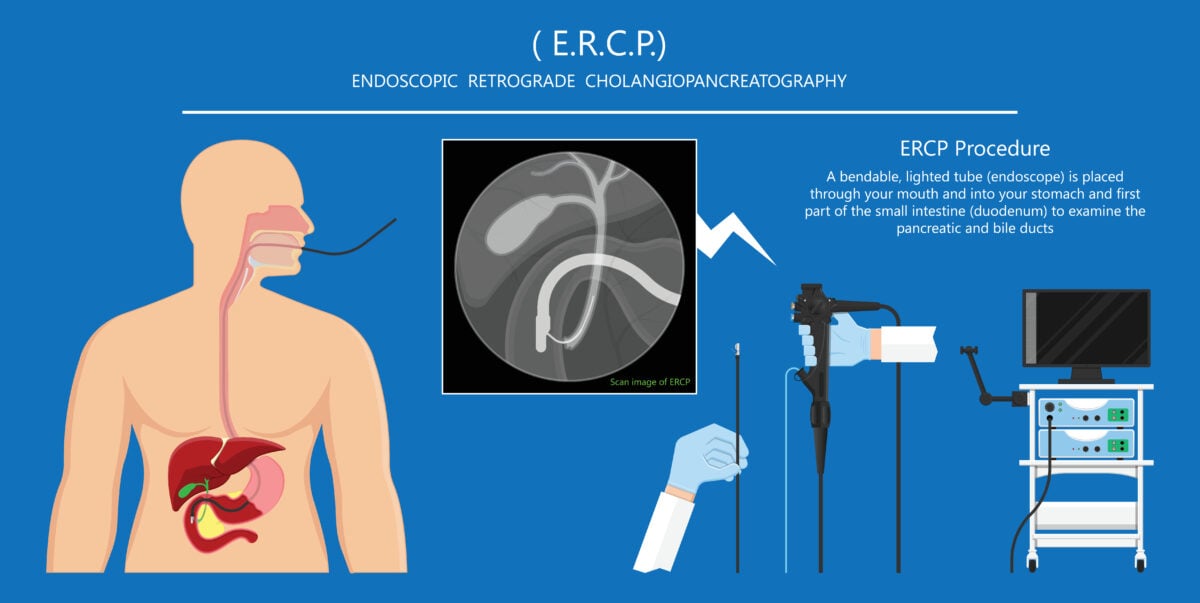
- Insertion of the endoscope: The doctor will insert the endoscope through your mouth, advancing it through the esophagus, stomach, and into the duodenum.
- Cannulation: A small catheter is used to inject a contrast dye into the bile ducts and pancreatic ducts.
- Fluoroscopy: X-ray images are taken to visualize the ducts and identify any abnormalities.
- Interventions: If needed, therapeutic procedures such as stone removal, stent placement, or biopsy will be performed.
Post – Procedure Care
After the ERCP:
- Recovery time: You will be monitored in a recovery area until the sedation wears off, which usually takes about 1 – 2 hours.
- Diet: You might start with clear liquids and gradually return to your normal diet as tolerated.
- Activity: Avoid strenuous activities for the rest of the day.
- Follow – up: You will receive specific instructions regarding when to resume normal medications and any follow – up appointments.
- Warning signs: Contact your doctor if you experience severe abdominal pain, fever, vomiting, or signs of infection such as redness or swelling at the biopsy site.
Endoscopic Retrograde Cholangiopancreatography (ERCP) is a specialized procedure used to diagnose and treat conditions of the liver, bile ducts, gallbladder, and pancreas. It offers significant diagnostic and therapeutic benefits but also carries certain risks. Proper preparation and understanding of the procedure, its benefits, and potential risks are essential for a successful and safe outcome.
Endoscopic Retrograde Cholangiopancreatography (ERCP) Specialist
Dr. Aroon Siripun, Gastroenterology, GI and Liver Center, Bangkok Hospital
Hospital Specializes in Endoscopic Retrograde Cholangiopancreatography (ERCP)
At Bangkok Hospital, our GI and Liver Center is ready to provide consultation about any gastrointestinal problems, diagnostic endoscopy, state-of-the-art treatment for your precious quality of life.
References:
- American Society for Gastrointestinal Endoscopy. (n.d.). “Understanding ERCP.” [ASGE Patient Information](https://www.asge.org/home/for-patients/patient-information/understanding-ercp)
- Mayo Clinic. (n.d.). “Endoscopic Retrograde Cholangiopancreatography (ERCP).” [Mayo Clinic](https://www.mayoclinic.org/tests-procedures/ercp/about/pac-20385041)
- National Institute for Health and Care Excellence (NICE). (n.d.). “Endoscopic Retrograde Cholangiopancreatography.” [NICE Guidelines](https://www.nice.org.uk/guidance)