

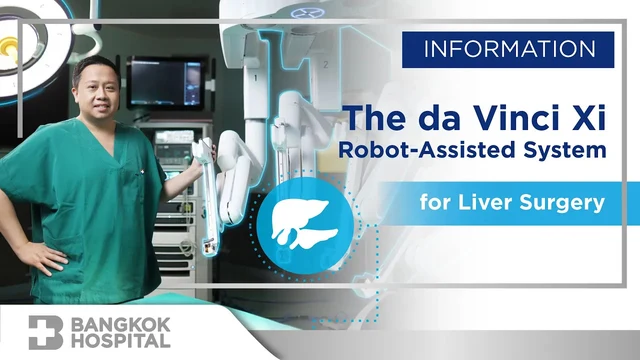
Liver and bile duct surgery is among the most complex surgical procedures because it requires precise identification of liver tissue, blood vessels, and bile ducts while preserving as much healthy tissue as possible.
The da Vinci Xi Robot-Assisted System enhances minimally invasive liver surgery with high-definition 3D visualization and Near Infrared Imaging, enabling surgeons to clearly identify important anatomical structures for greater precision and safety during surgery.
Video Summary
The da Vinci Xi Robot-Assisted System for Liver and Bile Duct Surgery
The da Vinci Xi Robot-Assisted System is used to treat a variety of liver and bile duct conditions, including:
- Liver cancer.
- Liver tumors.
- Congenital bile duct cysts.
- Bile duct cancer.
The robotic system provides enhanced access to complex anatomical structures within the liver and biliary system, allowing surgeons to perform precise tissue dissection while preserving healthy liver tissue whenever possible.
Three Main Components of the da Vinci Xi Robot-Assisted System
Surgeon Console: The surgeon performs the procedure from the Surgeon Console and independently controls the movement of the surgical camera for precise visualization throughout the operation.
Patient Cart: Supports robotic arms with exceptional flexibility and a wide range of motion, enabling precise surgical movements in deep and complex areas of the abdomen.
Vision Cart: Processes and displays real-time high-definition surgical images, supporting the surgeon and operating room team during every stage of the procedure.
Near Infrared Imaging for Enhanced Surgical Precision
One of the key advantages of the da Vinci Xi Robot-Assisted System is Near Infrared Imaging (Fluorescence Imaging), which helps surgeons visualize anatomical structures that may not be clearly visible to the naked eye.
This technology helps distinguish liver tissue that needs to be removed from healthy liver tissue that should be preserved. It also improves visualization of the bile ducts, allowing surgeons to identify precise locations for bile duct division and reconstruction with greater accuracy and safety.
Greater Precision in Complex Liver Surgery
The robotic arms of the da Vinci Xi Robot-Assisted System closely replicate the movement of the surgeon’s hands and wrists while providing 360-degree articulation and Built-in Tremor Filtration.
These capabilities allow surgeons to perform delicate tissue dissection, bleeding control, and complex liver and bile duct procedures with enhanced precision.
Benefits of the da Vinci Xi Robot-Assisted System for Liver and Bile Duct Surgery
The da Vinci Xi Robot-Assisted System offers several advantages for liver and bile duct surgery:
- Enhanced precision for complex liver and biliary procedures.
- Improved access to deep and difficult-to-reach anatomical areas.
- High-definition 3D visualization for greater surgical accuracy.
- Near Infrared Imaging to clearly identify liver tissue and bile ducts.
- Reduced blood loss and a lower risk of surgical complications.
- Smaller incisions, less postoperative pain, and faster recovery.
Enhanced Precision for Safer Liver Surgery. At Bangkok Hospital, experienced hepatobiliary surgeons combine advanced surgical expertise with the da Vinci Xi Robot-Assisted System to deliver precise, minimally invasive treatment for appropriate patients. The goal is to preserve important liver structures, improve surgical accuracy, and support a faster recovery after surgery.