
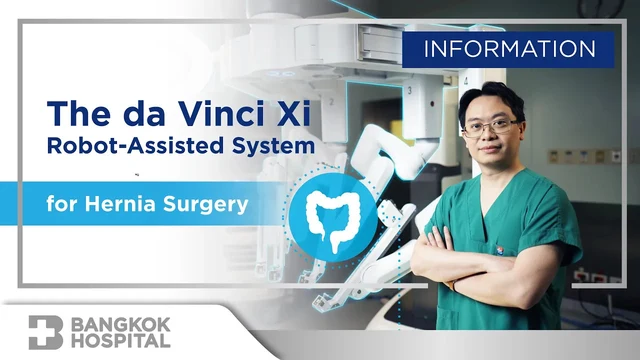
Inguinal hernia is a common condition that can be effectively treated with surgery. For patients with large, recurrent, or complex inguinal hernias, surgical precision is essential to repair the abdominal wall and reinforce it securely.
The da Vinci Xi Robot-Assisted System enhances minimally invasive hernia surgery with greater precision, improved visualization, and better access to difficult-to-reach anatomical areas. This helps reduce tissue trauma while supporting a faster recovery after surgery.
Video Summary
The da Vinci Xi Robot-Assisted System for Inguinal Hernia Surgery
The da Vinci Xi Robot-Assisted System is particularly beneficial for selected patients with inguinal hernias, including:
- Recurrent inguinal hernias.
- Large or complex inguinal hernias.
- Patients who have previously undergone prostate surgery.
- Patients with obesity.
- Selected elderly patients or patients with heart or lung conditions.
The most appropriate surgical approach is determined by the surgeon based on each patient’s condition and overall health.
Three Main Components of the da Vinci Xi Robot-Assisted System
Surgeon Console: The surgeon performs the procedure from the Surgeon Console, controlling every movement of the robotic instruments while viewing a magnified high-definition 3D image of the surgical field.
Patient Cart: Supports four robotic arms that control the surgical camera and instruments, providing precise movement within confined areas of the abdomen.
Vision Cart: Processes and displays real-time high-definition surgical images, providing clear visualization for both the surgeon and the operating room team.
Enhanced Precision for Abdominal Wall Repair
The da Vinci Xi Robot-Assisted System allows surgical instruments to move with wrist-like flexibility, closely replicating the natural movements of the surgeon’s hands.
During inguinal hernia surgery, the hernia is returned to its normal position and the weakened abdominal wall is reinforced with surgical mesh placed with enhanced precision.
Supporting Precise Mesh Placement and Reduced Risk of Recurrence
High-definition 3D visualization helps surgeons clearly identify nerves and surrounding anatomical structures, enabling more precise mesh placement. In appropriate patients, this approach may reduce the need for mesh fixation with tacks, helping minimize the risk of nerve injury and chronic postoperative pain.
For patients with complex inguinal hernias, robotic-assisted surgery may also reduce the likelihood of conversion to open surgery and help reduce the risk of hernia recurrence in appropriately selected patients.
Benefits of the da Vinci Xi Robot-Assisted System for Inguinal Hernia Surgery
The da Vinci Xi Robot-Assisted System offers several advantages for inguinal hernia surgery:
- Enhanced precision during abdominal wall repair.
- High-definition 3D visualization for greater surgical accuracy.
- More precise placement of surgical mesh.
- Better preservation of surrounding nerves in appropriate patients.
- Smaller incisions, less postoperative pain, and faster recovery.
- Reduced risk of surgical complications and reduced risk of recurrence in appropriate patients.
Enhanced Precision. Faster Recovery. At Bangkok Hospital, experienced general surgeons combine advanced surgical expertise with the da Vinci Xi Robot-Assisted System to provide precise, minimally invasive treatment for selected patients with inguinal hernias. The goal is to reduce surgical trauma, support faster recovery, and help patients return to their daily lives with confidence.