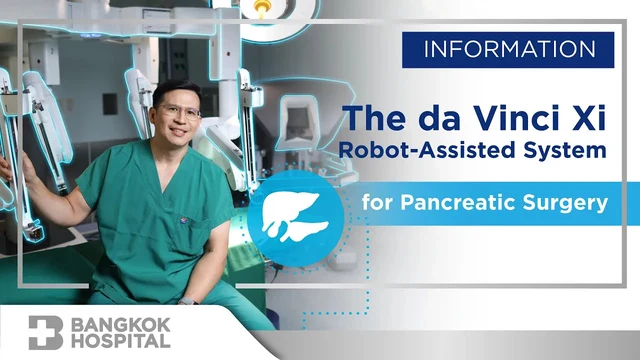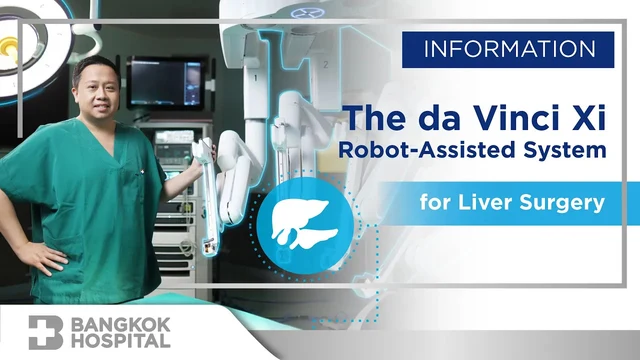


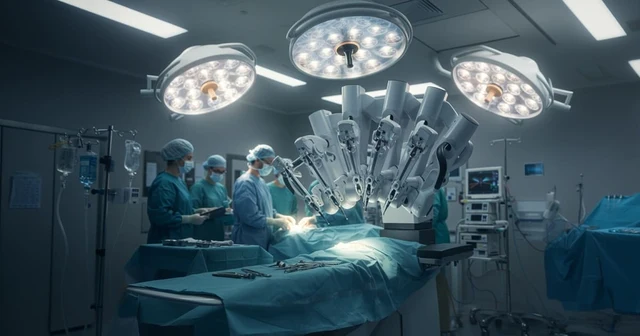

Robot-assisted laparoscopic surgery (Robotic Surgery) is a medical technology that has been continuously growing in popularity, especially for treating cancer and conditions that require surgery in hard-to-reach areas such as the pelvis, chest cavity, or deep within the abdomen.
The da Vinci Xi robot is a technology that supports surgeons in performing surgery through small incisions, enhancing surgical dexterity and visualization of the operative field with high-resolution 3D imaging. Treatment outcomes depend on each patient’s disease and condition.
What is Robotic Surgery (robot-assisted surgery)?
Robotic Surgery, or robot-assisted laparoscopic surgery, is a minimally invasive surgery technique that uses robotic arms to work in place of the surgeon’s hands. The surgeon controls the operation from a surgeon console via a magnified 3D display. The incisions for inserting surgical instruments are small and made at multiple sites, with incision size depending on the type of surgery.
Compared with open surgery, robotic surgery is another minimally invasive option that may help reduce injury to surrounding tissues in some patients. Outcomes depend on the type of disease and the physician’s assessment.
Compared with conventional laparoscopic surgery, the da Vinci Xi system provides higher image resolution and greater mechanical wrist dexterity. The highly flexible EndoWrist® instruments, which can move with multiple degrees of freedom, allow more delicate tissue suturing and repair in tight spaces, especially in patients with obesity or abdominal adhesions from prior surgery.
Robotic surgery is particularly important in cases where the lesion is difficult to access, such as cancers deep in the pelvis, or conditions requiring highly precise tissue dissection without damaging adjacent nerves—for example, prostate surgery, which requires special care to preserve the nerves controlling erectile function.
Body systems involved in robotic surgery
The surgical capabilities of the da Vinci Xi robot are not limited to a single organ, but can be used to treat conditions across multiple body systems including:
- Gastrointestinal system from the esophagus to the colon
- Liver, pancreas, and biliary system
- Urinary system such as the prostate, bladder, and kidneys
- Female reproductive system such as the uterus and ovaries
- Thoracic system
- Head and neck (Head and neck), an area where many blood vessels, nerves, and critical structures lie close together
The robot’s ability to access narrow and complex areas with delicacy is considered a major turning point in modern surgery.
Types of diseases treatable with Robotic Surgery
Robot-assisted surgery with the da Vinci Xi covers a wide range of conditions, categorized by organ system as follows:
- Abdominal and liver-related conditions such as conditions of the pancreas and bile ducts, hernias, gallstones, liver cancer, pancreatic cancer, and gallbladder cancer
- Gastrointestinal conditions such as esophageal cancer and colorectal cancer
- Thoracic conditions such as lung cancer, chest wall cancer, and thymic diseases
- Urinary tract conditions such as prostate cancer, bladder cancer, and kidney cancer
- Gynecologic conditions such as uterine fibroids or uterine cancer, ovarian masses, and pelvic organ prolapse
- Ear, nose, throat, and head and neck conditions such as benign throat tumors, neck masses, tonsil cancer, base-of-tongue cancer, laryngeal cancer, and nasopharyngeal cancer
Most conditions in this group are cancers or diseases requiring surgery in deep and complex areas. Robotic technology supports surgery in complex regions and helps surgeons access the operative site more conveniently in suitable patients. However, robot-assisted surgery should be based primarily on evaluation and clinical judgment by a specialist physician, as suitability for treatment varies among patients.
Symptoms that may indicate robotic surgery should be considered
Because Robotic Surgery is a surgical approach rather than a treatment for a specific disease, the symptoms leading to consideration of surgery vary depending on the underlying condition. In some patients—especially with certain cancers—there may be no clear symptoms in the early stage, and the disease may be detected through screening.
Common symptoms in patients who may need surgery include:
- Chronic abdominal pain or intermittent pain, especially under the right rib cage or in the lower abdomen
- A palpable lump in the abdomen, neck, or other parts of the body
- Abnormal urination such as frequent nighttime urination, blood in the urine, or difficulty urinating
- Abnormal menstruation or spotting in women
- Unexplained weight loss accompanied by loss of appetite
- Persistent hoarseness, difficulty swallowing, or a neck mass that keeps enlarging
- Chronic cough or coughing up blood when lung or thoracic disease is suspected
- Yellowing of the skin and eyes when liver or bile duct disease is suspected
Those with these symptoms should undergo diagnostic evaluation by a specialist to assess the need for treatment. Early detection increases the chance of cure and expands the options for minimally invasive surgical techniques.
Risk groups that should consider treatment with Robotic Surgery
Not everyone needs robotic surgery, but certain patient groups may benefit especially from this technology.
- Patients with cancers in hard-to-reach locations, such as prostate cancer deep in the pelvis or nasopharyngeal cancer near critical cranial nerves. The robotic arms’ precision and ability to reach complex areas reduce the risk of injury to nerves and adjacent organs.
- Overweight or obese patients, because thick abdominal fat can make open or conventional laparoscopic surgery more difficult. The system helps surgeons see internal structures more clearly with high-resolution 3D imaging.
- Patients with prior abdominal surgery and adhesions. Adhesions increase surgical complexity; detailed 3D imaging helps surgeons distinguish structures more clearly.
- Patients who wish to preserve organ function, such as in prostate surgery that must carefully protect the nerves controlling erectile function and urinary continence.
- Some older adults may benefit from minimally invasive surgery; this depends on comorbidities and physician assessment.
- Patients requiring multi-organ surgery in a single session. The da Vinci Xi robot-assisted system can change the angle of its arms flexibly without much patient repositioning, helping reduce operating time in complex cases.
Diagnosis before deciding on surgery
Physicians must always establish a clear diagnosis before planning surgery. Common methods include:
- Medical history and physical examination (Physical examination) to assess symptoms and the location of a mass or abnormality
- Blood tests (Blood test), including tumor markers (Tumor markers) such as PSA for prostate cancer or CEA for colon cancer
- Diagnostic imaging such as computed tomography (CT scan) or magnetic resonance imaging (MRI) to evaluate size, location, and spread of a mass
- Ultrasound (Ultrasound) in some cases, such as evaluation of the gallbladder or uterus
- Biopsy (Biopsy) to confirm whether the tissue is malignant or benign before surgical planning
- Endoscopy (Endoscopy), such as colonoscopy (Colonoscopy) when colorectal cancer is suspected
Once all results are available, a multidisciplinary team—including surgeons, medical oncologists, and radiologists—will meet to plan the most appropriate treatment for each patient.
Approaches to Robotic Surgery
Today, there are several approaches to robot-assisted surgery, depending on each patient’s suitability.
- Robot-assisted surgery with the da Vinci Xi system (da Vinci Xi Robot-Assisted Surgery)
This is the core technology of Robotic Surgery. It consists of four robotic arms controlled by the surgeon via a console, along with a high-magnification 3D camera that provides images up to 10 times clearer than the naked eye. A key feature is the mechanical wrist (Patient-side Cart), which rotates freely 360 degrees, enabling tissue suturing and repair at angles beyond what the human hand can achieve. The system also includes tremor filtration, allowing millimeter-level precision. - Conventional laparoscopic surgery (Conventional Laparoscopic Surgery)
Used in less complex cases. It is also minimally invasive, but the instruments do not have wrist-like rotation as in robotic systems, and the view is 2D, creating more limitations in narrow or highly complex spaces. - Open surgery (Open Surgery)
Still necessary in some situations, such as emergencies with heavy bleeding or very large masses requiring a wide incision for maximum safety. Although recovery time is longer, it remains necessary in certain circumstances.
The choice of surgical method depends on the judgment of the specialized surgeon, together with a discussion of the pros and cons of each approach with the patient, because no single method is suitable for every patient.
Preparation before surgery
Patients undergoing robot-assisted surgery should prepare as follows:
- Avoid food and water for the period specified by the physician, typically about 6–8 hours before surgery.
- Inform the physician of all medication and food allergies, and all regular medications, including blood thinners or certain supplements that may need to be stopped several days before surgery.
- Undergo physical examination and blood tests to assess readiness of the heart, lungs, and blood clotting.
- Stop smoking and drinking alcohol at least 2–4 weeks in advance to reduce the risk of pulmonary complications and delayed wound healing.
- Get adequate rest before surgery.
- Prepare personal items for hospital recovery and plan for a caregiver after surgery.
- Ask the physician about the procedure, expected duration, and potential risks before surgery.
Postoperative care
Robot-assisted surgery generally allows faster recovery than open surgery, and many patients can get up and walk within a short time after surgery. However, length of hospital stay depends on the type of disease and the complexity of the operation. Proper self-care is still necessary to ensure good wound healing and reduce the risk of complications.
- Check surgical wounds daily. If you notice redness, swelling, pus, or fever, see a doctor immediately.
- Avoid heavy lifting or strenuous exercise during the first 2–4 weeks, depending on the type of surgery.
- Gradually increase daily activities, starting with light walking and increasing distance as advised by the physician.
- Eat easily digestible foods with adequate protein to help tissue repair, and drink enough water.
- Take painkillers and antibiotics exactly as prescribed. Do not stop medication on your own even if symptoms improve.
- Attend all follow-up appointments to assess wound healing and pathology results when a biopsy has been taken.
- Cancer patients should continue long-term follow-up, as some may require additional adjuvant treatments such as chemotherapy or radiation therapy.
Prevention of diseases that may lead to surgery
Robotic Surgery can reduce risk and increase surgical safety, but preventing disease from the outset remains the most important approach.
- Have regular annual health checkups, especially age-appropriate cancer screening such as PSA testing in men aged 50 and older, or Pap smear screening in women.
- Eat a high-fiber diet and reduce processed foods and large amounts of red meat to lower the risk of colorectal cancer.
- Maintain a healthy weight, as obesity increases the risk of many diseases, including certain cancers.
- Exercise regularly for at least 150 minutes per week.
- Quit smoking and reduce alcohol consumption, as these are major causes of many cancers, including lung cancer and head and neck cancers.
- If you have abnormal symptoms such as chronic abdominal pain, a palpable lump, or abnormal urination, see a doctor immediately rather than waiting until symptoms become severe.
- Those with a family history of cancer should consult a doctor to plan more intensive screening than the general population.
FAQ: Frequently asked questions about Robotic Surgery
How is Robotic Surgery different from conventional laparoscopic surgery?
The main difference is instrument dexterity. Robotic systems such as the da Vinci Xi have mechanical wrists that rotate 360 degrees, while conventional laparoscopic instruments have limited range of motion. In addition, robotic systems provide high-magnification 3D images, allowing clearer visualization of blood vessels and nerves. This helps improve surgical dexterity and visualization of the operative field in narrow or complex spaces.
Is robot-assisted surgery less painful than traditional surgery?
Incisions are small, typically only 1–2 cm, compared with open surgery where the incision may be 15–20 cm long. Postoperative pain is therefore significantly less. However, the level of pain also depends on the type of disease and the surgical site.
Who is not suitable for robot-assisted surgery?
Patients with severe heart or lung disease who cannot tolerate prolonged general anesthesia, or patients with very large masses that the robot cannot access, may not be suitable. In addition, in emergencies with heavy bleeding requiring urgent surgery, open surgery may be safer because the situation can be controlled more quickly. The physician will assess suitability on an individual basis.
Is the cost of surgery with the da Vinci Xi system higher than other surgical methods?
Costs are generally higher than conventional laparoscopic or open surgery because the technology requires specialized equipment and high maintenance costs. However, although treatment costs may be higher than some surgical options, patients should consult their physician and the hospital to assess individual suitability and costs.
How long is the recovery period after robot-assisted surgery?
Most patients can go home within 2–4 days and return to light activities within 1–2 weeks. Returning to normal work or strenuous exercise may require 3–4 weeks, depending on the type of disease and the complexity of surgery. This is faster than open surgery, which may require recovery for as long as 6–8 weeks.
If it is cancer, can robot-assisted surgery remove all malignant tissue as completely as traditional methods?
Studies from many institutions worldwide have found that the complete resection rate of Robotic Surgery is not significantly different from open or conventional laparoscopic surgery. In some cases, such as prostate cancer, the robot’s precision can also help physicians better preserve surrounding tissues and nerves, which benefits postoperative quality of life.
How long do I need to stay in the hospital after surgery with this system?
Length of hospital stay depends on the type of disease and the complexity of surgery. On average, patients undergoing robot-assisted surgery have a 30–50% shorter hospital stay than those undergoing open surgery. In some less complex cases, the stay may be only 1–2 nights.
Bangkok Hospital is ready to care for patients with advanced Robotic Surgery using the da Vinci Xi system, supported by a team of specialized surgeons across multiple disciplines—including general surgery, oncology, urology, gynecology, and otolaryngology (ENT)—who have been trained directly by the manufacturer in using the robotic system, together with experienced nursing and anesthesiology teams who have long cared for complex surgical patients. If you or a loved one is facing a condition that requires surgery, do not let worry delay your decision. Consult the specialist medical team for an appropriate assessment and to jointly plan a treatment approach aligned with each patient’s health condition.