
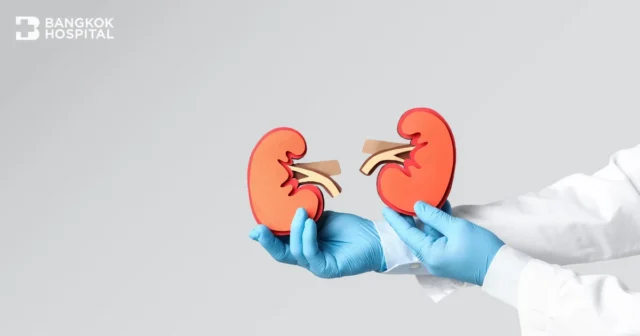

Medical information indicates that more than 70% of kidney tissue abnormalities found during annual health checkups are usually simple, harmless fluid-filled cysts and are not cancerous lesions. However, understanding what a kidney cyst is—how it can occur and which characteristics require close monitoring—can help reduce anxiety and enable patients to plan appropriate health care. Guidance from a specialized medical team and the use of advanced diagnostic technology will help differentiate types of cysts with greater accuracy and detail for targeted and safe treatment, with management appropriately tailored to each patient.
What is a kidney cyst
A kidney cyst (Kidney Cyst) is the formation of a round or oval sac filled with fluid that develops within the kidney tissue. Most are simple cysts and tend to be found more frequently with increasing age, especially in people aged over 50 years.
To explain the mechanism in an easy-to-understand way, a kidney cyst looks like a “water-filled balloon” that bulges out on the surface of the kidney. In most cases, it can be clearly distinguished from a “mass“ because a mass is solid tissue and has a higher risk of developing into malignancy than a typical cyst.
What causes kidney cysts
Although medicine still cannot definitively identify the cause of simple kidney cysts, key factors that contribute to their development include the following:
- Degenerative process of the body: As we age, small tubules in the kidney may become blocked or undergo structural changes, leading to fluid accumulation and expansion into a cyst.
- Genetic factors: Seen in patients with multiple kidney cysts, often with a family history of the condition.
- Sex and age: Statistics show that men are more likely to be diagnosed with this condition than women, and the risk increases with age.
Types of kidney cysts you should know
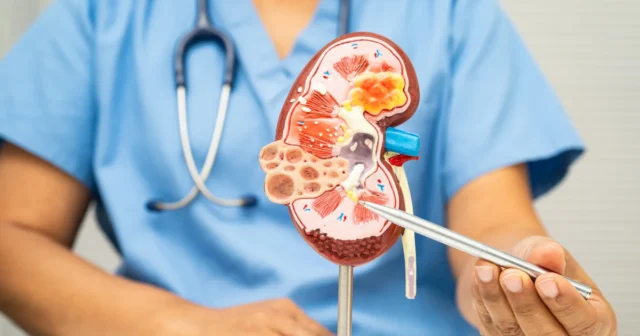
Classifying cyst types is important for treatment planning. They are divided into 3 main types:
Simple kidney cyst (Simple Renal Cyst)
A simple kidney cyst is a clear-fluid cyst with a thin wall and is usually found as only a few cysts. In most cases it causes no symptoms and is harmless, often discovered incidentally during health checkups. Generally, no treatment is required and there is no risk of becoming cancer.
Kidney cysts that may be a tumor or cancer (Complex Renal Cyst)
These cysts have complex or abnormal features such as a thick, irregular wall; septations that divide it into compartments; calcifications; or solid components within the cyst. This group is very important because it may be associated with tumors and kidney tumors and cysts (Kidney Tumors) and therefore requires further evaluation with computed tomography (CT) or magnetic resonance imaging (MRI) to stratify risk and determine the appropriate treatment approach.
Genetic kidney cysts (Polycystic Kidney Disease)
This is an inherited disease that causes numerous cysts to develop throughout both kidneys, leading to abnormal kidney enlargement and a long-term decline in kidney function. Patients often have flank pain, high blood pressure, and a risk of chronic kidney failure, so ongoing monitoring and care by specialists is necessary.
Differences between kidney tumors and kidney cysts (Kidney Tumors)

Doctors use radiologic classification criteria to distinguish which features represent a simple cyst and which features may indicate kidney tumors and cysts (Kidney Tumors) to reduce anxiety and identify the most appropriate treatment approach.
Comparison table: simple cyst vs. cyst with tumor risk
|
Comparison topic |
Simple cyst (Simple) |
Kidney tumors and cysts (Complex) |
|
Physical characteristics |
Thin, smooth wall; clear fluid inside |
Thick wall; solid tissue or calcifications present |
|
Cancer risk |
Very low (almost 0%) |
At risk (requires in-depth evaluation) |
|
Care approach |
Observe symptoms and follow up |
Medical treatment or surgery |
Symptoms that may indicate you have a kidney cyst problem
Although most patients have no obvious symptoms, if the cyst enlarges or complications occur, the following warning signs may be present:
- Pain and swelling in the flank or back: A dull ache in the back under the ribs on the side with the cyst
- Blood in the urine: A sign that may result from cyst rupture or inflammation inside
- Abnormally high blood pressure: Because pressure from the cyst can affect the function of the excretory system
- A palpable abdominal mass: May be found when a cyst becomes very large and pushes the abdominal wall outward
How kidney cysts are diagnosed
To obtain accurate results, doctors use a combination of radiologic examinations:
- Ultrasound (Ultrasound): An initial method to assess size and the fluid characteristics of the cyst
- Computed tomography (CT Scan): Provides detailed information about the wall and internal components of the lesion
- Magnetic resonance imaging (MRI): Used for differential diagnosis when malignancy is suspected
Self-care after kidney cysts are detected
When kidney cysts or fluid-filled sacs in the kidney tissue are detected, proper self-care can reduce the workload on the kidneys and help prevent complications as follows:
- Strictly follow scheduled medical appointments: For simple cysts, doctors often recommend periodic ultrasound or CT scans to monitor size and shape changes that may carry a risk of malignancy.
- Control blood pressure: High blood pressure directly affects kidney filtration efficiency. Patients should keep blood pressure within the normal range to slow deterioration of the remaining kidney tissue.
- Drink an appropriate amount of clean water: Adequate water intake helps the waste excretion system work better. However, in patients with genetic polycystic kidney disease (Polycystic Kidney Disease) who are beginning to have declining kidney function, consult a doctor about the appropriate daily fluid amount.
- Choose kidney-friendly foods: Focus on high-quality protein in appropriate amounts. Avoid high-sodium foods and strongly seasoned foods to reduce the risk of edema and high blood pressure.
- Exercise regularly, but in moderation: Choose low-impact activities such as brisk walking or yoga to improve circulation and help control weight.
Precautions and contraindications when kidney cysts are detected
To prevent cyst inflammation, infection, or rupture, patients should be cautious about certain behaviors that may affect the kidney cyst condition, as follows:
- Avoid activities or sports with impact to the abdomen and back: Such as football, boxing, or lifting excessively heavy objects, because strong impact may rupture the cyst, causing severe abdominal pain or blood in the urine.
- Use caution with painkillers and herbal medicines: Avoid self-medicating with NSAIDs (such as ibuprofen) continuously for a long time, and avoid uncertified herbal medicines, because these may harm kidney function in kidneys with cysts.
- Quit smoking and limit alcohol consumption: Smoking causes the blood vessels supplying the kidneys to narrow and deteriorate faster, which may accelerate the severity of cyst-related damage to kidney tissue.
- Do not leave chronic urinary tract inflammation untreated: If there is painful urination, cloudy urine, or fever, see a doctor immediately, because pathogens may spread and infect the kidney cyst itself, which is difficult to treat and dangerous.
- Do not ignore abnormal warning signs: If you have sudden severe one-sided flank or back pain, feel a lump in the abdomen, or have blood in the urine, see a doctor immediately without waiting for your appointment date.
Screening and treatment services for kidney cyst disease at Bangkok Hospital
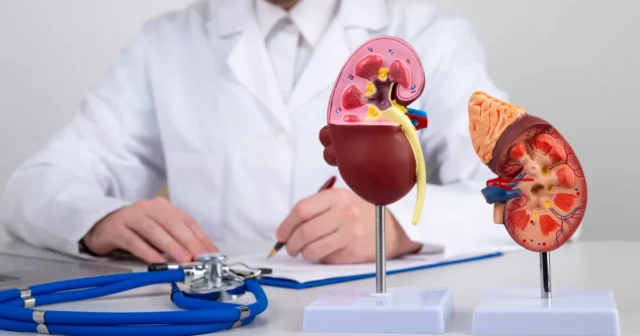
The Kidney Center and Urology Center at Bangkok Hospital focuses on providing patient care with an expert medical team and standardized medical technology. We emphasize detailed disease analysis to design individualized treatment plans, under international safety standards.
Collaboration between nephrologists and urologists at Bangkok Hospital enables systematic and comprehensive diagnosis and treatment of kidney tumors and cysts (Kidney Tumors) at every step, from screening through kidney-preserving treatment techniques.
Treatment methods for kidney cysts
If a cyst affects quality of life or poses a risk, doctors may consider the following treatments:
- Follow-up monitoring: Repeat ultrasound every 6 – 12 months to assess the growth rate
- Aspiration and sclerotherapy (Sclerotherapy): Using a needle to drain fluid when the cyst compresses nerves
- Laparoscopic surgery (Laparoscopic Surgery): A minimally invasive technique used to remove kidney tumors and cysts (Kidney Tumors) to help patients recover faster and experience less wound pain
Article summary
In summary, a kidney cyst is a common condition and in most cases is not dangerous. However, annual health checkups are key to detecting abnormalities early, which increases treatment opportunities and helps prevent progression into serious long-term health problems.
For care at the Kidney Center, Bangkok Hospital, we are ready to provide services under international safety standards. Our specialist surgeons will assess the most suitable individualized treatment approach to help patients return to normal life with quality.
- Find a doctor: https://www.bangkokhospital.com/th/bangkok/doctor
- Make an appointment: https://www.bangkokhospital.com/th/bangkok/appointment/step1
- Contact us: https://www.bangkokhospital.com/th/bangkok/contact
Frequently asked questions about kidney cysts (FAQ)
1. Can kidney cysts become cancerous?
Simple cysts usually do not develop into cancer. However, if a complex cyst (Complex Cyst) is found, there is a risk that it may be kidney tumors and cysts (Kidney Tumors), which requires detailed differential diagnosis.
2. If a kidney cyst is found but there are no symptoms, does it need treatment?
If it is a simple cyst and not large enough to interfere with bodily function, doctors usually recommend annual ultrasound follow-up rather than surgery.
3. Is kidney cyst surgery dangerous?
With today’s minimally invasive laparoscopic surgery technology, the risk is greatly reduced. Patients experience less blood loss, less pain, and can return to normal life faster.
4. Is there a way to prevent kidney cysts?
Currently, there is no 100% certain prevention method. However, maintaining kidney health through blood pressure control, adequate water intake, and attending scheduled health checkups can help reduce potential complications.
5. How common are kidney cysts??
This condition is more common than many people think, especially among older adults. Patients aged 50 years and older are often found to have cysts incidentally from abdominal ultrasound or CT scans. Studies show that almost 25% of people older than 50 years will be found to have at least 1 kidney cyst, and the likelihood increases with age, with most cases not causing harm.
6. Can kidney cysts go away on their own??
In general, kidney cysts do not resolve on their own naturally. However, if a simple cyst is detected, smaller than 4 – 5 centimeters, and causes no pain, doctors usually do not recommend surgery because it does not affect bodily function. Patients only need periodic follow-up ultrasound to monitor changes in size and characteristics. If it does not enlarge to compress kidney tissue or carry a risk of malignancy in the future, surgical treatment is not necessary.