
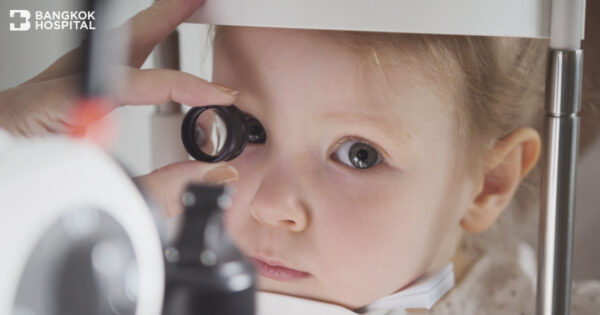
Parents should not neglect to have their children’s eyes tested, as the children do not necessarily recognize any problem with their eyesight until it is too late. So, it is important for the children to have their eyes examined periodically to ensure the health and proper care for their vision.
Eye Examination by Age
Children’s eye examination can be divided according to 3 main age groups.
1) Infant and Toddler (0-2 years)
Premature infants need retinopathy at 4-6 weeks postnatal. Pediatrician and pediatric ophthalmologist will work together for this examination, which is repeated again when the baby is 3 months old to assess the baby’s vision and retina. At the age of 1 year old, the baby’s vision can then be re-assessed along with visual acuity and strabismus examination.
For a full-term baby, if the parents observe the following symptoms, they should have their child’s to eyes examined immediately:
- Baby does not make eye contact at 3 months old.
- Baby’s eye turns inward and outward before the age of 6 months.
- Persistent watery eyes or excessive eye discharge. This may be due to blocked tear ducts or congenital glaucoma.
- Drooping upper eyelid on either side or both may have been caused by lazy eye syndrome.
- Nystagmus–eyes making rapid, repetitive, uncontrolled movements.
- Larger than normal pupils, sensitivity to light and teary eyes may point to congenital glaucoma.
Moreover, pediatrician usually sends children with developmental delay or Down’s Syndrome to undergo eye examination for cataract and other vision problems. Pituitary gland disorders in children also affect their optic disc.
2) Preschool Age (2-5 years old)
At this age, children develop strong visual skills. This is the time when parents need to be alert for vision problems that include crossed eyes or lazy eye. The obvious symptoms are:
- Tilting their heads when looking at an object.
- Blinking their eyes frequently.
- Family history of crossed eyes or lazy eye.
- Learning disability.
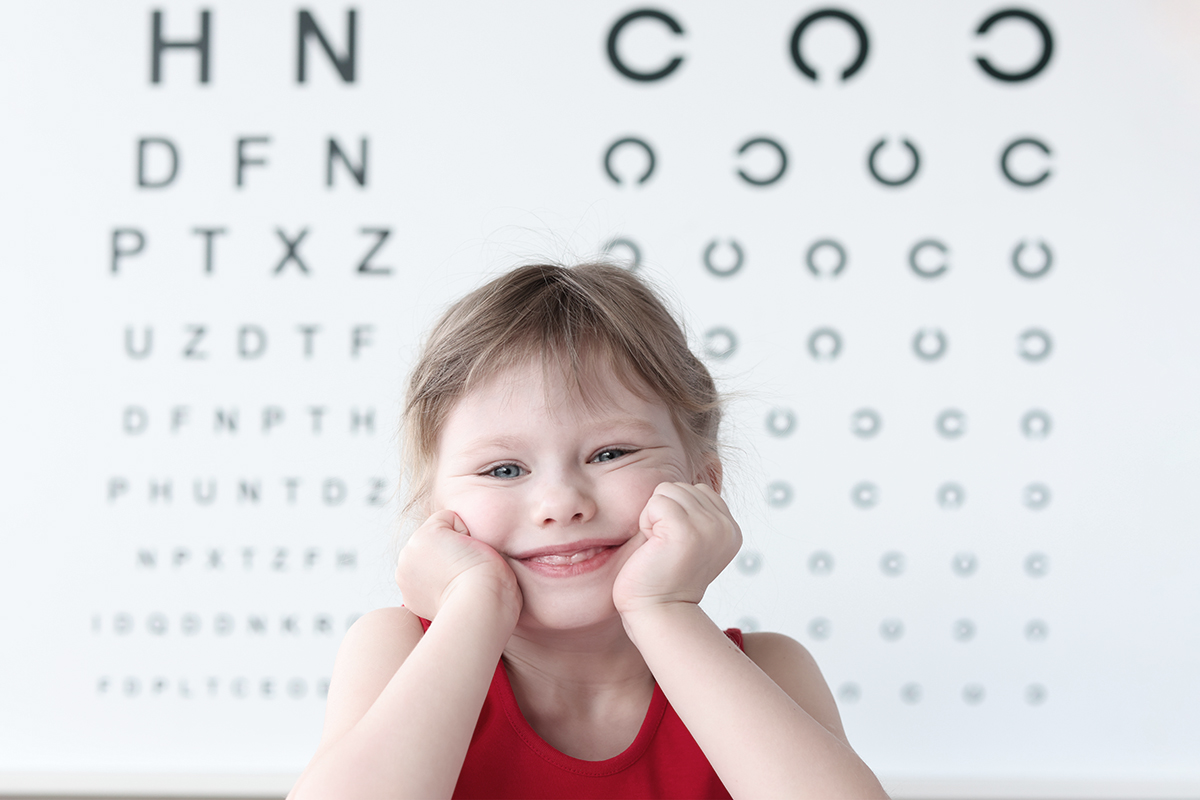
3) School Age (5 years old and above)
This is the age when children use their eyesight the most and often spend more time on-screen, which impacts their eyesight. They should be assessed for eye disorders and lazy eye condition.
The pediatric ophthalmologist will perform a comprehensive 10-part eye examination as follows:
- Visual Behavior.
- Visual Acuity. There are many techniques to assess lazy eye syndrome.
- Stereopsis. This is to evaluate how children perceive the world in three dimensions (3D), in order to assess their visual ability development.
- Color Blindness. This hereditary condition is more common in male. So, family members should help prepare their child for schooling accordingly.
- Eye Movement. The examination helps to determine squints in children.
- Anterior Segment. A special equipment is used to examine conjunctiva, cornea, iris and lens.
- Refractive Error. This test is to determine whether or not the child needs to wear glasses. If there is still any doubt, the doctor may order dilating eye drops for detailed examination. (This procedure takes approximately 1 hour, after which the child will experience blurry vision for about 24 hours, but the condition will subside the next day.)
- Eye pressure test for glaucoma.
- Visual Field. In a case where the child has glaucoma and a brain condition, the child’s field of vision can be affected also.
- 10)Fundus Photo. This involves photographing the rear of an eye to observe if there is any change year-on-year.
Impairments in children’s eyes are of great concerns. The sooner a condition is detected, the quicker it can be treated. This will certainly help reduce its severity and prevents vision problems in the long run. Parents should take heed and have their children’s eyes examined annually, and follow the advice of their pediatric ophthalmologist accordingly.