


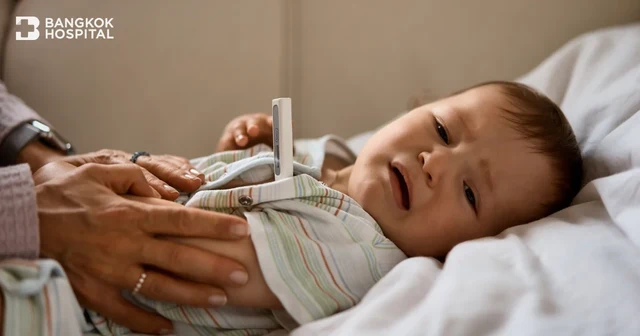

When your beloved child is unwell, one of the things that often worries parents the most is noticing that your child is breathing rapidly abnormally, or breathing more laboriously than usual. These symptoms may simply be the body’s natural mechanism, or they may be a warning sign of an underlying respiratory problem. This article will help parents understand what causes tachypnea in children, how to correctly count the respiratory rate, along with initial care tips to keep your little one safe and help parents respond calmly and mindfully.
What causes rapid breathing in children? Causes of heavy, fast breathing in infants

We can broadly divide the main causes that make infants breathe more forcefully and faster than normal into 2 groups as follows:
Causes from the body’s natural mechanisms (not dangerous)
Sometimes, seeing an infant breathing forcefully and rapidly is not always due to an abnormality. It may be a natural bodily response, such as when an infant is crying intensely, feeling excited or startled, or in an active child who has just been running around or exercising. Once the child rests or calms down, the breathing rate will gradually return to normal on its own.
Causes from illness
If parents notice that their child is unwell and has rapid breathing even while resting or sleeping, it is often caused by a physical illness, such as:
- Respiratory tract infections: such as pneumonia, bronchitis, or RSV infection, which can narrow the airways, so the body tries to breathe faster to get oxygen.
- Asthma or allergies: making the bronchi sensitive to triggers, causing bronchospasm and difficulty breathing.
- High fever: when a child has a fever, the body’s metabolic rate increases and it tries to dissipate heat, which can cause your child to breathe forcefully and rapidly and have a faster heart rate than normal when the fever spikes.
Table of normal breathing rate criteria for children by age
Because children at different ages have different physiology and lung sizes, their breathing rates are not the same. Parents can use the criteria below to make an initial assessment of abnormalities.
|
Child’s age range |
Normal breathing rate (breaths/minute) |
Breathing rate considered abnormally fast |
|
Newborn – 2 months |
30 – 60 |
More than 60 breaths/minute |
|
Infant 2 months – 1 year |
25 – 50 |
More than 50 breaths/minute |
|
Toddler (1-3 years) |
20 – 40 |
More than 40 breaths/minute |
|
Children 5 years and older |
15 – 30 |
More than 30 breaths/minute |
How to observe abnormalities when your child breathes rapidly (ages 0-3)
Although toddlers have similar breathing-rate criteria, their development and communication differ. Parents can observe abnormalities from their child’s behavior at each age as follows:
Newborn – 1 year (observe feeding and nostril flaring)
The respiratory system in infants at this age may naturally be irregular. A key point to observe is “feeding.” If you find that your baby alternates sucking with frequent pauses to gasp for breath, chokes on milk, or has a grunting sound in the throat, along with clearly flaring nostrils when inhaling, these are signs that the infant is working harder than normal to breathe.
Age 1 (observe eating and sleeping)
When you notice rapid breathing in a 1-year-old, children at this age cannot describe how they feel when ill, so you must mainly observe basic behaviors. If you notice your child nursing or eating less, nursing only a little and then needing to pause to gasp for breath, or being fussy and restless during sleep together with forceful breathing, you should promptly assess the breathing rate.
Age 2 (distinguish panting from play vs illness)
For this age, when they can run and play more actively, if you notice rapid breathing in a 2-year-old, the important thing is to distinguish normal panting after running around from panting due to illness. The trick is to have your child stop the activity and sit still to rest. If after 10–15 minutes your child’s chest is still moving up and down rapidly, this is a sign that requires close monitoring.
Age 3 (observe communication and speech)
Children at this age begin to communicate their needs and describe basic feelings. When you notice rapid breathing in a 3-year-old, in addition to counting chest movements, observe speech. If your child complains of tiredness, cannot speak in long sentences because they must pause to gasp while talking, or seems lethargic and does not want to run and play like usual, that may indicate the respiratory system is having a problem.
How to correctly count your child’s breathing rate

To assess whether your child’s rapid breathing is abnormal, you need to count correctly to obtain the most accurate information.
- Choose the right time: Count when your child is still, calm, not crying. The best time is “while your child is sleeping.”
- How to count: Look at your child’s chest or abdomen. One full rise and fall of the chest counts as 1 breath. Time it for a full 1 minute.
- Additional notes: For newborns up to 1 month old, there may be brief pauses in breathing (no longer than 10–15 seconds) alternating with rapid breathing. This pattern is called periodic breathing in infants. It is mostly considered normal because the breathing control system is not yet fully developed. However, if your child stops breathing for more than 20 seconds, you should take them to see a doctor immediately.
What accompanying symptoms mean that forceful and rapid breathing may be dangerous?
If you observe that your child is breathing forcefully and rapidly together with these warning signs, you should take your child to the hospital as soon as possible.
- Chest retractions (Chest Retractions) observed when the child inhales: the area between the ribs, below the rib cage, or above the collarbone sinks in deeply and clearly, indicating that the child is using accessory muscles to breathe intensely.
- Wheezing (Wheezing) like a whistle when exhaling, or continuous noisy rattling sounds even after clearing nasal mucus.
- Bluish-green discoloration of the lips, fingernails, or toenails (Cyanosis) which is a sign of low blood oxygen.
- Your child becomes noticeably lethargic, not cheerful, refuses to drink milk, or cannot eat.
Initial care when your child has a fever and is breathing rapidly
When a child has a fever, parents often find that the child has a hot body, rapid breathing, and a strong heartbeat, which is the body’s natural mechanism for dissipating heat. Proper initial care can help improve symptoms.
- Tepid sponging to reduce fever: Use warm water or room-temperature water to sponge correctly, helping open pores and focusing on skin folds to aid heat dissipation.
- Giving fever-reducing medicine: You may consider giving paracetamol for children, calculating the dose by body weight (follow the advice of a doctor or pharmacist).
- Offer frequent sips of water: To prevent dehydration due to elevated body temperature.
- Monitor after the fever comes down: If you sponge and give medicine until the fever decreases but the breathing rate remains labored or faster than normal, you should promptly take your child to a pediatrician for further evaluation.
Doctor’s tip: Easy ways for parents to observe symptoms

To communicate more clearly and accurately with the treating doctor, parents can use these simple tips to collect initial information:
- While counting the breathing rate, lift up your child’s shirt so you can clearly see the skin over the chest and abdomen to observe chest retractions.
- Record a video clip (about 30–60 seconds) while your child has forceful breathing, labored breathing, or noisy rattling sounds, to show the pediatrician for assessment. This helps the doctor see the clearest possible picture.
Pediatric Center, Bangkok Hospital, ready to care for your child’s respiratory health
If you are concerned when your child has a fever and is breathing rapidly, the Pediatric Center at Bangkok Hospital is fully equipped to provide comprehensive pediatric care. Services are provided by a team of specialized pediatricians and experienced registered nurses, ready to diagnose and treat respiratory diseases and infectious diseases in children, in a child-friendly environment to reduce children’s fear, along with safety measures, to help your little one return to being healthy, bright, and growing appropriately for their age.
Article summary
Rapid breathing in children can occur from many factors, both natural mechanisms and illness. When you notice that your child is breathing rapidly or an infant has loud rattling breathing sounds, parents should stay calm, know how to correctly count the breathing rate, and observe other accompanying symptoms. If your child has a fever, begin with initial fever reduction by tepid sponging, but if you find warning signs indicating that your child is having difficulty breathing, you should take your child to see a doctor immediately. Close monitoring is the best shield for your beloved child’s safety.
- Find a doctor: https://www.bangkokhospital.com/th/bangkok/doctor
- Make an appointment: https://www.bangkokhospital.com/th/bangkok/appointment/step1
- Contact us: https://www.bangkokhospital.com/th/bangkok/contact
Frequently asked questions (FAQ) about rapid breathing in children
1. An infant has loud rattling breathing sounds but no fever—what is the cause?
It may be due to nasal mucus congestion, or because the infant’s larynx is not yet fully developed and firm (laryngomalacia). If your baby can still nurse well, sleep well, and is cheerful as usual, it is often not severely dangerous, but you should consult a doctor to be sure.
2. My child breathes forcefully and rapidly only during sleep—is it abnormal?
If your child cried intensely before bedtime, or is in REM sleep, the body may temporarily breathe faster. However, if your child breathes rapidly throughout the night, or has pauses in breathing as well, you should take your child to consult a doctor to check respiratory function.
3. My child has a high fever with rapid breathing and a strong heartbeat—should I sponge them or give fever medicine first?
Parents should give fever-reducing medicine along with correctly performed tepid sponging immediately, to lower the body temperature as quickly as possible. As the fever begins to decrease, labored breathing and heart rate will gradually slow and return to normal.
4. How can chest retractions be observed?
You can observe by removing your child’s shirt and looking at the area below the rib cage, between the ribs, and above the collarbone. If, when your child inhales, the skin in those areas sinks in or retracts deeply and clearly, it is a danger sign indicating that your child is using a lot of accessory muscle effort to breathe, and you must take them to the hospital immediately.