
What is it?
An echocardiogram, or ultrasound of the heart, is a noninvasive test that uses ultrasound technology to provide a picture of the structures of the heart.
How does it work?
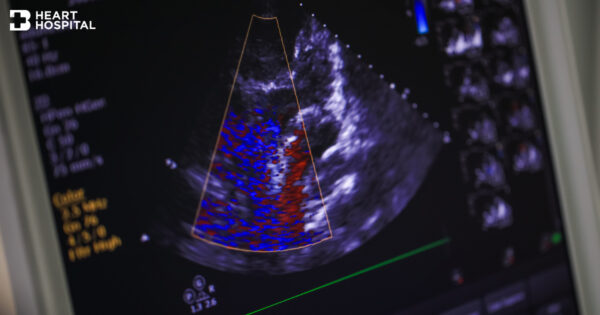
A transducer applying on the chest wall transmits high frequency sound into the chest. This ultrasound wave will bounce off the walls and valves of the heart. The sound waves return to the transducer as echoes, which are then converted into moving images of your beating heart and its valves as they open and close
How is it done?
An echocardiogram may be done in a hospital, clinic, or doctor’s office. It can also be done at the bedside in the hospital.
Transthoracic echocardiogram (TTE) and Doppler echocardiogram
- The patient will lie on your back or on your left side on a bed or table. A small instrument (transducer) that looks like a microphone, covered with gel, is pressed firmly against the chest wall and moved slowly back and forth. This instrument sends sound waves into the chest and picks up the echoes as they reflect off different parts of the heart. The echoes are sent to a video monitor that records pictures of your heart for later viewing and evaluation.
- The test usually takes from 20 to 40 minutes.

Exercise stress echocardiogram
- Echocardiogram (TTE type) will be done before and immediately after exercise (usually walk on the treadmill).
- An exercise stress echo takes about 45 to 60 minutes.
Dobutamine stress echocardiogram
- In patient who cannot walk adequately, medicine called dobutamine is used instead of exercise to stress the heart. Dobutamine will be given intravenously to make the heart work harder like exercise. Echocardiogram images will be taken while you receive the dobutamine intravenously. A dobutamine stress echo takes about an hour.
Transesophageal echocardiogram (TEE)
- Before the test, medicine to decrease saliva and stomach secretions and sedative to relax the patient. The throat may be numbed with an anesthetic spray to ease insertion of the probe.
- The test takes about 20 to 40 minutes

Pre-procedure preparation
Transthoracic echocardiogram (TTE) and Doppler echocardiogram
- You do not need any special preparation for a transthoracic or Doppler echocardiogram.
Stress echocardiogram
- Do not eat or drink for 3 hours before a stress echo. The patient may feel nauseated if exercise with a full stomach or from the injection of dobutamine.
- Wear flat, comfortable shoes (like tennis or walking shoes) and lightweight shorts or sweatpants.
- Ask your doctor whether you should take your regular medicines as usual. Tell your doctor if you take insulin or diabetic medicine.
Transesophageal echocardiogram (TEE)
- Do not eat or drink for at least 6 hours before the TEE.
- If the patient has dentures or dental prostheses, they may need to be removed before the test.
- If you have medical problems involving the throat, esophagus, or stomach, tell your doctor before getting this test.
- Before a TEE, you will be given a sedative. You will not be able to drive for at least 12 hours after the procedure. Be sure to make arrangements in advance for someone to pick you up after the test.
Risks
- An echocardiogram is safe, because the test uses only high frequency sound waves that have not been shown to have any harmful effects
Transthoracic echocardiogram (TTE) and Doppler echocardiogram
- There are no known risks from a transthoracic or Doppler echocardiogram. During a transthoracic echo, the technician may have to press hard on your chest with the transducer. Tell the technician if you feel any pain or discomfort.
Stress echocardiogram
- A stress echocardiogram can cause dizziness, low blood pressure, shortness of breath, nausea, irregular heartbeats, and heart attack which is very rare. These symptoms are from the exercise part and not from the echocardiogram part
Transesophageal echocardiogram (TEE)
- Nausea.
- Mouth and throat discomfort.
- Minor bleeding.
- Trouble breathing.
- Slow or abnormal heartbeats.
- Insertion of the probe may cause esophageal damage. This is rare.
TEE is not recommended if you have:
- Recently had radiation treatment to the neck or chest.
- Serious problems with your esophagus, such as a very narrow esophagus, dilated (engorged) veins in the esophagus that could rupture and bleed (esophageal varices), or severe arthritis of your neck.
- Trouble swallowing.
- A bleeding disorder, such as hemophilia or anticoagulation medicine.
Results
Results are usually available within one day.