

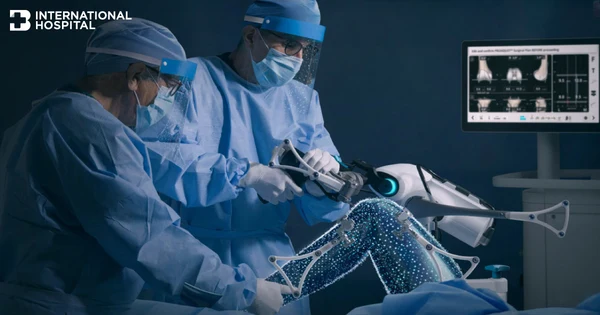

Degeneration is unavoidable—especially knee osteoarthritis, which is common among older adults and causes painful suffering with every movement. Total knee replacement surgery is therefore a treatment option that is continually being developed. VELYS™ is a new robotic technology that helps surgeons perform knee replacement with accurate positioning and appropriately balance the knee joint, enabling those with degenerative knee problems to move again with confidence.
VELYS™ What is personalized robotic-assisted knee replacement surgery?
VELYS™ Robotic-Assisted Solutions (VRAS) is a new-generation Generation 4 robotic-assisted knee replacement system under the control of the operating surgeon. It is a key assistant in surgery, capable of moving in all directions as directed by the surgeon to access the correct surgical position. It controls every angle of the procedure and the placement position of the implant on a Real-Time computer display and locks instrument movement to prevent deviation from the specified position. This not only helps surgeons successfully perform knee replacement surgery, but also increases surgical efficiency, reduces complications and impact on surrounding tissue, and elevates knee replacement to match each patient’s unique anatomy. It boosts confidence during surgery, helps patients regain better mobility, and contributes to a longer implant lifespan over the long term.
Who is the VELYS™ robotic-assisted knee replacement suitable for?
- Patients with knee osteoarthritis due to aging
- Patients with knee degeneration from other causes, such as rheumatoid arthritis or accidents
- Those who previously underwent knee replacement using other methods and experienced abnormalities or unnatural function

Features of the VELYS™ robotic system
- CT-Free Technology is a robotic-assisted surgical technology that does not require CT Scan. The VELYS™ robot can work with more accurate positioning without requiring a preoperative CT scan or knee computed tomography, so patients do not have to risk radiation exposure and the surgical process becomes more convenient and faster.
- Real-Time Data Real-time data: During surgery, the VELYS™ robot provides real-time data to help the surgeon adjust bone cuts and fine-tune the tension of tissues and ligaments around the knee accurately, to position the knee implant in the most appropriate location for each individual patient
- Adaptive Planning Adaptable planning: The VELYS™ robotic system continuously customizes knee replacement surgery to match each patient’s anatomy, making planning and surgery efficient.
Why choose the VELYS™ robot for personalized total knee replacement?
- High accuracy: The VELYS™ robot uses advanced technology to analyze and plan surgery, enabling accurate procedures while reducing complications and postoperative side effects. The VELYS™ robotic-assisted system can adjust the patient’s leg alignment and place the implant with fine precision to less than 0.5 millimeters and less than 0.5 degrees—currently considered a knee replacement method that is highly accurate and precisely positioned.
- Faster recovery: With surgery that is clear in every detail, the VELYS™ robot helps reduce operating time, allowing patients to recover faster, shorten rehabilitation time, and return to daily life more quickly
- Less pain: Surgery with the VELYS™ robot helps reduce injury to tissues around the knee, so patients experience significantly less pain after surgery and can move the knee more comfortably.
- Personalized surgical planning: Because each person’s knee is different , the VELYS™ robot can plan surgery to suit each patient’s physical condition and needs, resulting in knee implant placement in the most suitable position for each individual patient
- Stabilizes knee balance: Because the VELYS™ robotic-assisted system can help perform surgery with adjustments as fine as 0.5 millimeters or 0.5 degrees, the surgeon can plan accurately and quickly measure results during surgery, appropriately balancing the implant for each patient. It helps create optimal balance of tissues and ligaments around the knee for flexion and extension through all degrees of bending.
- Reduces surgical complications: It reduces both tissue injury and inflammation, including ligaments around the knee. The VELYS™ robotic-assisted system controls surgical instruments to remain within the specified position and has a response system that works quickly and provides clear information.
- Extends the lifespan of the knee implant: The VELYS™ robot helps surgeons place the knee implant in an accurate position appropriate for each individual patient, thereby prolonging the implant’s lifespan longer than before.

How to prepare before robotic-assisted knee replacement surgery with VELYS™
A multidisciplinary specialist medical team will prepare patients physically and mentally before robotic-assisted knee replacement surgery with VELYS™, including a thorough health examination. If the patient is taking anticoagulant medications, it is necessary to stop blood-thinning drugs, and if there are any medications being taken or underlying conditions, the doctor must be informed immediately.
How to care after robotic-assisted knee replacement surgery with VELYS™
After robotic-assisted knee replacement surgery VELYS™ patients should strictly follow the doctor’s instructions. Generally, all patients can walk on the day of surgery or within 24 hours after surgery. Most will stay for recovery for about 1 – 2 days and undergo knee rehabilitation physical therapy to build strength after surgery.
What are the risks of robotic-assisted knee replacement surgery with VELYS™
The risks of robotic-assisted knee replacement surgery VELYS™ depend primarily on the patient’s physical condition and the severity of the disease. In any case, the surgeon and multidisciplinary team will thoroughly examine the patient before surgery.
View all additional promotions
Hospital specialized in robotic-assisted knee replacement surgery with VELYS™
Hip & Knee Center, Bangkok Hospital International, with expert specialist surgeons performing surgery with the VELYS™ robot and an experienced multidisciplinary team, as well as modern technology for effective total knee replacement surgery. Combined with a total knee replacement patient care program accredited by the Joint Commission International or JCI from the United States, it helps patients receive effective surgical care, reduce complications, have smaller wounds, less pain, faster recovery, and return to life with confidence every day.
Physician specialized in robotic-assisted knee replacement surgery with VELYS™
Dr. Phonthakorn Panichkul Orthopedic Surgeon, Hip & Knee Center, Bangkok Hospital International
You can click here to make an appointment yourself.
New!! Generation 4 VELYS™ robotic-assisted total knee replacement
Frequently Asked Questions (FAQ) about robotic knee surgery with VELYS™
1. Does the VELYS™ robot perform the entire surgery by itself?
No. The VELYS™ robot does not perform surgery automatically. It is a tool and assistant that remains under the control of a specialist surgeon at all times. The surgeon makes decisions and performs the operation, while the robot helps process data and lock movement positions so that implant placement is accurate according to the planned approach.
2. How does CT-Free (no CT scan required) technology benefit patients?
CT-Free technology allows surgeons to plan and perform surgery directly using real-time data in the operating room. The benefits are that patients do not need to spend time having a computed tomography (CT scan) in advance, and it reduces unnecessary radiation exposure risk, making the treatment process more convenient and faster.
3. How long after robotic knee replacement with VELYS™ can I walk?
Most patients can begin walking practice within 24 hours after surgery, and some can get up and walk from the first day of surgery. This depends on the doctor’s assessment and each individual patient’s physical condition. A physical therapy team will provide close care and movement training.
4. How does the VELYS™ robot help extend the lifespan of the knee implant?
Because the VELYS™ robot can help the surgeon balance ligament tension and position the knee implant with precision to less than 0.5 millimeters or 0.5 degrees, the implanted knee fits each person’s unique anatomy, reducing impact forces and abnormal wear. As a result, the implant can have a longer service life.
5. Can patients who previously had knee surgery but have problems use this technology for revision treatment?
Yes. The VELYS™ robotic system is suitable both for first-time knee replacement patients and for those who previously underwent knee replacement using other methods but developed abnormalities or unnatural function. However, the surgeon will thoroughly evaluate the knee structure to plan the most appropriate treatment for each case.