


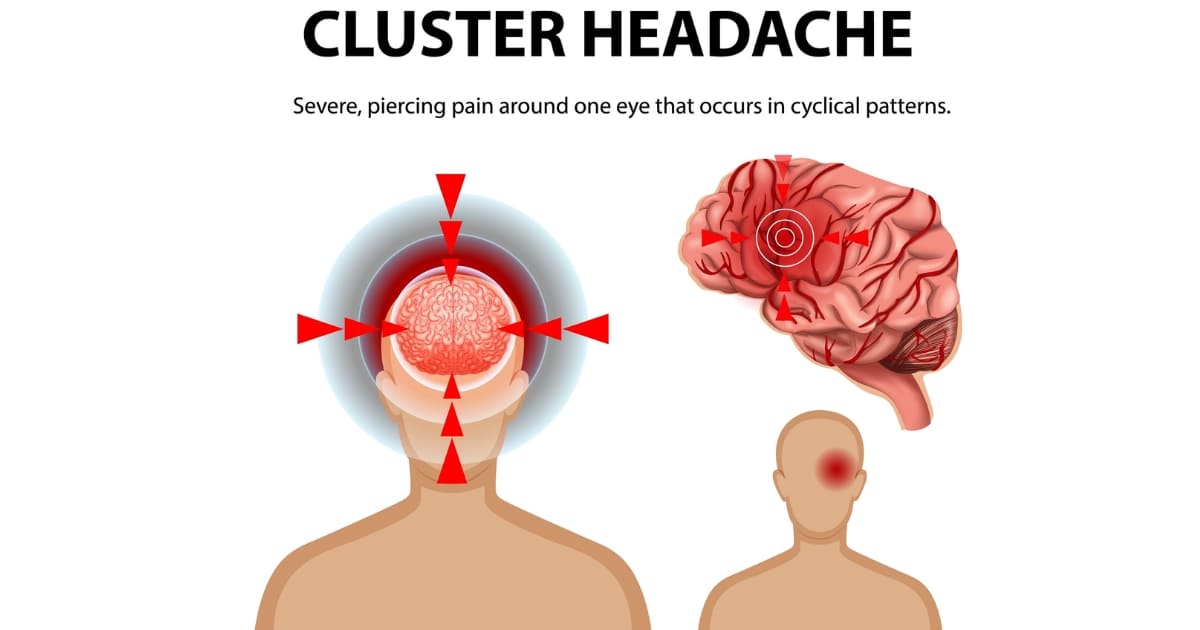
If you have ever felt severe pain in one eye socket on one side—so intense that you cannot stay still—at the same time repeatedly every day, it may not be just migraine, but a sign of cluster headache (Cluster Headache) one of the most painful headache disorders, also known as Suicidal Headache —a headache so painful you almost don’t want to live.
What is cluster headache?
Cluster headache (Cluster Headache) is a neurological disorder that causes severe unilateral headache. It often occurs in clusters (Cluster) during a particular time of the year, such as daily attacks for several consecutive weeks up to 3 months, then disappearing for a long time—often for years—before recurring.
How common is cluster headache?
Cluster headache (Cluster Headache) occurs in men about 3 times more often than in women, and typically begins between the ages of 20 – 40 years.
What causes cluster headache?
Medically, the exact cause of cluster headache is still unknown, but it is believed to be related to abnormal function of the hypothalamus (Hypothalamus) , which controls the body’s biological clock. Trigger factors to watch out for include alcohol consumption, smoking, strong odors, extreme heat, stress, etc.
What are the symptoms of cluster headache?
- Sudden, severe headache
- Pain in the eye socket, around the eye, behind the eyeball, temple, and forehead on one side only
- Red eye, tearing, drooping eyelid, swelling
- Nasal congestion, runny nose, restlessness
- Sweating on the forehead or face

How is cluster headache different from migraine headache?
Many people mistakenly think it is migraine and therefore do not receive proper treatment. Cluster headache (Cluster Headache) differs from migraine headache (Migraine) as follows:
|
Cluster headache (Cluster Headache) |
Migraine headache (Migraine) |
|
Severe headache but short-lived; can resolve within 3 hours |
Throbbing pain; headache on one side lasting up to 3 days |
|
Pain in the eye socket, around the eye, behind the eyeball, temple, and forehead always on one side |
Unilateral headache; may alternate left or right, but usually affects one side at a time |
|
Prominent autonomic nervous system symptoms during the attack, on the same side as the pain ได้แก่ Red eye, tearing, drooping eyelid, swelling, nasal congestion, runny nose, restlessness |
Mild autonomic nervous system symptoms; may have an aura (Aura) before pain such as shimmering lights, zigzag lines, blurred vision, etc. |
|
Patients often cannot stay still and may pace or rock |
Patients want to lie still in a dark and quiet place |
|
The pain cycle is highly punctual (Alarm Clock Headache) and often occurs at the same time every day for example, 1 – 2 hours after falling asleep or in the early morning. Each attack lasts about 15 minutes – 3 hours, may occur from 1 up to 8 times per day, and may persist for months or years depending on severity. |
The migraine phases (The migraine phases) include a pre-headache phase (Prodrome) 1 – 2 days, an aura phase (Aura) 5 – 60 minutes before headache, a migraine headache phase (Headache) lasting 4 – 72 hours, and a postdrome phase (Postdrome) with possible fatigue and weakness that may resolve on its own within 48 hours. |

Treatment approach for cluster headache
- Acute treatment (Acute Treatment) When pain occurs, the physician treats with the goal of stopping the suffering as quickly as possible, including:
- Inhalation of 100% oxygen (High Flow Oxygen 12 – 15 L/Minute) via a Non – Rebreathing Mask can relieve pain by up to 80%
- Triptans (Sumatriptan) as injection or nasal spray to suppress pain
- Transitional therapy to break the pain cycle (Transitional Therapy) Because the main preventive medications take time to take effect, medications are used in the interim to stop pain, including:
- Corticosteroids short-term high-dose steroid therapy to stop the pain cycle
- Greater Occipital Nerve Block (GON Block) injecting local anesthetic mixed with steroid into the occipital nerve on the painful side, which quickly reduces frequency and severity
How to prevent pain in the long term
Long-term prevention (Preventive Therapy) such as Verapamil, Topiramate, Melatonin, Lithium including medications that inhibit CGRP (Galcanezumab dose 240 – 300 mg) administered by subcutaneous injection, which can effectively reduce the number of attacks in those with episodic cluster headache (Episodic Cluster Headache) .
Although cluster headache is not life-threatening, it undermines quality of life. If you have severe one-sided headache with tearing or nasal congestion, you should not buy medication to take on your own. You should see a brain and neurological specialist for proper diagnosis and treatment, helping you return to normal life and have a good quality of life.
Physician specializing in cluster headache treatment (Cluster Headache)
Dr.Kiratikorn Vongvaivanich Neurologist, specializing in headache and migraine treatment Bangkok Hospital International, the hospital for brain and bone
You canclick hereto make an appointment yourself.
Hospital specializing in cluster headache treatment (Cluster Headache)
Brain and Nervous System Center, Bangkok Hospital International the hospital for brain and bone, is ready to provide diagnosis and care for cluster headache (Cluster Headache) with a team of specialist physicians, including multidisciplinary expert doctors and modern treatment technology, so patients can live with quality every day.