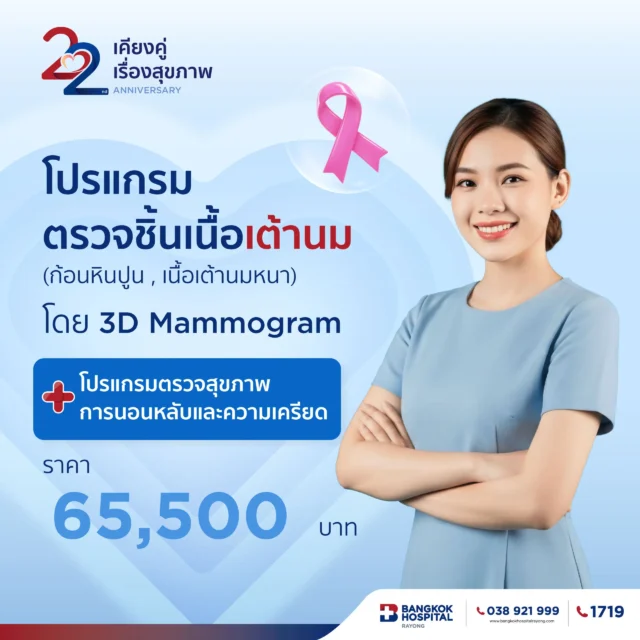
Breast cancer screening and treatment using modern medical technology
-
Core Biopsy
Automated cutting gun technology helps cut tissue to analyze whether it is cancerous or not. It is accurate and safe, helping doctors plan treatment effectively. -
Digital breast cancer screening with mammography and 3D ultrasound
-
Breast cancer treatment with aspirate
This method reduces swelling and pain from fluid in the breasts, and is a painless procedure that is suitable for early stage patients. -
Needle Localization
The process of localizing the tumor before surgery using a special needle increases accuracy and reduces the risk of surgery. -
Ductography (X-ray of the mammary ducts)
Suitable for detecting abnormalities in milk ducts, such as abnormal flow of secretions, helping to identify the problem at the right point. -
Fine Needle Aspiration
A technique for detecting cancer cells using a small needle reduces the pain and allows results to be obtained quickly. -
Breast cancer screening with digital mammogram and ultrasound
Modern technology to accurately diagnose the characteristics, size and shape of the tumor, allowing for targeted and most effective treatment.
All of these steps are essential in breast cancer screening and treatment to maximize a patient’s chances of achieving full health recovery.
How many breast surgeries are there?
There are several methods of breast surgery for breast cancer patients, depending on the stage of the disease, the characteristics of the tumor, and the patient’s physical condition. They can be divided into the following main methods:
1. Breast-Conserving Surgery
- Also known as Lumpectomy or Partial Mastectomy
- It is a surgical procedure to remove only the cancerous part and surrounding tissue, while trying to preserve the shape of the breast.
- Suitable for early stage cancer and patients with small tumors.
2. Total breast removal surgery (Mastectomy)
- It is a surgical procedure to remove all of the breast to remove cancer cells. There are several types, including:
- Simple Mastectomy: Removing only the breast, without affecting the lymph nodes or muscles under the breast.
- Modified Radical Mastectomy: The entire breast is removed, including some lymph nodes, to prevent spread.
- Radical Mastectomy: Traditional surgery that removes the breast, pectoral muscles and lymph nodes (rarely used today due to its gentler approach)
3. Oncoplastic Surgery
- Combining medical treatment and cosmetic procedures, by surgically removing cancerous tissue and reshaping the breast to create a balanced appearance.
4. Axillary Surgery
- Used in conjunction with breast surgery in cases where the cancer has spread to the lymph nodes.
- Sentinel Lymph Node Biopsy: Nearest lymph node dissection to check for spread
- Axillary Lymph Node Dissection: Multiple lymph node dissection in cases of metastasis
5. Reconstructive Surgery
- It is a breast reconstruction after mastectomy using your own tissue or artificial material (silicone).
- It can be done immediately after mastectomy or later.
Choosing a surgical method
It depends on various factors such as cancer stage, tumor characteristics, patient’s physical condition and individual needs. Consulting a specialist is important to make the most appropriate decision.