Skin cancer

5 minute(s) read
Skin cancer
Bangkok Rayong Cancer Hospital
Table of contents
  • Types of cancer
  • Cause
  • Symptom
  • How many stages are there in cancer?
  • Screening methods
  • Treatment method
  • Protection

What is skin cancer?

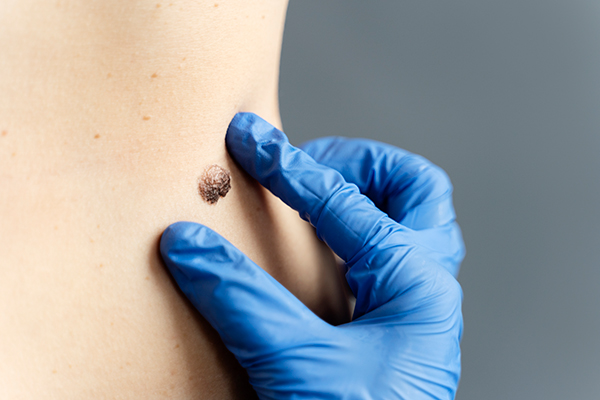
Skin cancer is a malignant change in cells on the skin and mucous membranes. There are many types of skin cancer, with the most common being basal cell carcinoma, squamous cell carcinoma, and melanoma.
Causes of Skin Cancer

The exact cause of skin cancer is currently unknown, but risk factors have been identified as follows:

  1. Sunlight: Skin cancer often occurs in areas exposed to intense sunlight for extended periods, those who work outdoors, enjoy tanning, or have a history of sunburn.
  2. Ethnicity: Fair-skinned people with bronzed hair have less melanin, which reduces the ability of skin cells to protect against ultraviolet light.
  3. People with compromised immune systems, such as those with HIV or AIDS, or those taking immunosuppressive medications.
  4. Long-term smoking.
  5. A family history of skin cancer.
  6. A history of exposure to chemicals, such as arsenic, or prolonged exposure to chemicals.
  7. Skin has been irradiated.

What are the symptoms of skin cancer?

Skin cancer occurs on the skin, visible to the naked eye, and can occur throughout the body. Symptoms of skin cancer vary depending on the type of skin cancer, as follows:

It can be of many colors, from black, red, pink, brown, and gray. The color of the skin cancer is not uniformly distributed on the lump. It is the least common type, but it is highly aggressive because it is more likely to spread to nearby tissues and other areas than other types, and can quickly enter the bloodstream. If left untreated, it can cause death within 3-6 months.

How many stages are there of skin cancer?
Stages of non-melanoma skin cancer

Stage 1: The lesion is no larger than 2 centimeters (the 5-year survival rate after treatment is approximately 90-100%).
Stage 2: The lesion is larger than 2 centimeters or any size, but the cancer cells are highly proliferative or have spread deep beneath the skin (the 5-year survival rate after treatment is approximately 70-80%).
Stage 3: The disease has spread to other tissues adjacent to the skin, or to a single nearby lymph node, and the node is no larger than 3 centimeters (the 5-year survival rate after treatment is approximately 50%).
Stage 4: The lesion has spread to the bone or nerves, to more than one lymph node, or to a lymph node larger than 3 centimeters, or to the bloodstream. When spreading, it often extends to the lungs. (The 5-year survival rate after treatment is approximately 0-30%)

Stages of Melanoma

Stage 1: The lesion is 0-1 millimeters deep. (The 5-year survival rate after treatment is approximately 75-80%).
Stage 2: The lesion is 1 millimeter or more deep. (The 5-year survival rate after treatment is approximately 40-70%).
Stage 3: The disease has spread to the lymph nodes. (The 5-year survival rate after treatment is approximately 30-40%).
Stage 4: The disease has spread to the bloodstream, often to the lungs, bones, and brain. (The 5-year survival rate after treatment is approximately 0-10%).

Skin Cancer Screening Methods

  • A doctor can diagnose skin cancer based on a patient’s history and risk factors, examining the lesion’s appearance, color, size, and abnormal skin shape, and palpating lymph nodes.
  • A definitive diagnosis involves a skin biopsy of a lesion, lump, wound, or mole for pathological examination. This biopsy may be performed on a partial or complete lump.

There are several preliminary screening methods, including:

Early Skin Cancer Assessment: Since skin cancer treatment is most effective and curable when detected early, those with the aforementioned risk factors should periodically examine their entire body. This can be done using a standing mirror or a hand mirror. The examination steps are as follows:

  1. Stand in front of a mirror and look at the front, back, and sides of the body, both left and right, and raise your arms.
  2. Examine the arms, armpits, hands, backs of hands, and elbows.
  3. Examine the front and back thighs, calves, shins, knees, insteps, and between the toes.
  4. Examine the front and back of the neck, scalp, and hairline.
  5. Examine the back. (This can be observed using the ABCDE principle.)

A: Asymmetry: The asymmetry of the skin lesion on each side.
B: Border irregular: The edges of the skin lesion are irregular and unclear.
C: Color multiple: The color of the lesion is uneven and changes color.
D: Diameter > 6 mm. or Ugly duckling: The structure of the skin lesion is larger than 6 mm.
E: Evolution in the last 3 months: There has been a change in size and shape over the past 3 months.

Skin Cancer Treatment Methods

  1. Scraping and electrocautery are suitable for relatively small cancerous tumors. The tumor is scraped out and an electric current is applied to the surrounding tissue. This procedure may require 2-3 consecutive sessions to completely remove the tumor.
  2. Cryosurgery is often used for early-stage skin cancer. Liquid nitrogen is applied to the affected skin, causing a scab to form. The scab will then fall off after approximately one month.
  3. Skin surgery is a standard surgical procedure that involves removing the cancerous tumor from the skin and surrounding tissue. If the surgical site is large, skin from another area may be used to cover the wound to speed healing and minimize scarring.

For cases of extensive or inoperable tumors, or cancer that has spread to other areas, or melanoma that has already metastasized, doctors may prescribe radiation therapy in combination with chemotherapy. Treatment results are generally successful and can lead to a complete cure.

Skin Cancer Prevention

  • Avoid intense sunlight and prolonged sun exposure, especially between 10:00 AM and 3:00 PM, when sunlight is at its peak. However, if necessary, wear protective clothing to protect from the sun. Applying sunscreen with an SPF of 50 or higher and a PA+++ rating is the best protection.
  • Avoid chronic exposure to toxins or carcinogenic chemicals, such as arsenic found in water, and taking Chinese, Thai, and herbal medicines, as these may contain carcinogenic arsenic.
  • Avoid chewing betel nut or smoking. Maintain good oral and dental hygiene. Be careful not to have cavities or sharp teeth that rub against the mouth, leading to chronic wounds and potentially cancer.
  • Maintain cleanliness around the genitals to prevent fermentation.
  • Prevent diseases that compromise the body’s immune system, such as HIV or AIDS.
  • Regularly inspect your skin throughout the body, noting any abnormalities such as warts, moles, freckles, birthmarks, and scars (e.g., premature growth). If the skin changes color and shape, is itchy, cracked, or bleeds, or if you have a chronic wound or a wound that doesn’t heal within four weeks, or if you’re concerned about such a lesion, see a doctor for early diagnosis and appropriate treatment.

Those at high risk, such as those with a family history of skin cancer or those who work in the sun, should see a doctor for early skin cancer screening at least once a year.