
Bangkok Hospital
Caret Right
Search
CTA Curve
Find doctors icon
Find doctors
Appointments icon
Appointments
Contact icon
Contact
Call undefined
Menu
  • Select Hospital

  • Language & Currency

Doctor not found
Doctor not found
Doctor not found
Doctor not found
Bangkok Hospital
Contact us
View on Google Maps
    Privacy Policy

    |

    Cookie Policy

    Copyright © 2026 Bangkok Hospital. All right reserved


    Network Hospitals Directory
    MEMBER OFBDMS logo

    AI-Assisted Colonoscopy: Smarter Colorectal Cancer Screening

    4 minute(s) read
    Information by
    Bangkok Hospital Pattaya
    Updated on: 31 Aug 2026
    Recommended Packages
    CT Calcium Scoring
    CT Calcium Scoring
    AI-Assisted Colonoscopy: Smarter Colorectal Cancer Screening
    Bangkok Hospital Pattaya
    Updated on: 31 Aug 2026
    Table of contents
    • AI-Assisted Colonoscopy: Smarter Colorectal Cancer Screening
    • Frequently Asked Questions (FAQ)

    Don’t wait for symptoms

    Colorectal cancer is the third most commonly diagnosed cancer in the world — and one of the most preventable when caught early. The problem is that small polyps, which can be the very starting point of colorectal cancer, often cause no symptoms at all. By the time something feels wrong, the disease may already be at an advanced stage.

    Early detection changes outcomes. And now, Bangkok Hospital Pattaya is making that detection even more reliable with AI-Assisted Colonoscopy.

    What is a colonoscopy and why does it matter?

    A colonoscopy is a procedure in which a flexible camera is passed through the large intestine to examine the lining for abnormalities — particularly polyps, which are small growths that can develop into cancer over time. It is currently the gold standard for colorectal cancer screening and is recommended for adults from the age of 45, or earlier for those with risk factors such as a family history of colorectal cancer, inflammatory bowel disease, or previous polyps.

    Most people experience no symptoms in the early stages of colorectal cancer, which is why routine screening is so important — it finds problems before they become serious.

    Did you know?

    Even in experienced hands, conventional colonoscopy can miss certain lesions — particularly small, flat, or subtle polyps that blend into the surrounding tissue. Studies suggest that some polyps can be missed during conventional colonoscopy. AI technology was developed specifically to address this gap.

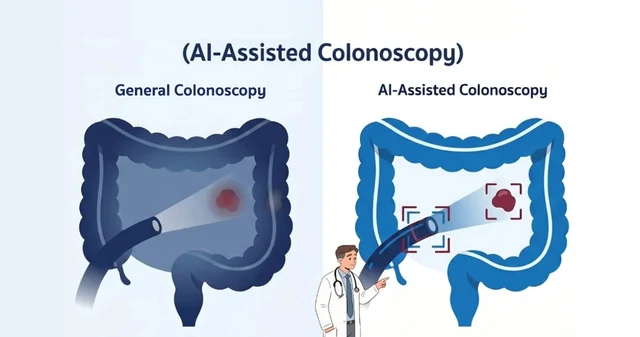
    Traditional Colonoscopy vs. AI-Assisted Colonoscopy

      Traditional Colonoscopy AI-Assisted Colonoscopy
    Polyp detection Relies entirely on physician’s visual assessment AI flags suspicious areas in real time alongside the physician
    Small lesion visibility Subtle or flat polyps may be missed Enhanced detection of small and flat lesions
    Miss rate Higher risk of overlooking lesions Significantly reduced miss rate
    Real-time analysis Not available AI analyses images continuously during the procedure
    Physician role Sole decision-maker Supported by AI — final decisions remain with the physician
    Screening confidence Standard Higher confidence in thorough examination

    What is AI-Assisted Colonoscopy?

    AI-Assisted Colonoscopy uses real-time artificial intelligence to support the physician during the procedure, continuously analyzing the endoscopic image and flagging areas of concern that might otherwise be easy to overlook. The AI does not replace the doctor’s expertise — it works alongside it, adding an extra layer of precision to every examination.

    Key benefits:

    • Increases the detection rate of polyps and small lesions that are difficult to see with the naked eye
    • Improves confidence in early-stage colorectal cancer screening
    • Helps physicians identify cancer-causing polyps more accurately
    • Reduces the risk of lesions being missed during the procedure
    • Provides real-time image analysis throughout the entire examination

    Who should consider a colonoscopy?

    A colonoscopy is recommended for:

    • Adults aged 45 and over as part of routine colorectal cancer screening
    • Those with a family history of colorectal cancer or polyps
    • Those with a personal history of inflammatory bowel disease
    • Anyone experiencing symptoms such as rectal bleeding, changes in bowel habits, unexplained weight loss, or persistent abdominal discomfort
    • Those who have had polyps removed previously and require follow-up surveillance

    What to expect during the procedure

    A colonoscopy is typically performed under sedation, so most patients feel little to no discomfort during the examination. The procedure itself usually takes 30–60 minutes. Beforehand, the bowel needs to be thoroughly cleared using a preparation solution taken the day before — your doctor will provide full instructions. After the procedure, patients rest briefly before being discharged, usually on the same day.


    Frequently Asked Questions (FAQ)

    What is AI-Assisted Colonoscopy?

    It is a colonoscopy procedure that incorporates real-time artificial intelligence to help the physician detect polyps and lesions during the examination, reducing the chance of anything being missed.

    Is AI-Assisted Colonoscopy safe?

    Yes. The procedure is the same as a standard colonoscopy — the AI technology simply enhances the physician’s ability to detect abnormalities by analyzing images in real time. It does not change the nature of the examination itself.

    Is AI-Assisted Colonoscopy better than a traditional colonoscopy?

    AI-Assisted Colonoscopy offers a higher level of detection accuracy, particularly for small or flat polyps that can be difficult to spot visually. For patients who want the most thorough screening available, it is the more comprehensive option.

    Does the AI replace the doctor?

    No. The AI acts as a support tool, flagging areas of concern for the physician to assess. All clinical decisions remain with the doctor. The combination of physician expertise and AI precision delivers a more thorough result than either alone.

    Who should have a colonoscopy?

    Adults aged 45 and over are generally recommended for routine colorectal cancer screening. Those with risk factors — including family history, previous polyps, or inflammatory bowel disease — may need to start screening earlier. Anyone with symptoms such as rectal bleeding or persistent changes in bowel habits should not wait and should consult a doctor promptly.

    How do I prepare for a colonoscopy?

    The bowel must be completely clear before the procedure. Your doctor will prescribe a bowel preparation solution to be taken the day before, along with dietary instructions. Full preparation guidance will be provided at your consultation.

    Is the procedure painful?

    Colonoscopy is performed under sedation, so most patients experience little to no discomfort during the examination. Some mild bloating or cramping may occur afterward, which typically resolves quickly.

    Available now at Bangkok Hospital Pattaya

    AI-Assisted Colonoscopy is available now at Bangkok Hospital Pattaya’s Gastrointestinal and Liver Center. If you are due for a colonoscopy — or have been putting it off — this is the right time to act.

    For more information, please contact

    Gastrointestinal and Liver Center

    B building, 2nd floor

    Monday to Sunday
    8:00 am - 5:00 pm

    +66 3890 9345

    +66 3825 9986

    [email protected]

    Consult a Specialist Doctor

    See all doctors

    Packages & Promotions

    CT Calcium ScoringCT Calcium Scoring
    CT Calcium Scoring

    2,900 Baht

    Detail
    Bright Brain: Dementia Screening PackageBright Brain: Dementia Screening Package
    Bright Brain: Dementia Screening Package

    10,000 Baht

    Detail
    Stroke Screening PackageStroke Screening Package
    Stroke Screening Package

    17,000 Baht

    Detail
    More packages

    Health Info

    More health info

    Health Info

    6 Colon Cancer Symptoms You Should Not Ignore — and When to Start Screening Image
    6 Colon Cancer Symptoms You Should Not Ignore — and When to Start Screening
    Frequently Asked Questions About Liver Cancer Image
    Frequently Asked Questions About Liver Cancer
    Hepatitis: Understanding Liver Inflammation, How Hepatitis Spreads, and Its Many Causes Image
    Hepatitis: Understanding Liver Inflammation, How Hepatitis Spreads, and Its Many Causes
    More health info