


Frozen shoulder — known medically as adhesive capsulitis — is one of those conditions that creeps up quietly yet can dramatically affect the way you live. It is especially common among people over 40, those with diabetes, and anyone whose shoulder has been immobilised for a period after injury or surgery. Women are affected more often than men.
What often begins as a mild ache can, over weeks and months, become far more disruptive. Getting dressed, reaching for a book on a shelf, fastening a seat belt, or simply finding a comfortable sleeping position can all become unexpectedly difficult.
Dr Sira Prueksaritanond (Medical Licence No. 37673), an orthopaedic surgeon specialising in sports medicine at Bangkok Hospital Hua Hin, explains that frozen shoulder develops when the shoulder capsule — the connective tissue surrounding the joint — becomes inflamed and progressively thickens. Tight bands of scar tissue form, reducing the space within the joint and restricting smooth, pain-free movement.

WARNING SIGNS AND SYMPTOMS
The hallmark symptoms are deep, persistent pain and increasing stiffness. Patients typically describe a dull ache originating from within the shoulder that worsens at night or whenever they attempt to move the arm away from the body. Over time, the range of motion diminishes steadily — lifting the arm overhead, reaching behind the back, or rotating the shoulder outward becomes progressively harder.
THE THREE STAGES OF FROZEN SHOULDER
The condition tends to develop gradually and follows a recognisable pattern of three overlapping stages:
- Freezing Stage (approx. 6–9 months): Pain builds gradually with every shoulder movement, and range of motion begins to narrow. This is often the most uncomfortable phase.
- Frozen Stage (approx. 4–12 months): Pain may stabilise or ease somewhat, but stiffness intensifies. The shoulder is at its most restricted during this phase, with a marked impact on daily activities.
- Thawing Stage (approx. 6 months–2 years): The tight tissue gradually loosens and the shoulder begins to regain its range of movement. Recovery can be slow, but consistent rehabilitation makes a significant difference.

TREATMENT OPTIONS
The primary goals of treatment are to relieve pain and progressively restore movement. Your specialist will tailor the approach to the stage and severity of your condition.
- Medication: Anti-inflammatory medicines (NSAIDs) can help manage pain. In some cases, a corticosteroid injection directly into the shoulder joint may be recommended to reduce inflammation more rapidly and create a window for effective physiotherapy.
- Physiotherapy: The cornerstone of recovery. A physiotherapist will use manual therapy techniques, pain-relief modalities, and carefully guided exercises to stretch tight tissue and gradually improve mobility.
- Advanced Interventions: When conservative measures are insufficient, further options may include hydrodilatation (expanding the joint capsule with fluid under pressure) or arthroscopic surgery to release scar tissue and restore range of motion.
WHEN SHOULD YOU SEE A DOCTOR?
Early intervention can shorten recovery time considerably. Do not wait until movement becomes severely restricted. Seek specialist advice if you experience:
- Shoulder pain persisting for more than two to three weeks without improvement
- Pain that regularly disrupts your sleep
- Increasing difficulty with everyday movements — combing your hair, getting dressed, or reaching behind your back
THREE SIMPLE EXERCISES YOU CAN DO AT HOME
The following exercises can help prevent frozen shoulder from worsening between appointments. They are gentle enough to perform at home, but consistency is key.
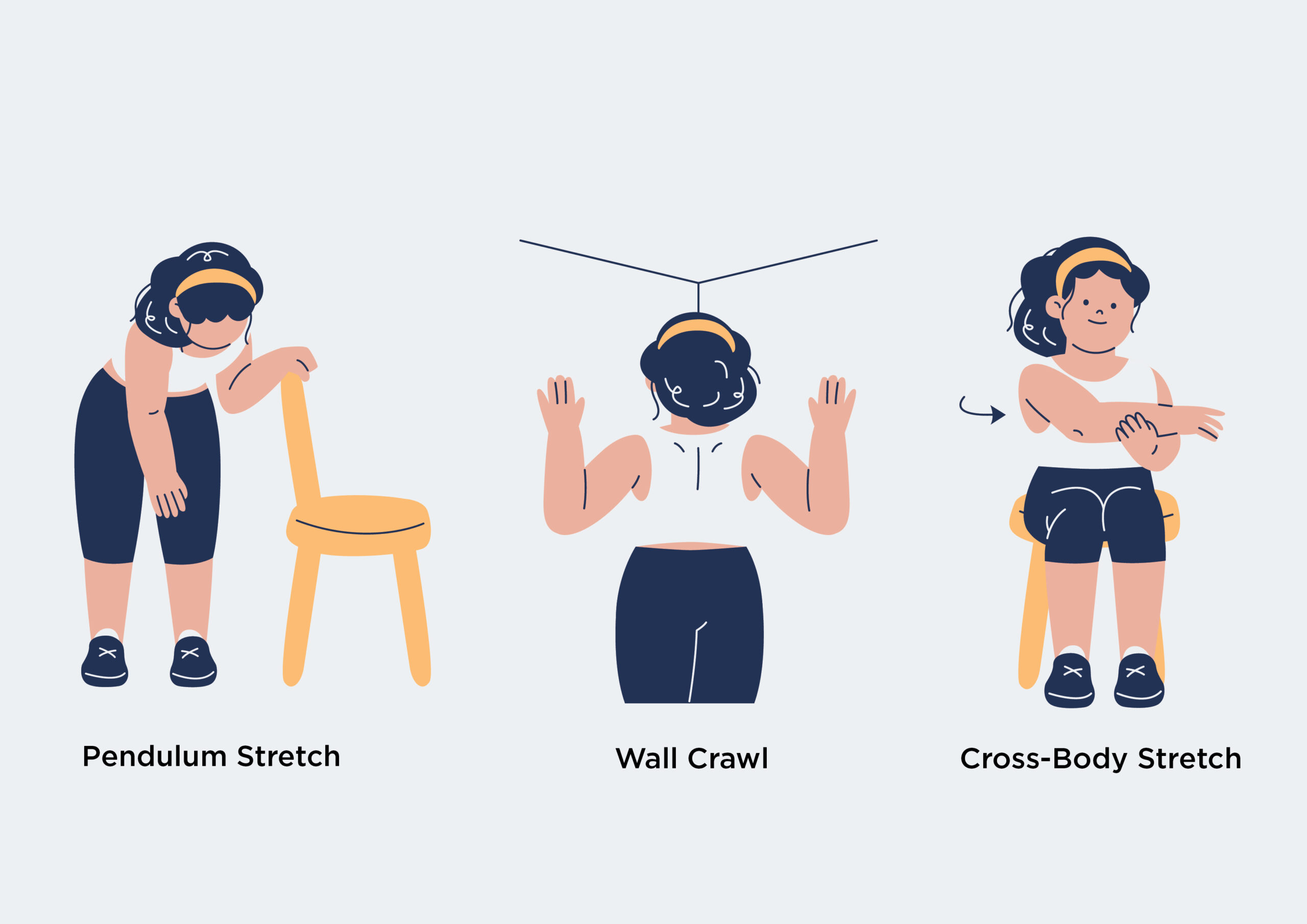
-
Pendulum Stretch
One of the safest starting exercises, this uses gravity to create gentle space within the shoulder joint without straining the muscles.
How to do it: Lean slightly forward and support yourself with your unaffected arm on a table or chair. Let the affected arm hang loosely.
Movement: Gently swing the arm in small circles, like a pendulum. Start small and gradually increase the range without causing pain. Rotate 10 times clockwise and 10 times anticlockwise.
Frequency: 2–3 sets per day
-
Wall Crawl
This exercise helps improve your ability to raise the arm upwards in a controlled manner.
How to do it: Stand facing a wall at arm’s length. Place your fingers on the wall at waist level, keeping your elbow straight.
Movement: Slowly “walk” your fingers up the wall as high as you comfortably can. Hold for 15–30 seconds, then slowly walk your fingers back down.
Frequency: 5–10 repetitions per session
-
Cross-Body Stretch
This stretches the posterior capsule at the back of the shoulder.
How to do it: Stand or sit upright. Extend the affected arm in front of you. Use your other hand to hold the elbow.
Movement: Gently draw the arm across your chest until you feel a stretch at the back of the shoulder. Hold for 15–20 seconds. Avoid raising the shoulder towards your ear.
Frequency: 5–10 repetitions per session
Important: When exercising at home, you should feel a moderate stretch — not sharp or severe pain. If discomfort worsens at any point, stop immediately and rest. Always consult your doctor or physiotherapist before beginning a new exercise routine.

Frozen shoulder may not be life-threatening, but left untreated, it can profoundly affect your quality of life. Recognising the symptoms early and committing to consistent, appropriate physiotherapy can speed recovery considerably and reduce the risk of long-term stiffness. If you are experiencing persistent shoulder pain or difficulty moving your arm, please do not ignore it. Seek medical advice early so you can return to the activities you enjoy.”
— Dr Sira Prueksaritanond
——————————————————
Bangkok Hospital Hua Hin • Orthopaedic & Sports Medicine Centre
For appointments and enquiries, please contact
Tel. 032-616-832 Orthopaedic Department (8.00 – 17.00 hr)
Tel. 032-616-800 Call Center, Bangkok Hospital Hua Hin