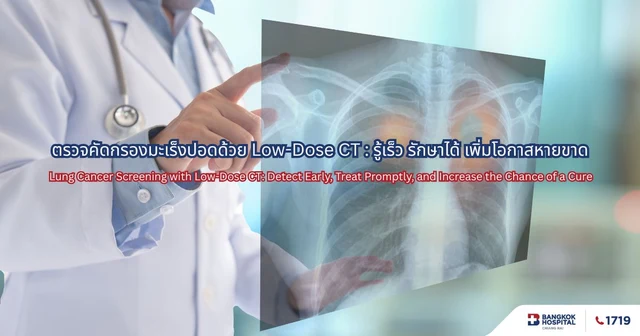
Lung Cancer: A Serious Disease That Often Shows No Warning Signs
Lung cancer is one of the leading causes of cancer-related death worldwide, including in Thailand. One of the major challenges is that most patients have no symptoms during the early stages of the disease. By the time symptoms such as a persistent cough, coughing up blood, shortness of breath, chest pain, or unexplained weight loss appear, the cancer may already have progressed. This can make treatment more complex and reduce the likelihood of a cure.
In contrast, when lung cancer is detected at an early stage, the chance of successful treatment through surgery or other localised therapies is significantly higher. This is why lung cancer screening with Low-Dose Computed Tomography, also known as Low-Dose CT or LDCT, is important.
What Is Low-Dose CT?
Low-Dose CT is a computed tomography scan of the chest that uses less radiation than a conventional CT scan while still providing sufficiently detailed images to detect small abnormalities or tumours in the lungs.
Benefits of Low-Dose CT include:
- The scan takes approximately 5–10 minutes
- No fasting is required
- No contrast injection is required
- The procedure is painless, and patients can return home immediately
- It can detect lung cancer before symptoms develop
Who Should Consider Lung Cancer Screening?
Current guidelines recommend lung cancer screening for individuals at high risk, including those who:
- Are 50–80 years old
- Have a smoking history of at least 20 pack-years
- Currently smoke or have quit within the past 15 years
- Are healthy enough to undergo treatment if lung cancer is detected
What Is a Pack-Year?
A pack-year is a unit used to estimate a person’s cumulative exposure to cigarette smoking.
Calculation formula:
Number of cigarette packs smoked per day × Number of years smoked
Examples:
- 1 pack per day × 20 years = 20 pack-years
- 2 packs per day × 10 years = 20 pack-years
- Half a pack per day × 40 years = 20 pack-years
Those who are unsure whether they meet the screening criteria should consult a doctor for an individual risk assessment.
Are There Other Risk Factors Besides Smoking?
Although smoking is the most important risk factor for lung cancer, the disease can also occur in people who have never smoked, particularly when other risk factors are present, including:
- A family history of lung cancer, especially in a first-degree relative
- Chronic lung diseases such as chronic obstructive pulmonary disease (COPD), emphysema, or pulmonary fibrosis
- Exposure to radon gas
- Occupational exposure to carcinogens such as asbestos, arsenic, chromium, nickel, silica, and diesel exhaust
- Previous radiation therapy to the chest or a history of certain cancers
- Long-term exposure to second-hand smoke
Although these factors may increase the risk of lung cancer, Low-Dose CT screening is currently recommended primarily for individuals who meet the age and smoking-history criteria. People with other risk factors should consult a doctor for an individual assessment.
Can Lung Cancer Screening Really Reduce the Risk of Death?
Yes.
Large studies conducted in the United States and Europe have shown that Low-Dose CT screening in high-risk individuals can:
- Detect more lung cancers at an early stage
- Increase the likelihood of receiving potentially curative surgery
- Reduce lung cancer mortality by approximately 20–24%
For this reason, many countries recommend lung cancer screening for high-risk populations.
Does Finding a Lung Nodule Mean That It Is Cancer?
Not necessarily.
Lung nodules are relatively common, and most are not cancerous. Possible causes include:
- Scarring from a previous infection
- Tuberculosis
- Fungal infection
- Inflammation
- Benign tumours
- Early-stage lung cancer
Doctors assess the size, shape, and location of the nodule, together with the patient’s individual risk factors, to determine whether follow-up or further testing is needed.
If the Result Is Abnormal, Is Immediate Surgery Necessary?
Not always.
Management depends on the nature of the abnormality and may include:
- A repeat Low-Dose CT scan after an appropriate period
- PET/CT
- Bronchoscopy
- A biopsy
- Surgery, if early-stage lung cancer is strongly suspected
The doctor will recommend the most appropriate approach for each individual patient.
Are There Any Limitations to Low-Dose CT Screening?
Although Low-Dose CT provides important benefits, there are several limitations to consider:
- It may detect a non-cancerous nodule, known as a false-positive result, which may require additional follow-up
- It may detect a very slow-growing cancer that might never cause harm during the person’s lifetime, known as overdiagnosis
- Further investigations, such as PET/CT or a biopsy, may be required
- The scan involves exposure to radiation, although the dose is low
For these reasons, screening should be performed in people who meet the appropriate criteria and after receiving medical advice.
Should Former Smokers Still Be Screened?
People with a significant smoking history may remain at higher risk of lung cancer even after quitting.
Those who stopped smoking within the past 15 years and have a smoking history of at least 20 pack-years may still be considered for screening, depending on their doctor’s recommendation.
Lung Cancer Screening Does Not Replace Smoking Cessation
Although Low-Dose CT screening can reduce lung cancer mortality, quitting smoking remains the most effective way to reduce the risk of lung cancer.
Smoking cessation also lowers the risk of heart disease, stroke, and chronic obstructive pulmonary disease, while improving long-term health and quality of life.
Frequently Asked Questions
Should People Who Have Never Smoked Be Screened?
Routine screening is generally not recommended for people without recognised risk factors because the potential benefits may not outweigh the risks of unnecessary follow-up investigations. However, individuals with certain specific risk factors should consult a doctor for an individual assessment.
Can a Standard Chest X-ray Be Used Instead of Low-Dose CT?
No. A standard chest X-ray is not sufficiently sensitive to detect many early-stage lung cancers and is therefore not recommended as a lung cancer screening test.
How Often Should Screening Be Performed?
For individuals who meet the high-risk criteria, screening is generally recommended once a year. The need for continued annual screening should be reviewed with a doctor each year.
Summary
Lung cancer can be potentially cured when it is detected at an early stage. Low-Dose CT is an internationally recognised screening method for people at high risk. It can help detect lung cancer earlier, increase treatment opportunities, and reduce the risk of death from the disease.
People aged 50 years or older who have a history of smoking or other lung cancer risk factors should consult a pulmonologist to determine whether Low-Dose CT screening is appropriate for them.
Screening at the right time may be an important step towards detecting the disease early, receiving prompt treatment, and maintaining a better quality of life in the long term.