Who? If you’re enjoying eating with the food in hand but are still interested in dieting or want to lose weight but don’t know where to start, you might begin by understanding yourself first by checking your BMI (Body Mass Index) to see if your body is overweight. Alternatively, you can start by reading nutrition labels. According to the Thai Health Promotion Foundation, the daily nutritional requirement for Thais aged 6 and above should not exceed the recommended maximum amount in one day, as follows: energy should not exceed 2,000 kilocalories, sugar should not exceed 65 grams, fat should not exceed 65 grams, and sodium should not exceed 2,400 milligrams.
Nowadays, ready-to-eat food is gaining popularity because it is easy to consume. Reading nutrition labels before purchasing ready-to-eat foods is a way to ensure getting nutrients that meet requirements. It is beneficial for those caring about health or those with non-communicable diseases (NCDs) such as DiabetesHeart and Vascular DiseasesHypertensionCancer etc. This helps to know the types and amounts of nutrients to be obtained from consuming such food and helps consumers avoid unwanted nutrients or those not suitable for the body, or turn to adjust their eating lifestyle to be ‘good for the heart’.
Let’s Read Nutrition Labels
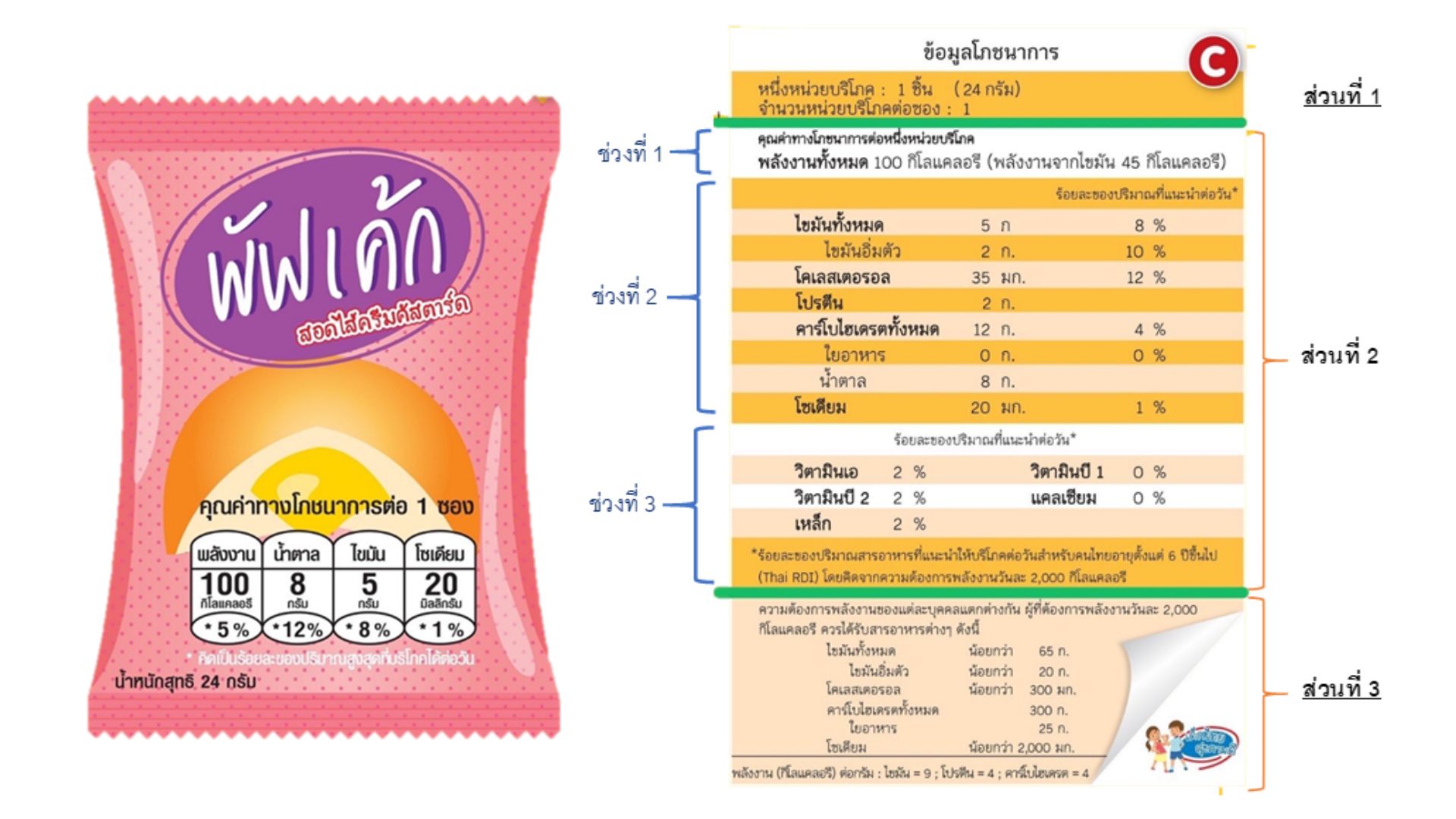
From the first three sections on the right side of the imageSection 1 refers to the amount the manufacturer suggests consuming each time.
The example in the image indicates that one serving equals 1 piece or 24 grams.
Section 2 means the amount of nutrients received from consuming the recommended amount, which can be divided into three parts. As shown:
Part 1 indicates that one serving provides 100 kilocalories, with 45 of those kilocalories coming from fat.
Parts 2 and 3 indicate what nutrients are provided by consuming this food and what percentage of the daily requirement they cover. For example, a custard-filled puff cake packet contains 8 grams of sugar. To find out how many teaspoons of sugar it is, divide 8 by 4 to get 2, indicating that there are 2 teaspoons of sugar per serving.
Note: Dietary guidelines for the good health of Thais according to nutritional flags recommend consuming sugar as little as possible or no more than 6 teaspoons (24 grams) a day.
Section 3 refers to the recommended amount of nutrients for Thais per day.
This is information that consumers should not overlook or ignore on nutrition labels. Reading the nutritional information on food product labels before deciding to buy will help consumers avoid unwanted nutrients or those they wish to limit. They can compare and choose food products of the same type by choosing brands with better nutritional value and select foods that suit their needs.
If you’ve tried controlling your food intake and reading nutrition labels but still feel that your weight is not decreasing as desired, you can contact an appointment with a metabolism expert to evaluate treatment and manage weight individually, in collaboration with a professional dietitian, to provide dietary recommendations suitable for each individual’s body for sustained strength and health.
Best wishes,
Nattrika Phanyo, Professional Dietitian
Internal Medicine Department | Bangkok Hospital Chiang Mai
Tel. 052 089 888 or call center 1719








 Nowadays, ready-to-eat food is gaining popularity because it is easy to consume. Reading nutrition labels before purchasing ready-to-eat foods is a way to ensure getting nutrients that meet requirements. It is beneficial for those caring about health or those with non-communicable diseases (NCDs) such as Diabetes Heart and Vascular Diseases Hypertension Cancer etc. This helps to know the types and amounts of nutrients to be obtained from consuming such food and helps consumers avoid unwanted nutrients or those not suitable for the body, or turn to adjust their eating lifestyle to be ‘good for the heart’.
 From the first three sections on the right side of the image
Section 1 refers to the amount the manufacturer suggests consuming each time.
The example in the image indicates that one serving equals 1 piece or 24 grams.
Section 2 means the amount of nutrients received from consuming the recommended amount, which can be divided into three parts. As shown:
From the first three sections on the right side of the image
Section 1 refers to the amount the manufacturer suggests consuming each time.
The example in the image indicates that one serving equals 1 piece or 24 grams.
Section 2 means the amount of nutrients received from consuming the recommended amount, which can be divided into three parts. As shown:
 If you’ve tried controlling your food intake and reading nutrition labels but still feel that your weight is not decreasing as desired, you can contact an appointment with a metabolism expert to evaluate treatment and manage weight individually, in collaboration with a professional dietitian, to provide dietary recommendations suitable for each individual’s body for sustained strength and health.
Best wishes,
Nattrika Phanyo, Professional Dietitian
Internal Medicine Department | Bangkok Hospital Chiang Mai
Tel. 052 089 888 or call center 1719
If you’ve tried controlling your food intake and reading nutrition labels but still feel that your weight is not decreasing as desired, you can contact an appointment with a metabolism expert to evaluate treatment and manage weight individually, in collaboration with a professional dietitian, to provide dietary recommendations suitable for each individual’s body for sustained strength and health.
Best wishes,
Nattrika Phanyo, Professional Dietitian
Internal Medicine Department | Bangkok Hospital Chiang Mai
Tel. 052 089 888 or call center 1719