
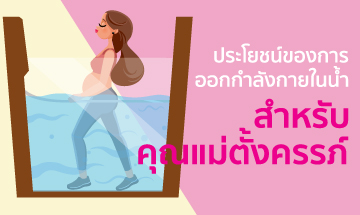

Currently, pregnant mothers without contraindications for exercise are encouraged to exercise throughout their pregnancy. This is because it has been found that exercising during pregnancy is beneficial and safe. It can be started by those who have never exercised before or those who exercise regularly. Exercising not only directly benefits the mother’s health but also helps reduce or prevent various risks, both short-term and long-term, that may occur during pregnancy.
Benefits of exercise for pregnant mothers include:
- Helps prevent excessive weight gain during pregnancy
- Helps prevent gestational diabetes
- Helps reduce the risk of high blood pressure during pregnancy
- Helps reduce back pain
- Helps reduce the risk of urinary incontinence
- Helps prevent depression or improve stress symptoms
- Helps maintain physical fitness
- Helps prevent prolonged recovery and postpartum care
- Helps reduce the risk of cesarean delivery
Recommended exercises for pregnant mothers
Pregnant mothers are advised to exercise regularly at a moderate level, starting initially with 15 minutes/day, less than 3 days/week. Gradually increase until reaching approximately 20-30 minutes/day, 3-5 days/week (approximately 150 minutes/week in total), equivalent to the promotion of health in the general adult population. Those who have not or rarely exercised before should start at a light intensity level first.
Recommended exercise forms include low-impact aerobic activities such as walking, swimming, hydrotherapy, stationary cycling, aerobic dancing, aquatic treadmill exercise, and simple yoga stretches for pregnant women. If resistance training is desired, such as weightlifting, dumbbells, or jogging, it should be performed by someone who has regularly done such exercises and under the consultation of a physician or supervisor. Additionally, exercises to strengthen the pelvic floor and surrounding muscles should also be included to help reduce the risk of urinary incontinence.
Exercises not suitable for pregnant mothers
Exercises at a high intensity or with high impact, such as boxing, basketball, soccer, certain specific or extreme sports like deep diving, cliff jumping, and exercising in very hot environments such as hot yoga or hot tubs, should be avoided. These can cause the mother’s body temperature to rise too high and may affect fetal growth.
Appropriate gestational age for exercising
Pregnant mothers may exercise continuously throughout pregnancy, from the first trimester until the third trimester when nearing delivery if there are no exercise restrictions or prohibitions under medical advice. It is advised to consult with an obstetrician and rehabilitation physician first.
Contraindications for exercise in pregnant mothers
- Severe heart or lung disease
- Loose cervix
- Multiple pregnancy at risk for preterm delivery
- Vaginal bleeding during the second or third trimester or any unexplained vaginal bleeding
- Placenta previa after 26 weeks of pregnancy
- Ruptured amniotic sac
- Pre-eclampsia or pregnancy-induced hypertension
- Severe anemia
- Intrauterine growth restriction
- Type 1 diabetes, uncontrolled hypertension, or severe and uncontrolled thyroid disease
Benefits of water exercise for pregnant mothers
Water exercise for pregnant mothers takes advantage of the unique properties of water, including buoyancy, resistance, water pressure, and water conductivity, which benefit exercise.
Buoyancy of water supports the body, reduces joint impact, lowers joint stress, and increases freedom of movement.
Water resistance depends on the direction, speed, and nature of movement in water, enhancing the safety and effectiveness of strength-building exercises.
Water pressure depends on how much of the body is submerged, with increased blood circulation in submerged areas, reduced swelling in extremities, and adaptive heart rate, blood pressure, and body temperature during exercise being less elevated compared to land exercise.
Thermal conductivity of water is related to suitable water temperature, which should be room temperature, approximately 28-33 degrees Celsius, safe for pregnant mothers to avoid overheating and affecting fetal temperatures. The appropriate temperature also aids relaxation and reduces fatigue-related symptoms such as back pain, pelvic pain, and muscle ache.
Research shows pregnant mothers participating in water exercise programs for 1 hour, 3 times a week, for 6 weeks, experience reduced discomfort or distress, improved mobility, better body image, and enhanced health-promoting behaviors compared to a control group that doesn’t exercise.
Before starting exercise, advice or consultation should be sought from an obstetrician and rehabilitation physician to evaluate any contraindications or precautions for exercise.
Contraindications for water exercise
- Unstable heart disease
- Infections that may spread through water, such as skin infections or open wounds
- Inability to hold back stool/urine
- Severe epilepsy
- Patients with suicidal thoughts
What is a private aquatic treadmill exercise machine?
In addition to traditional water exercise in swimming pools, modern technology now includes personal aquatic treadmill exercise.
Private aquatic treadmill exercise involves low-impact aerobic exercises, walking and moving in water with appropriate temperature adjustments, enclosed in a safety glass capsule with water current generators. The treadmill allows for adjusting the pace of walking or movement more easily and naturally even in limited spaces.
Initially, the patient enters the capsule, which is then filled with water at the desired level. When the treadmill and water current generator are activated, clean, sterilized water is used and drained immediately after use. Video cameras monitor movement in desired positions during exercise, with close supervision by physiotherapists for enhanced safety. Prior to exercising, there should be no abnormalities or contraindications, or exercise recommendations must be obtained from a physician.
Dr. Sineenart Phonphromrachakorn Rehabilitation Physician Rehabilitation Department | Bangkok Hospital Chiang Mai Tel. 052 089 780 or 1719 References 1. Perales M, Artal R, Lucia A. Exercise during pregnancy. JAMA. 2017;317:1113-4. 2. American College of Sports Medicine. ACSM’s Guidelines for Exercise Testing and Prescription. 10th ed. Philadelphia: Lippincott Williams & Wilkins, 2018. 3. ACOG Committee Opinion No. 650: Physical activity and exercise during pregnancy and the postpartum period. Obstet Gynecol. 2015;126:e135-42. 4. Mottola MF, Davenport MH, Ruchat SM, et al. 2019 Canadian guideline for physical activity throughout pregnancy. Br J Sports Med. 2018;52:1339-46. 5. Cameron MH. Physical agents in rehabilitation from research to practice. 4th ed. Missouri: Elsevier Saunders; 2013. 6. Smith SA, Michel A Y. A Pilot Study on the effects of aquatic exercises on discomforts of pregnancy. J Obstet Gynecol Neonatal Nurs. 2006;315-323.