


What is ECMO?
ECMO stands for Extracorporeal Membrane Oxygenation. You will also hear the term ECLS or Extracorporeal Life Support. ECMO is a special procedure that takes over the work of the heart and/or lungs when they are too sick to properly support the body. ECMO allows the heart and/or lungs time to rest and heal. ECMO does not cure these organs, but allows them time to rest.
ECMO is very similar to the machine used for open heart operations. While those patients are on the machine for only hours, ECMO patients can be on from days to weeks.

What is the goal of ECMO?
By taking over the work of the “sick” organ – heart or lungs, ECMO provides time for these organs to rest and heal. ECMO does not heal the organs. It only allows the time for them to rest. ECMO will be used only after all other medical measures have been attempted. When the heart and/or lungs have healed then the patient will be taken off of ECMO. This can takes days to weeks in the adult patient.
How does ECMO work?
Cannulas are placed in the artery or vein of the patient neck, neck and groin, or just the groin. They can be placed surgically, or they can be placed percutaneously. This means that they are placed like an IV. The ECMO physician will determine which method is required. These cannulas allow blood to be removed from the patient and move through the ECMO circuit where it has oxygen added and carbon dioxide removed. It is then warmed and returned to the patient through the second cannulas. At this time all adult patients on ECMO require 2 ECMO cannulas to be placed.
Types of ECMO
An ECMO circuit can be set up in three ways:
- Veno-arterial ECMO (VA-ECMO): allows gas exchange and hemodynamic support while blood is pumped from the venous to the arterial side. This system supports heart and lung like the system used in the operating room for heart operations.
- Veno-venous (VV-ECMO): facilitates gas exchange. Blood is removed from the venous side and then pumped back into it. This system supports lung only.
- Arterio-venous ECMO (AV-ECMO): facilitates gas exchange by using the patient’s own arterial pressure to pump the blood from the arterial to the venous side.
The circuit setup for VA or VV is almost identical. Blood movement is facilitated by an external pump that then pushes the blood through a membrane allowing gas exchange (oxygenation and CO2 removal), before returning the blood to the patient’s circulation via a warmer.
Due to its configuration, VA-ECMO bypasses the patient’s heart and lung and part or all of the blood flow is diverted through the ECMO circuit. In contrast, VV-ECMO returns the blood before it enters the pulmonary circulation.
When a pumpless circuit is used (AV-ECMO), blood flows from the femoral artery through a membrane and is passively returned into the femoral vein, the whole process dependent on the patient’s cardiac output.
The ECMO physician will decide at the time of cannulation which method is best.
Clinical indications for ECMO support
VA-ECMO is indicated in patients with refractory cardiogenic shock who have an underlying potentially reversible heart condition, although it can also be used as a bridge to a ventricular assist device (VAD) or cardiac transplantation. VA-ECMO can also be used as a salvage technique during cardiac arrest, and the current data support its use after 10 min of adequate but unsuccessful Advanced Life Support (ALS).
In-hospital survival rate of patients with VA-ECMO varies from 30% to 50% according to the cause of the cardiac dysfunction. VA-ECMO can be considered in patients with systolic arterial pressure lower than 85 mm Hg, cardiac index lower than 1.2 liter min/m2, despite adequate preload, more than two inotropes in use, intra-aortic balloon counterpulsation (IABP), and systemic signs of low cardiac output.
The paucity of data in the literature makes it difficult to determine which patients will benefit from.
It is strongly recommended to discuss all possible cases with the experienced ECMO center.
| VA-ECMO | VV-ECMO |
| Clinical | |
| Weaning from cardiopulmonary bypass after cardiac surgery | Any potentially reversible acute respiratory failure |
| Bridge to left ventricular assist device (LVAD), cardiac transplantation | ARDS. Associated with pneumonia (viral or bacterial) |
| Acute myocarditis | Failed lung transplant graft |
| Intractable arrhythmia | Trauma (pulmonary contusion) |
| Post-cardiac arrest (as part of Advance Life Support) | Pulmonary embolism (if acceptable cardiac function) |
| Local anesthetic toxicity | Pulmonary hypertension (after pulmonary endarterectomy) |
With current technology and proven and unproven benefit, ECMO should be considered when other standard therapies fail.
Contraindications
Patients with irreversible organ damage, multi-organ failure will usually not benefit from ECMO support. ECMO is not generally recommended in patients who cannot be anticoagulated, but this is not an absolute contraindication. Severe aortic regurgitation or aortic dissections are contraindications for VA-ECMO.
ECMO therapy is continuously evolving and it is preferable to involve an ECMO specialist in discussing indications and contraindications in each instance.
Complications
- Hemorrhage: Most patients require continuous anticoagulation and more than 50% of them will suffer at least one hemorrhagic complication. Half of these relate to the cannulation site particularly the arterial cannula. Other important bleeding is the intracranial hemorrhage.
- Thromboembolism during ECMO is multifactorial. Thrombus in the circuit can affect the function of the pump or the oxygenator. In VA-ECMO, it can lead to stroke or leg ischemia. ECMO management includes close coagulation monitoring, ensuring the best possible balance in coagulation homeostasis.
- Infective complications can be related to the indwelling lines, access sites, or primary pathology. Strict aseptic handling of lines is required.
- ECMO circuit failure or breakage may lead to catastrophic failure, but this is unusual as long as all components are secure.
- Cannula displacement or malposition is a major issue as this affects blood flow and ECMO efficiency. There should be trained bedside staff to check the circuit integrity regularly to prevent problems and to react promptly in the case of acute failure.
Organ systems require monitoring and management properly
- Pulmonary System
- Cardiovascular System
- CNS
- Renal System
- Hematologic
- Infection Control
- Fluids, Electrolytes, and Nutrition
Where should ECMO be provided?
- A multidisciplinary team heading by specialized cardiothoracic and vascular surgical services. Well trained staff is required.
- There is criteria for ECMO management, including indications and contraindications. ·
- Appropriate transportation system.
Bangkok Heart Hospital experience with ECMO
- In the past 2 years, we have used ECMO in 5 cases, consist of 1 child and 4 adults. There are 2 cardiac failure and 3 respiratory failure.
- Length of ECMO time is 6 – 20 days (mean 11.8 days).
- Overall survival rate is 40% (2/5). Two cases with cardiac failure survived.
| Sex | Age | Diagnosis | Type | Duration (day) |
| male | 64 | Severe COPD, lung fibrosis | VV | 13 |
| male | 4 | Acute myocarditis | VA | 6 |
| female | 26 | Acute myocarditis | VA | 11 |
| male | 57 | Pulmonary complication from lung cancer | VV | 20 |
| male | 38 | H1N1 pneumonia | VV | 9 |
VA = Veno-arterial ECMO; VV = Veno-venous ECMO
Transportation to Bangkok Heart Hospital
- There should be a good communication and discussion between Bangkok Heart Hospital ECMO team and referral hospital team (should include patient and family).
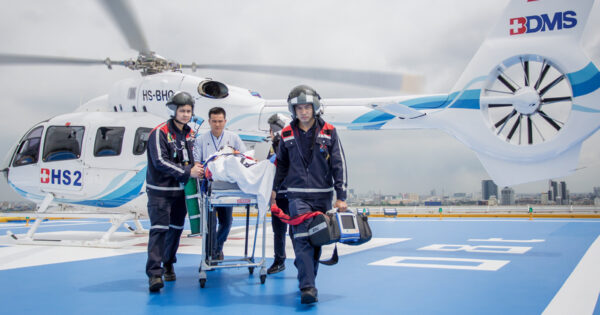
- Patient may be transported with or without ECMO depend on stability of the patient. If the patient is too unstable to be transported with just the ventilator then we will prepare to place a portable ECMO and transport back to Bangkok Heart Hospital.
- Transportation team