

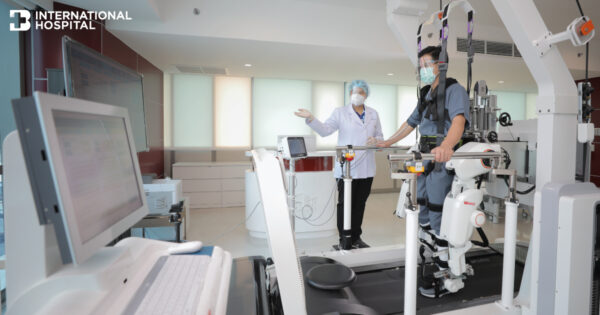
For patients who are unable to walk due to neurological disorder or are recovering from a surgery, WALKBOT – a robotic assisted gait training of a treadmill – is designed to restore their walking abilities or negate their impairment for more accessibility in their daily life. It will help improve their pace, endurance and gait quality, as well as their respiratory and cardiovascular systems. Together with the traditional method, this is suitable for rehabilitating patients; and will help improve the patients’ quality of life.
What is WALKBOT?
Walkbot, or Robotic Assisted Gait Training, is a treadmill-based robotic equipment with body weight support for gait and balance, to help patients who have walking disability from neurological, muscle or bone disorders so that they will be able to walk again. Each patient’s basic movements along with physical attributes are recorded by the system as reference before the Walkbot is attached, such that the length of the robot’s legs can be adjusted accordingly. During every session, the patient must wear a safety harness that has a counter-balance system to support the patient’s weight while taking steps. The robot will stop immediately when it detects a pulling force, tugging, or greater than acceptable resistance. If there is any problem, the patient or the therapist can abort the training directly by means of the emergency.
Who are suitable for WALKBOT?
Walkbot is suitable for patients who are sufferring from the following conditions:
- Stroke
- Parkinson’s disease
- Spinal cord injury
- Multiple sclerosis
- Cerebral palsy
Walkbot also works well for patients with brain injuries, prosthetic joint relacement, weak muscles, degenerative joint disease, or those who have undergone joint surgery, etc. However, patients must be evaluated by a physiatrist before treatment can commence.
Preparation for WALKBOT treatment
Each session of Walkbot treatment takes about 30-45 minutes depending on the patient’s ability. For each session, the following preparations are recommended:
- Wear suitable clothing – not too loose nor tight – so that it will not interfere with body movements.
- Articles of clothing for the training should include ankle-height walking shoes, long socks and trousers.
- Rest sufficiently prior to every session.
- A session should commence no sooner than 30 minutes after a meal.
- Food is prohibited during a session.
- Inform the therapist immediately if you have an unusual symptom – such as extreme fatigue, nausea, light-headedness, heart palpitation, chest pain, etc.
Disadvantages of WALKBOT
Walkbot does not work with patients who are on ventilator, recently had muscle contraction treatment, have degenerative joint disease, have a hip wound and require attached walking assistive devices, have blood circulatory problems, have irregular heartbeats, have been on continuous intravenous infusion for extended periods, suffer from severe cognitive disorders and become uncooperative or resistive, have bone or bone marrow diseases, have severe peripheral artery disease; and patients who cannot be moved due to abscess in the bone, burn injury or infected wounds; as well as those who have undergone hip, knee or ankle surgeries.
Precautions about WALKBOT
Side effects from the use of Walkbot include abrasion, reddish marks or bruising around the areas where the harness is attached, etc.
Hospital with WALKBOT-Ready Treatment
Bone X Brain Hospital is equipped with Walkbot technology to help treat our patients, by stimulating and restoring their muscles performance along with their neurological system; to reassure our patients’ confidence as they resume their daily routine more quickly. Our team of specialists, nurses, physical therapists and multidisciplinary professionals is always on hand to care for our patients closely.