
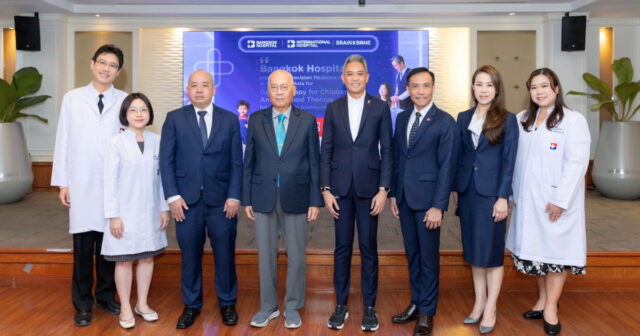
Bangkok Hospital Headquarters and Bangkok International Hospital reaffirm their position as regional leaders in advanced medicine and breakthrough therapeutics, delivering precision-driven care that transforms patient’s lives. As pioneers in Southeast Asia, both hospitals have introduced Gene Therapy – a groundbreaking innovation to treat children with fatal genetic condition, called Spinal Muscular Atrophy (SMA) and Anti-Amyloid Therapy, an advanced treatment for early-stage Alzheimer’s disease. These medical advancements go beyond symptom control, focusing on preserving patient’s independence and improving quality of life.
Hope unlocked with GENE THERAPY – A novel treatment for spinal muscular atrophy (SMA) in children
Dr. Thianchai Bunnalai, Assistant Hospital Director of Wattanosoth Cancer Hospital and Medical Administrative Assistant, Child’s Health Center, Bangkok Hospital Headquarters, stated: “Spinal muscular atrophy or SMA in children represents a group of rare, severe genetic neuromuscular disorder, causing certain muscles throughout the body to become weak and shrink (atrophy). SMA involves the loss of a specific type of nerve cells in the spinal cord due to a faulty or missing gene, known as “survival of motor neuron 1 or SMN1”. Without these nerve cells, muscles do not receive the nerve signals that allow them to move. Besides impaired physical movement, swallowing and breathing ability, SMA drastically affects a child’s growth and development. Tests to diagnose SMA involve electromyography (EMG) and nerve conduction studies as well as genetic testing to identify mutations of SMN1 gene. Infants born with SMA often face significant mortality risks within the first two years of life. Early intervention, ideally before symptoms appear or around six weeks of age, is therefore critically important. While there is not a cure for SMA, conventional treatment strategies using disease-modifying therapy and symptomatic treatments, e.g. ventilation assistance, physical therapy and rehabilitation are carefully tailored according to disease severity and the child’s age to optimize outcomes.”
Due to medical advancements in bioengineering and genomic medicines, gene therapy has emerged as a novel approach to treat SMA in children aiming at replacing the defective SMN1 gene using a modified virus vector to deliver a functional SMN1 gene to lower motor neurons, addressing the root cause of SMA. To achieve the best possible treatment outcome, a single-dose intravenous infusion of gene therapy is recommended in newborn diagnosed with SMA from after birth until 24 months of age. Early treatment of gene therapy results in significant improvement of motor function, increasing survival rates and reducing the need for permanent ventilation and nutritional support. Gene therapy has been approved for treating SMA by US FDA in 2019 and by Thai FDA in 2023.
Given that SMA is a genetic condition, it cannot be directly prevented once inherited. SMA screening strategies focus on genetic carrier screening for prospective parents, prenatal testing during pregnancy and using IVF with preimplantation genetic testing to ensure embryos do not carry the disease. More importantly, newborn screening remains vital, aiming to identify SMA in infants shortly after birth, typically within the first few days of life, in order to initiate life-altering, pre-symptomatic treatment planning. Our pediatrician and multidisciplinary teams at Child’s Health Center, Bangkok Hospital are highly experienced in managing genetic neuromuscular disorders in children of all ages, including SMA. Our center is fully equipped with cutting-edge technology and facilities in pediatric care, ensuring appropriate treatment and care best suited to each child and family.
Your memories are invaluable – Anti-Amyloid Therapy for Early-Stage Alzheimer’s Disease
Dr. Chaisak Dumrikarnlert, neurologist specializing in memory disorders and Alzheimer’s disease at the Neuroscience Center, Bangkok International Hospital, explained: “Alzheimer’s disease profoundly affects daily living. In advanced stages, patients may experience severe cognitive decline, particularly memory loss, resulting in complete dependence and the need for continuous supervision. Referring to disease mechanism, beta-amyloid protein start to accumulate before symptoms onset 10-15 years then amyloid can trigger accumulation of tau tangle, second abnormal protein in Alzheimer’s disease, and neurodegeration. Deposition of amyloid plaques along with tau tangles in neuron contributes to neuronal damage, memory loss and cognitive decline, resulting in Alzheimer’s Disease.”
Anti-amyloid therapy is an innovative antibody treatment recommended in patients with early stages of Alzheimer’s disease. By targeting the cellular level and reducing the accumulation of abnormal beta-amyloid proteins in the brain, anti-amyloid therapy can significantly slow the progression of cognitive and functional decline rather than just treating symptoms. Administered intravenously every two to four weeks, treatment plans are individualized based on specialist evaluation, offering a promising new pathway to preserve cognitive function and extend independence.
Dr. Sarinporn Manitsirikul Tipudom, specializing in memory disorders and Alzheimer’s disease at the Neuroscience Center, Bangkok International Hospital added: “We are fully prepared to care for both patients and their families, enabling them to live as normally and confidently as possible. Our multidisciplinary team approach integrates expert neurologists, specialized nurses and allied health professionals, supported by advanced diagnostic technology. We are able to detect Alzheimer’s disease at a preclinical stage through comprehensive diagnostic approaches, e.g. advanced imaging, lumbar puncture analysis, blood biomarkers for brain waste products and PET scans to detect the accumulation of beta-amyloid in the brain, facilitating precise diagnosis and proactive treatment planning.”
Considered a novel treatment for early stage Alzheimer’s disease, clinical outcomes retrieved from anti-amyloid therapy have shown measurable cognitive improvement alongside a significant reduction in beta-amyloid plaque accumulation while helping patients maintain independence, preserving daily functioning and reducing caregiver burden.
Mr. Boonsook Sunkrasmee, Chairman of TIC Group and a patient treated with anti-amyloid therapy, shared: “When I began noticing changes in my memory, I sought medical care under close supervision by the specialist team at Neuroscience Center, Bangkok International Hospital. Today, I feel my memory and concentration have considerably improved. I am happier and able to resume my professional and personal life with confidence. With timely and effective treatment, this condition can be effectively controlled.”
A Commitment to Sustainable Quality of Life
Since innovation in medicine continues to evolve, Bangkok Hospital is fully devoted to delivering precise care to patients of all ages. By integrating cutting-edge therapeutics with highly specialized multidisciplinary expertise, both hospitals remain steadfast in their mission to elevate standards of care for children with SMA and adults with early stage Alzheimer’s disease. Our unwavering dedication ensures that patients not only receive advanced treatment but also achieve the highest possible degree of independence with an enhanced quality of life.