


Many people may not know that kidney stones can be found in people of all sexes and all ages. In particular, men are more likely to have them than women, and the most commonly affected age range is 30–40 years. If left untreated for a long time, frequent infections may occur, leading to kidney tissue damage, decreased kidney function, and chronic kidney failure in the future. Therefore, they should be treated promptly before becoming severe.
Understanding Kidney Stones
Kidney stones are caused by the accumulation of various hard minerals that form solid stones of different types and sizes. They are commonly found in the kidney’s renal pelvis and the urinary tract. They result from highly concentrated urine that precipitates into stones, and kidney stones can recur.
Causes of Kidney Stones
The formation of kidney stones is associated with abnormally high calcium in the urine due to various factors, including:
- Consuming excessive amounts of calcium, protein, salt, and sugar
- Drinking too little water
- Adding too much sugar to beverages
- Eating foods high in oxalate that inhibit calcium absorption, such as nuts, bamboo shoots, chocolate, spinach, sweet potatoes, etc.
- Taking more than 1,000-2,000 milligrams of vitamin C per day
- Overactive parathyroid glands
- Complications from gout
- Chronic inflammatory bowel disease
- Obesity/being overweight
- Diabetes
Signs and Symptoms
Symptoms that may indicate kidney stones include:
- Flank pain on the side with the stone
- Back pain or lower abdominal pain on one side
- Intermittent colicky pain/cramping pain
- Fever and chills
- Nausea and vomiting
- Cloudy, reddish urine
- Sand-like particles in the urine
- Painful urination
- Frequent urination
- Low urine output
- Inability to urinate
- Severe abdominal cramping pain if the stone drops into the ureter
*Some patients may have no symptoms.
People with stones may have no symptoms, especially small stones located in the kidney that do not obstruct the urinary tract. However, they should consult a doctor to plan follow-up, because stones may grow, move, cause obstruction, or become infected in the future.
Symptoms that may occur when a stone causes obstruction or irritation include:
- Flank or side pain, which may be intermittent and crampy and may radiate to the lower abdomen if ureteral obstruction occurs
- Blood in the urine; pink, red, or brown urine
- Burning/painful urination, inability to urinate
- Sand-like particles or stone fragments in the urine
- Nausea and vomiting
- Cloudy urine or unusual odor, especially if there is an infection
- Fever or chills, which requires urgent medical attention; do not wait and observe symptoms on your own
Diagnosis of Kidney Stones
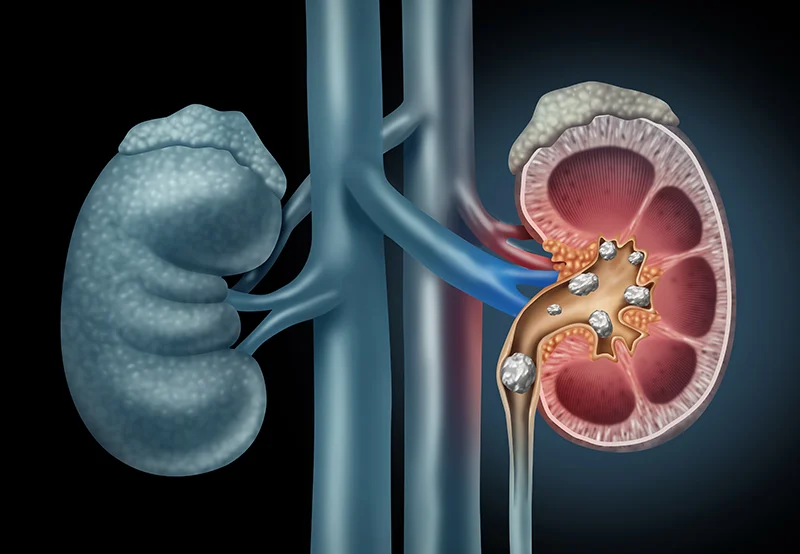
Diagnosis of kidney stones should be primarily evaluated by a specialist physician. There are several methods, including:
- Urinalysis If a large number of red blood cells is found, the doctor may suspect kidney stones.
- Blood test Patients with kidney stones often have excessively high levels of calcium or uric acid in the blood.
- Abdominal X-ray Helps the doctor see stones in the urinary tract.
- Kidney ultrasound Helps detect kidney stones and can identify kidney swelling or obstruction.
- Computed tomography (CT Scan / non-contrast CT) Helps the doctor confirm the location, size, number, and density of stones, and assess obstruction when appropriate.
*Additional diagnostic tests should be performed according to the doctor’s recommendations.
Treatment of Kidney Stones
Most kidney stone treatments are based on the type and cause, including:
- Non-surgical treatment or monitoring If the stone is very small, it may pass on its own by drinking plenty of water to flush it out through urine. The doctor may consider prescribing medication to help pass the stone as appropriate, and will schedule follow-up for symptoms and imaging at intervals.
- Shock wave lithotripsy (Extracorporeal Shock Wave Lithotripsy : ESWL) This breaks up stones no larger than 2 centimeters using high-frequency sound waves, causing the stone to fragment and be passed through urine. The patient may experience mild pain and other side effects, so it should be performed closely by an experienced specialist physician.
The success rate depends on the stone’s location, size, hardness, body habitus, and obstruction. Some people may need more than one session or additional procedures. - Endoscopic treatment for kidney stones (Retrograde Intrarenal Surgery : RIRS, Flexible Ureterorenoscopy(URS))
The doctor inserts a small scope through the urethra, bladder, and ureter up into the kidney, then uses a laser to break up the stone and remove fragments. There is no surgical incision and it is suitable for many cases of kidney stones, especially when SWL is not appropriate or when the patient wants a higher chance of stone clearance in a single session. Limitations include the need for general anesthesia or sedation, and a temporary ureteral stent may be required after the procedure (Double-J stent). - Surgical treatment (PercutaneousNephrolithotomy : PCNL / mini-PCNL) Suitable as an option when kidney stones are large, other treatments are ineffective, or the stones are complex, such as large branching stones (Staghorn stone). The advantage is that a large stone burden can be removed in a single session. The doctor makes a small puncture in the back into the kidney, uses a scope and stone-fragmenting instruments, and then removes the stone fragments.
Preventing Kidney Stones
- Drink plenty of water to reduce the chance of stone precipitation
- Consume adequate calcium from natural foods
- Avoid salty foods; reduce salt in meals
- Control intake of meat, milk, and butter
- Drink water regularly: Aim for a total urine output over 24 hours of more than 2.5 liters, primarily plain water (if you have heart disease, kidney disease, or your doctor has restricted fluids, ask what amount is appropriate for you first)
- Reduce salt: Limit total table salt/sodium chloride to no more than about 4–5 grams per day, and be cautious with processed foods, stock cubes, pickled/fermented foods, and seasonings
- Do not eliminate dietary calcium on your own:For general adults, an appropriate dietary calcium intake is about 1,000–1,200 mg/day. Avoiding calcium unnecessarily may increase oxalate absorption from the intestines– Do not consume excessive animal protein: Especially for those with high urinary uric acid or uric acid stones, reduce high-purine foods as recommended by the doctor
- Adjust oxalate intake based on test results : It is not necessary to avoid all vegetables, but if urinary oxalate is high, the doctor may recommend reducing high-oxalate foods and consuming dietary calcium with meals
- Review supplements : Always inform your doctor or pharmacist about any vitamin C, supplements, or herbs you are taking, and avoid high-dose vitamin C supplements if you have had calcium oxalate stones, unless the doctor determines they are necessary
- Control weight and underlying conditions: such as diabetes, insulin resistance, and gout
Frequently Asked Questions (FAQ) About Kidney Stones
If I have kidney stones but no symptoms at all, is it necessary to receive any treatment?
Treatment is necessary if the doctor determines there is a risk of kidney damage. Very small stones may be managed with medication along with drinking plenty of water to help them pass on their own. Larger stones require lithotripsy or surgery as recommended by the doctor.
What eating habits can trigger urine precipitation leading to kidney stones?
Drinking too little water together with eating foods high in protein, salt, and sugar, as well as foods high in oxalate such as bamboo shoots, chocolate, spinach, and taking more than 1,000-2,000 milligrams of vitamin C per day.
What type of pain indicates that a stone has moved down and obstructed the ureter?
Patients will have severe cramping abdominal pain, colicky pain, and intermittent pain in the back or lower abdomen on one side, along with cloudy reddish urine, pain during urination, or inability to urinate.
What stone size is shock wave lithotripsy, or ESWL, suitable for, and how does it work?
It is suitable for stones no larger than 1-2 centimeters by using high-frequency sound waves delivered from outside the body to break the stone into small pieces, which then pass out with urine.
In cases where kidney stones are very large, what minimally invasive surgical options are available?
The doctor will use a method of making a small puncture in the back (PCNL) and then insert an endoscope and instruments to break the stone into small pieces before extracting the stone through the same opening by a specialist physician.