


Infertility is a common medical problem affecting a large number of couples worldwide. Due to modern medical advancements, several infertility treatments are currently available. These often refer to in vitro fertilization (IVF) and intracytoplasmic sperm injection (ICSI) – a specialized form of IVF. IVF and ICSI have gained increasing popularity since the success rates are considerably high. However, the most commonly asked questions are whether these procedures can give a 100 percent chance for pregnancy at the first time and the conceived embryo will be completely grown to be a healthy baby. Aiming at increased chance of pregnancy, the processes of assisted fertilization techniques are different. It is important to understand the basic knowledge of an ovulation process and fertilization process as well as pregnancy and delivery. The most appropriate technique for each couple will be discussed by the fertility specialist based on the particular couple’s conditions and relevant infertile problems. For those exploring options like ICSI in Thailand, modern fertility centers offer comprehensive care to guide you through every step of this journey.
Ovulation
Ovulation is the monthly release of an egg from one of a woman’s ovaries. After the egg is released, it travels down the fallopian tube, where fertilization by a sperm cell may occur. Sperm and eggs are sex cells. Meiosis is the process in which sex cells divide and create new sex cells with half the number of chromosomes, reducing from 46 to 23 cells. However, there is a chance that chromosomes might not divide into half during the natural process. During the IVF process, the eggs in a particular cycle will be stimulated by ovulation stimulating medications to reach the maximum number, for instance, 10-15 stimulated eggs per one cycle. Medications used to induce ovulation act exactly the same as natural hormones released from the body. Therefore, chromosomes in the stimulated eggs are similar to those derived from natural processes. Not every single egg is completely healthy. However, the advantage from the egg stimulation process is to quickly obtain 10 mature eggs within a month, rather than 10 months required for natural process.
Fertilization
The fertilization process is the union of an egg and sperm, usually occurring in the ampulla of the fallopian tube. After an egg is fertilized, it results in the production of a zygote cell, initiating prenatal development. However, problems generated from both eggs and sperms can largely prohibit the fertilization process that is assumed to naturally happen.
In vitro fertilization is a process of external fertilization where an egg is combined with sperm outside the body, in vitro. This procedure allows the fertilization to be monitored whether the selected eggs are healthy and able to be conceived. Some eggs might not be able to be fertilized or to continue growing due to slow cell division rates. After the eggs are retrieved from a woman’s ovaries and are fertilized with sperm, embryos are created. Embryos are then grown under very strictly controlled conditions. Five days after fertilization, embryos turn to be blastocysts. Only healthy blastocysts are selected to be transferred to the uterus for implantation into the uterine wall (endometrium). The remaining blastocysts which are unhealthy will be then rejected. Out of 10 eggs, only 3-4 healthy blastocysts might remain. Since a blastocyst transfer involving transferring one or more embryos that are at a very advanced stage of development, the chance of getting pregnant is considerably higher than other reproductive techniques such as IUI – intrauterine insemination which involves sperm placed inside the uterus when only 1 or 2 eggs are readily ovulated.
Get to know IVF and ICSI
In vitro fertilization can be mainly divided into 2 techniques:
1) IVF (In Vitro Fertilization)
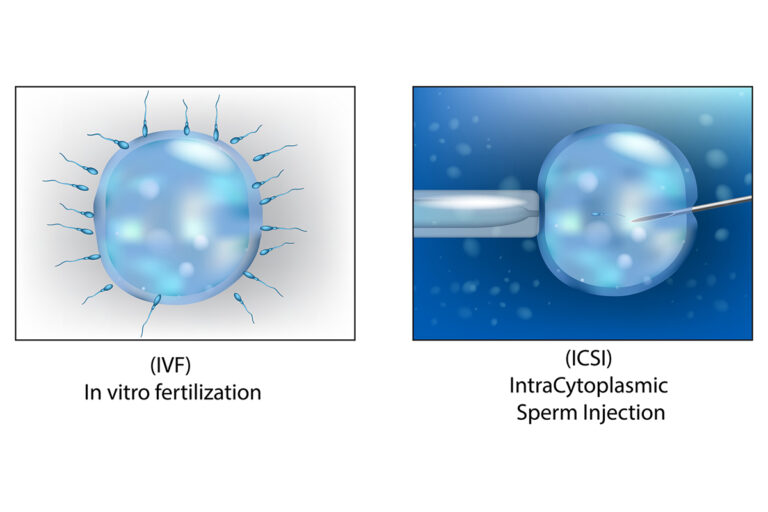
During IVF, mature eggs are collected (retrieved) from ovaries. Collected eggs are then fertilized by selected sperms outside the body, known as in vitro. The strongest sperm will penetrate the egg membrane, allowing for the fertilization process. Then the fertilized egg (embryo) or eggs (embryos) are transferred to a uterus, enabling prenatal development. During this procedure, the fertilization process happens naturally, similar to the natural mechanism occurring in the fallopian tube.
IVF involves several steps, including ovarian stimulation, egg retrieval, sperm retrieval, fertilization and embryo transfer. One cycle of IVF takes about two to three weeks. More than one cycle may be required in some cases. Physical examination and certain tests will be conducted to ensure optimal health conditions prior to treatment. Ovulation induction usually begins on the 2nd or 3rd day of the period. Medications for ovarian stimulation will be administered consecutively for 8-14 days via subcutaneous injection in the abdomen. When reaching the desired number of the eggs, medications to help the eggs mature will be additionally given and the appointment day for egg retrieval can be made. For men, sperm retrieval will be subsequently conducted. During fertilization, healthy sperms and mature eggs are conceived under highly strictly controlled conditions. After fertilization, embryos are then formed and grown in culture media that are developed to mimic the composition of oviduct and uterine fluids to maximize cell growth. After embryo selection, embryo transfer is conducted 3 to 5 days after egg retrieval. After embryo transfer for 10 days, an appointment will be made for follow-up to determine whether pregnancy is successful through checking pregnancy hormone in the blood.
2) ICSI (Intracytoplasmic Sperm Injection)
In some men, their sperm might have poor sperm motility (movement) or morphology (shape), resulting in inability to fuse and penetrate through the membrane of the egg. This has led to a novel technique, called ICSI. In ICSI, a single healthy sperm is injected directly into each mature egg. Egg stimulation and egg retrieval processes are similar to those performed in IVF. However, the different part is the fertilization process. In IVF, multiple sperms are mixed with eggs in the culture media dish. When the strongest sperm can get into the egg, the fertilization process happens naturally. In ICSI, a tiny needle, called a micropipette, is used to directly inject the healthiest sperm into the center of the egg, allowing for the fertilization process. In some couples, 10 eggs might be retrieved after the egg stimulation process. After the fertilization process using IVF technique, 1 or 2 embryos might be formed or even none. On the contrary, 7-9 embryos can be obtained if ICSI technique is deployed.
The most important indicator of ICSI success appears to be the fertilization rate which largely depends on sperm selection. Certain criteria including sperm shape and movement rates are used to select healthy sperms. A sperm cell consists of a flat, disc shaped head and a tail. The size of the sperm head is only 7 microns. It is impossible to visualize chromosomes contained in sperm and eggs while injecting selected sperm directly to a mature egg. Thus, ICSI does not aim at producing completely healthy embryos. Instead, its purpose is to maximize the chance of fertilization by yielding the highest number of embryos that need to be further selected for the best ones used for embryo transfer.
In ICSI, the egg stimulation process begins on the 2nd of the period. Medication for egg stimulation will be continuously injected for 8-14 days. When stimulated eggs are ready, medication for ovulation will be then administered. Ultrasound through vagina is performed to evaluate the size and amount of the eggs. Hormonal drugs will be further injected for egg maturation. Transvaginal ultrasound aspiration is the usual retrieval method. An ultrasound probe is inserted into your vagina to identify follicles. Then a thin needle is inserted into an ultrasound guide to go through the vagina and into the follicles to retrieve the eggs. The eggs are removed from the follicles through a needle connected to a suction device. Retrieved sperms and eggs will be brought to the specialized laboratory for the fertilization process. At the same time, hormonal medication used to prepare the lining of the uterus for embryo implantation will be administered. After the selected embryos are grown to a certain phase, embryo transfer via vagina will be then conducted.
Instructions prior to egg retrieval
- Stress and anxiety should be avoided. To fully relax, it is recommended to conduct pleasant activities that help to mitigate worry.
- Strenuous activities or exercise e.g. running and jumping requiring great exertion are prohibited since these high-impact exercises might potentially cause ovarian torsion. When undergoing IVF treatment, the ovaries become enlarged. With the impact of strenuous exercises, it is possible that the enlarged ovaries might become twisted and complicate the IVF treatment process.
- Food and fluid restrictions must be applied 6 hours before egg retrieval.
- Any underlying disease must be informed to the specialist.
- During egg retrieval, the patient is sedated and anesthetized. Sedation usually causes drowsiness and an uncomfortable feeling. Due to these side effects, the patient is not allowed to drive or take any form of public transportation back home by herself. Husband or relative should take care of the patient.
- Valuable belongings e.g. rings, necklaces and watches should be safely kept.
- Make-up, perfumes and nail polish must not be worn during egg retrieval since the eggs are highly sensitive to odors and colors.
- Husband should be prepared for sperm retrieval on the same day. It is highly suggested to refrain from sexual intercourse 3-7 days prior to sperm retrieval.
Instructions After Egg Retrieval
- After egg retrieval, it is common to experience abdominal cramping and feelings of fullness or pressure. Mild vaginal bleeding might develop within 24 hours after the procedure. Abnormal signs or symptoms must be closely observed. Painkiller drugs should be taken every 4-6 hours as directed. After egg retrieval, abdominal cramping should be alleviated within 2-3 days. In women with several eggs, their ovaries are enlarged. In such a case, they need to take sufficient rest and avoid strenuous activities 2-3 days after egg retrieval in order to reduce the size of the enlarged ovaries. Resting can largely help to minimize the abdominal pain after egg retrieval.
- If an abnormal sign or symptom arises, immediate medical assistance from the specialist at the fertility center must be sought. Taking drugs obtained from the pharmacy store is not recommended. Appropriate and timely treatment should continue by your fertility specialist.
- If any drug-related problem is suspected, medical attention must be provided by a fertility specialist.
- A day after egg retrieval, medical staff from the Fertility Center will keep you informed about the process. In case that more information about fertilization and embryo is required, please kindly contact the Fertility Center.
- Telephone numbers must be given in case of emergency.
- Appointments will be made as scheduled. For more information, please contact the Fertility Center.
Fertility Center at Bangkok Hospital
Fulfilling the dream of a complete family requires expertise, advanced technology, and compassionate care. Bangkok Hospital is a destination for those seeking infertility treatments in Thailand, offering specialized care for couples who have tried to conceive for over a year without success. Our Fertility Center provides comprehensive diagnostics and advanced solutions, including ICSI. We also utilize Preimplantation Genetic Testing for Aneuploidy (PGT-A) to screen embryos for chromosomal abnormalities, increasing pregnancy chances while minimizing miscarriage risks.
Frequently Asked Questions
1. When is a couple considered to be experiencing infertility, and what are the common causes?
If a couple has had regular, unprotected intercourse for 12 months without conceiving (or 6 months if the woman is 35 or older), they are considered to have infertility. Common causes include ovulation disorders, blocked fallopian tubes, uterine problems, declining egg quality with age, and male factors such as low sperm count or poor sperm quality. In some cases, no clear cause is found.
2. What is the fundamental difference between standard IVF and ICSI?
The key difference is how fertilization happens. In standard IVF, eggs are placed with many sperm in a lab dish and fertilization occurs naturally. In ICSI, an embryologist selects a single sperm based on its shape and movement and injects it directly into the egg using a micro- needle.
3. When is ICSI recommended over traditional IVF?
ICSI is commonly recommended for male infertility, such as low sperm count, poor sperm movement or abnormal sperm shape, or when there is no sperm in the semen but sperm can be retrieved directly from the testes. It may also be used when previous IVF cycles resulted in poor fertilization, when using frozen eggs, or when embryos will undergo genetic testing.
4. What options are available for individuals or couples who wish to delay starting a family?
Fertility naturally declines with age, and pregnancies later in life carry higher risks of miscarriage and chromosomal abnormalities. Egg, sperm or embryo freezing allows patients to preserve their reproductive cells for future use. Freezing at a younger age generally offers better chances of success, although it cannot guarantee a future pregnancy.
5. Can the clinic provide treatment if a woman has underlying reproductive issues like cysts or endometriosis?
Yes. For women experiencing issues such as ovarian cysts, endometriosis, chocolate cysts, or pelvic adhesions, a dedicated team of OB/GYN surgeons provides specialized treatment. These conditions are typically addressed using minimally invasive surgical techniques, including laparoscopic or robotic-assisted procedures, prior to fertility treatments.
Yes. Conditions such as ovarian cysts, endometriosis (including chocolate cysts, or endometriomas) and pelvic adhesions can be evaluated and treated by our OB/GYN specialists. When surgery is needed, minimally invasive surgery options may be used, and the treatment plan is tailored to each patient’s fertility goals.
Ref: