


Difficulty having a baby is one of the issues that troubles many couples, because no matter how hard they try, they still do not succeed. There are often many factors involved. Therefore, understanding infertility and seeking consultation with a specialist in infertility as early as possible will help couples have a better chance of achieving pregnancy in the future.
Natural conception
For natural conception, the first step is that the ovaries must ovulate (Ovulation). When an egg is released from the ovary, it travels into the fallopian tube on the same side as that ovary. Fertilization occurs in this fallopian tube, and sperm must travel through the vagina into the uterus and then to the fallopian tube to meet and fertilize the egg. After fertilization, the fertilized egg (embryo) travels from the fallopian tube to the uterus, implants in the uterine lining, and continues developing into a baby. If a problem occurs at any step in this process, it can lead to infertility.
What is infertility?
Infertility is when a woman is unable to become pregnant after trying to conceive through regular unprotected intercourse for 1 year However, if she is 35 years or older and has regular unprotected intercourse for more than 6 months without becoming pregnant, it may be considered infertility. It is found that at least 15% of couples have difficulty becoming pregnant.
What are the symptoms of infertility?
The clearest main symptom of infertility is being unable to become pregnant within the expected time frame. However, in some women there may be underlying symptoms that can be noticed, such as:
- Irregular periods
- Excessively heavy or very light periods
- Severe menstrual cramps
- Pain during sexual intercourse
These symptoms may be warning signs of abnormalities in the reproductive system that should be evaluated and diagnosed.
What causes difficulty conceiving? Check 5 main causes of infertility
The causes of infertility are divided into 5 main causes as follows:
1. Ovulation problems (Ovulation Factor)
Found in about 25% of infertile couples. It results from abnormal ovarian function, leading to no ovulation or irregular ovulation. Common causes include polycystic ovary syndrome (PCOS), hormonal imbalances (such as thyroid or prolactin), as well as age-related factors. As a woman ages, the number and quality of eggs decrease, causing the released eggs to be less mature and not ready for fertilization.
2. Fallopian tube problems (Tubal Factor)
The fallopian tubes are like a bridge connecting the egg and sperm. If they are narrowed or blocked, fertilization cannot occur. Most causes are pelvic inflammatory disease (PID), chronic untreated sexually transmitted infections, a history of abdominal surgery causing adhesions, or hydrosalpinx, which is a major obstacle preventing natural conception.
3. Sperm problems (Male Factor)
Male-related factors are found in about 40% of infertile couples. They are often due to abnormalities in sperm production, such as low sperm count, poor sperm motility, or abnormal sperm morphology. Causes may include genetics, varicocele, or lifestyle behaviors such as smoking, drinking alcohol, and frequent exposure to heat around the testicular area.
4. Uterine and cervical problems (Uterine / Cervical Factor)
These result from an environment that is not conducive to embryo implantation, such as fibroids in the uterine cavity, polyps, adhesions, or congenital uterine shape abnormalities. In addition, cervical problems may occur, such as cervical stenosis from prior surgery for abnormal cells (LEEP), or abnormally thick cervical mucus that obstructs sperm passage.
5. Peritoneal lining problems (Peritoneal Factor)
Found in as many as 35% of women in whom no other cause is identified. The main causes are endometriosis or chocolate cysts, which cause chronic pelvic inflammation, leading to scarring and adhesions that bind reproductive organs, distort anatomy, and create an environment unsuitable for fertilization.
Unexplained infertility

Unexplained infertility is found in about 10% of couples who seek consultation for infertility, in whom evaluation of both male and female factors shows no abnormalities. In this group, doctors recommend starting treatment immediately, beginning with intrauterine insemination (Intrauterine Insemination – IUI). If IUI has been tried for a period and is still unsuccessful (about 3–6 cycles), the doctor will consider proceeding to in vitro fertilization (In Vitro Fertilization – IVF).
Investigating the causes of infertility
Data indicate that at least 25% of infertile couples often have more than one contributing factor. Therefore, it is very important for doctors to evaluate all factors from both the male and female partners to identify the causes and provide appropriate treatment.
History taking and planning tests to identify the causes of infertility
The doctor will ask about:
- Frequency and regularity of the menstrual cycle
- Menstrual pain
- History of abnormal vaginal bleeding or pelvic infection
- History of previous pregnancies and miscarriages
- Past contraception methods
- For the male partner, a history of injury or surgery involving the genital organs, or a history of sexually transmitted diseases such as gonorrhea or syphilis, may lead to abnormal sperm issues
- Information about sexual activity, such as frequency of intercourse per week, pain during intercourse, difficulty having intercourse, erectile dysfunction, and ejaculation problems—all are important because they may be factors that make natural conception more difficult
In addition to history taking and planning tests to identify the causes of infertility, the doctor will provide guidance on preparing for a healthy pregnancy in the future, including healthy eating and taking vitamins to prepare beforepregnancy. Then the doctor will proceed with in-depth diagnostic evaluation based on the various possible causes.
Assessment of ovulation problems and ovarian reserve
Ovulation assessment can be initially self-checked using a urinary LH hormone test kit, which rises about 24–36 hours before ovulation. However, this method can easily yield false negatives. Having a doctor evaluate is therefore a recommended option, using pelvic ultrasound to assess follicle size or blood tests for thyroid and prolactin (Prolactin) levels.
In addition, the doctor will assess ovarian reserve by testing blood AMH levels and performing a transvaginal ultrasound to count antral follicles (Antral Follicle Count). This is very useful for predicting the number of follicles likely to grow, estimating the chance of success with in vitro fertilization (IVF), and preventing the risk of excessive ovarian response to stimulation (OHSS).
Testing for fallopian tube abnormalities
Evaluation of fallopian tube abnormalities can be done by hysterosalpingography (Hysterosalpingogram – HSG). If suspicious findings suggest narrowing or blockage, the doctor may consider laparoscopic pelvic surgery (Laparoscopy) for assessment and correction.
For women whose results confirm blockage of both fallopian tubes, treatment must switch to in vitro fertilization (IVF). In addition, in cases where blocked tubes are accompanied by hydrosalpinx, the doctor will recommend removing the swollen tube first to optimize the environment before transferring the embryo back into the uterine cavity.
Semen testing to identify male-factor causes
Semen analysis (Semen Analysis) is an important step to evaluate sperm quality, quantity, motility, and morphology. The male partner should abstain from ejaculation for 3–7 days before the test and submit the sample to the laboratory within 1 hour. If abnormalities are found, the doctor may order blood hormone tests or perform a testicular biopsy (Testes Biopsy) in cases where no sperm are found in the semen at all. For those with varicocele, they will be referred for further evaluation by a urologist (Urologist).
Diagnosis of uterine and cervical problems
Abnormalities in the uterine cavity such as fibroids, polyps, or adhesions require pelvic ultrasound (Pelvic Ultrasound), MRI of the pelvis (MRI Pelvis), saline instillation sonohysterography (Saline Instillation Sonohysterography), or diagnostic hysteroscopy (Diagnostic Hysteroscopy). Cervical causes are commonly found in women who have had cervical surgery (LEEP), which may lead to deformity or stenosis and become a cause of infertility.
Evaluation of peritoneal lining and endometriosis
Diagnosis of endometriosis (Endometriosis) or intra-abdominal adhesions can be effectively performed via diagnostic laparoscopy (Diagnostic Laparoscopy), allowing the doctor to diagnose and treat in the same procedure. If lesions or ovarian chocolate cysts are found during laparoscopy, the doctor will perform electrocautery to destroy lesions, lyse adhesions, remove cysts, and simultaneously inject dye to assess fallopian tube blockage in the same session.
How can infertility be treated?
Today, with advances in medicine, there are various approaches to treating infertility to help increase the chances of having a baby for couples. Treatment ranges from counseling and lifestyle modification to modern assisted reproductive technologies, as follows:
- Intrauterine insemination (IUI – Intrauterine Insemination): Healthy sperm are selected and injected directly into the uterine cavity during the woman’s ovulation period to reduce the distance sperm must travel and increase the chance of fertilization.
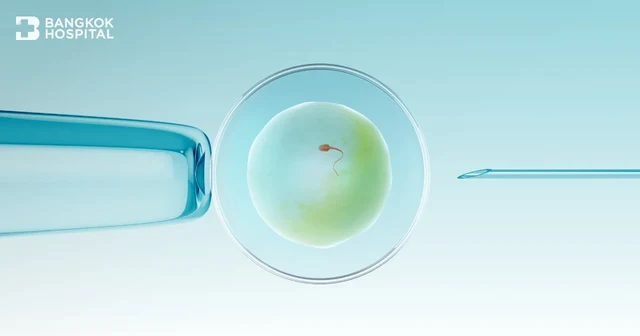
- In vitro fertilization (IVF – In Vitro Fertilization): Eggs and sperm are combined in a culture dish outside the body to achieve fertilization and form embryos. The doctor then transfers the developed embryo back into the uterine cavity to allow implantation and pregnancy.
- ICSI (ICSI – Intracytoplasmic Sperm Injection): An advanced technique based on IVF, in which an embryologist selects one healthy sperm and injects it directly into the egg. It is often used when the male partner’s sperm has strength issues or a low quantity.
- Preimplantation genetic testing (PGT-A and PGT-M): Screening for chromosomal and genetic abnormalities in embryos before implantation in the uterine cavity to increase the chance of a healthy pregnancy and reduce the risk of miscarriage.
Infertility Center, Bangkok Hospital, ready to care for every hope
If any couple is facing infertility, there is no need to worry. The Infertility Center, Bangkok Hospital has a team of skilled physicians and an experienced multidisciplinary team, ready to provide care at every step with medical standards and modern technology to help increase the chance of pregnancy and complete your family.
Article summary
If any couple is experiencing infertility, there is no need to worry, because today, with advances in medicine, there are many methods that help increase the chance of having a baby, including intrauterine insemination (IUI – Intrauterine Insemination), in vitro fertilization (IVF – In Vitro Fertilization), and ICSI (ICSI – Intracytoplasmic Sperm Injection), as well as preimplantation genetic testing (PGT-A and PGT-M).
The Infertility Center, Bangkok Hospital has skilled physicians and an experienced multidisciplinary team, ready to provide care at every step with international standards for the best chance of pregnancy and to complete your family.
Frequently asked questions (FAQ) about infertility
1. At what age is it considered difficult to conceive?
If the woman is under 35 years old and has regular unprotected intercourse for 1 year without becoming pregnant, it is considered infertility. However, if the woman is 35 years or older, the timeframe is reduced to only 6 months, and you should consult a doctor promptly to find solutions.
2. Do men contribute to infertility?
Very much so. Data show that about 40% of infertility problems are due to male factors, such as low sperm count, abnormal motility, or abnormal sperm morphology. Semen analysis is therefore one of the first important steps, no less important than testing in the female partner.
3. Besides seeing a doctor, how can you prepare before pregnancy?
In addition to medical treatment, doctors recommend lifestyle changes for good health, such as eating nutritious foods, taking vitamins to prepare, avoiding alcohol, cigarettes, drugs, and managing stress to prepare the body for pregnancy.