


Double Balloon Endoscopy (DBE) is an advanced gastrointestinal endoscopy technology that enables doctors to thoroughly examine and treat abnormalities of the small intestine (Small Intestine) in detail. The small intestine is approximately 5 – 6 meters long and has a tortuous structure, making it impossible for standard endoscopy to reach all areas. DBE was therefore developed to access the deep small intestine to help diagnose and treat complex small-intestinal diseases.
What is double-balloon small-bowel endoscopy (DBE)
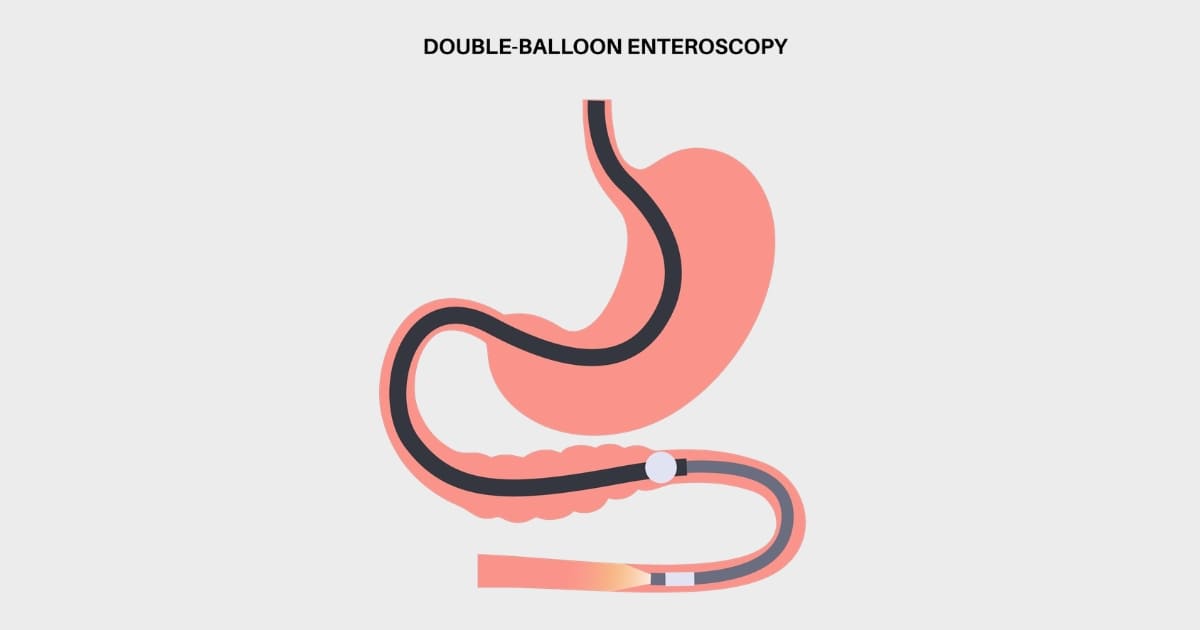
Double-balloon small-bowel endoscopy (Double Balloon Endoscopy – DBE) is an endoscopic examination using an Endoscope with 2 balloons: one at the tip of the scope and one on the scope sheath (Overtube) . The physician uses the Push – and – Pull Technique by alternately inflating and deflating the balloons to gradually advance the scope through the small intestine, allowing deeper examination than conventional endoscopy.
The examination can be performed in 2 ways:
- Through the mouth (Antegrade Approach) to examine the proximal small intestine
- Through the anus (Retrograde Approach) to examine the distal small intestine
Indications for double-balloon small-bowel endoscopy (DBE)
According to the American Society for Gastrointestinal Endoscopy (ASGE) guidelines, double-balloon small-bowel endoscopy (DBE) is used in patients suspected of having small-intestinal disease, such as:
- Small-bowel bleeding such as Obscure Gastrointestinal Bleeding, Iron Deficiency Anemia of unknown cause
- Small-bowel tumors or cancer such as Small Bowel Tumor, Neuroendocrine Tumor, GIST
- Small-bowel polyps such as Familial Polyposis Syndrome, Peutz – Jeghers Syndrome
- Inflammatory bowel disease such as Crohn’s Disease, Small Bowel Ulcer
- Vascular abnormalities such as Angiodysplasia, AV Malformation
- Abnormalities found on other tests such as Capsule Endoscopy, CT Enterography, MRI Enterography
Limitations of double-balloon small-bowel endoscopy (DBE)
Some patients may not be suitable for DBE such as:
- Absolute contraindications (Absolute Contraindications)
- Complete bowel obstruction
- Bowel perforation
- Unstable cardiopulmonary status (Unstable Cardiopulmonary Status)
- Precautions (Relative Contraindications) the physician will evaluate on a case-by-case basis before the examination
- History of multiple abdominal surgeries
- Extensive intra-abdominal adhesions
- Severe coagulation disorder (Severe Coagulopathy)
- Patients at high risk from sedation (Anesthesia)
How long does double-balloon small-bowel endoscopy (DBE) take
In most cases, the examination takes about 60 – 120 minutes, depending on the lesion location.

Treatments possible with double-balloon small-bowel endoscopy (DBE)
Double-balloon small-bowel endoscopy (DBE) is not only used for diagnosis, but can also be used to treat diseases in the same session.
- Hemostasis such as Argon Plasma Coagulation (APC), Clipping, Injection Therapy etc. used to treat
- Abnormal proliferation of blood vessels in the intestinal mucosa (Angiodysplasia)
- Bleeding from vascular abnormalities (Vascular Bleeding)
- Polyp removal (Polypectomy) such as endoscopic removal of mucosal tissue (Endoscopic Mucosal Resection: EMR)
- Dilation of intestinal strictures Balloon Dilation used to treat
- Crohn’s-related intestinal stricture (Crohn’s Stricture)
- Stricture at the anastomosis between the colon and rectum (Anastomotic Stricture)
- Lesion marking (Endoscopic Tattoo) to help identify the location for surgery
- Foreign body removal (Foreign Body Removal)
- Placement of tubes or other intervention procedures such as Enteral Stent a mesh stent or special tube inserted into the gastrointestinal tract, Enteroscopy – Assisted ERCP endoscopic examination of the bile duct and pancreas in patients who have undergone gastrointestinal surgery
Preparation before double-balloon small-bowel endoscopy (DBE)
- No food for at least 8 – 12 hours
- If the examination is performed via the anus, bowel preparation with laxatives is required
- Inform the doctor if you are taking aspirin (Aspirin), antiplatelet drugs (Clopidogrel), anticoagulants (Anticoagulants)
- Report any history of drug allergies
*The examination is usually performed under sedation (Sedation) or anesthesia (Anesthesia)
Possible complications
- Uncommon complications such as
- Sore throat
- Bloating
- Nausea
- Very rare complications include
- Bleeding
- Bowel perforation
- Pancreatitis
Is double-balloon small-bowel endoscopy (DBE) painful
Double-balloon small-bowel endoscopy (DBE) is usually performed under sleep sedation or general anesthesia, so patients do not feel pain during the examination.
How is double-balloon small-bowel endoscopy (DBE) different from Capsule Endoscopy
- Capsule Endoscopy uses a swallowable capsule camera; it is for examination only
- Double-balloon small-bowel endoscopy (DBE) can examine deeper and allows immediate treatment
After double-balloon small-bowel endoscopy (DBE) is hospitalization required
Doctors recommend that most patients stay in the hospital for observation for 1 night after the endoscopy.
A hospital specialized in double-balloon small-bowel endoscopy (DBE)
Digestive Disease and Liver Center, Bangkok Hospital is ready to provide diagnosis and treatment for all abnormalities of the small intestine using the double-balloon small-bowel endoscopy technique (Double Balloon Endoscopy – DBE), delivered by specialized physicians with expertise, nurses, and a multidisciplinary team, along with modern equipment and technology, to help you return to a good quality of life every day.
Physicians specialized in double-balloon small-bowel endoscopy (DBE)
Dr. Aroon Siripun, Gastroenterologist, Digestive Disease and Liver Center, Bangkok Hospital
You can click here to make an appointment yourself.