


Heart disease is considered a silent threat that claims the lives of Thai people among the leading causes. Statistics show that the death rate has continued to rise across all age groups. Detecting signs of heart disease from the early stage, while abnormalities are not yet severe, is very important because it increases the chance of treatment and of regaining a healthy heart. Understanding the risks and symptoms of heart disease is therefore essential for everyone to proactively take care of their health.
What is Heart Disease?
Heart disease refers to various abnormalities that occur in the components of the heart—whether the heart muscle, coronary arteries, heart valves, the heart’s electrical system, or the pericardium—which result in impaired heart function and can lead to life-threatening conditions if not diagnosed and treated promptly.
What causes heart disease? A deep dive into causes and avoidable risk factors
Heart disease results from multiple factors together—both factors that cannot be changed and factors that can be prevented or controlled. Risk factors that trigger heart disease can be categorized as follows:
- Lifestyle behaviors: Heavy smoking, excessive alcohol consumption, and lack of exercise all directly affect the strength of blood vessels and the heart muscle.
- Overweight: A starting point for chronic diseases that are risk factors for heart disease.
- Chronic conditions: Many heart disease patients often have underlying conditions such as diabetes, high blood pressure, and high blood lipids, which are key culprits that damage vessel walls and trigger inflammation.
- Nutritional factors: Consistently eating foods high in saturated fat, sodium, or sugar increases the risk of abdominal obesity, which leads to heart disease.
- Uncontrollable factors: Genetics—having family members with a history of heart disease at a young age—as well as increasing age, which naturally causes the heart to deteriorate.
9 symptoms of heart disease and warning signs of an acute flare-up

Many people may not know what heart disease symptoms are like until the condition progresses. In fact, the body often sends warning signals in advance. Paying attention to even small changes can help detect signs of heart disease sooner. The 9 early symptoms to watch for—and for which you should consult a doctor for a detailed heart check are as follows:
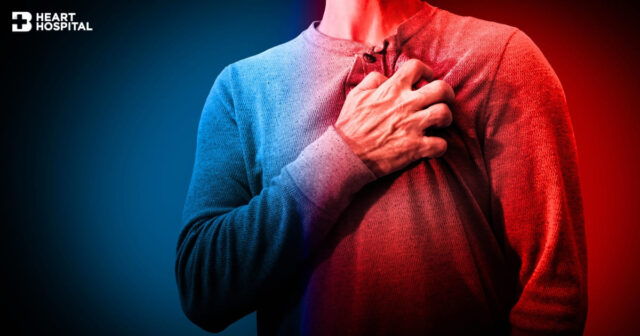
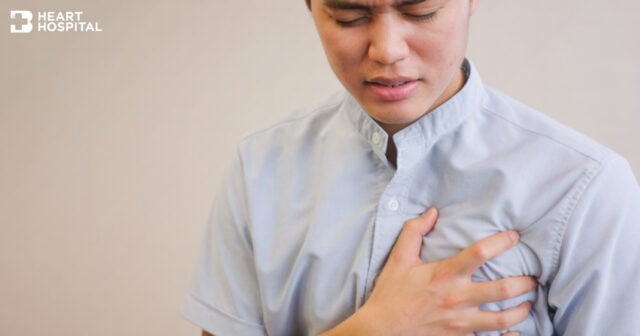
- Chest tightness or pain: Feels like something heavy pressing down or tightly squeezing the center of the chest; pain may radiate to the jaw, shoulder, and left arm—an outstanding sign of coronary artery narrowing.
- Unusual easy fatigue: Feeling short of breath with minimal exertion, such as climbing just a few steps; in severe cases, breathlessness may occur even while resting.
- Palpitations / irregular heartbeat: Feeling a rapid, pounding heartbeat, skipped beats, or an irregular rhythm even without exercise, which may lead to fainting or loss of consciousness.
- Feeling unable to get a full breath or difficulty breathing: Feeling that you cannot fully fill your lungs and needing to take deep breaths, or having a chronic cough without a clear cause.
- Lightheadedness / dizziness: Feeling faint frequently or suddenly collapsing because the heart cannot pump enough blood to the brain.
- Swelling in the body: Noticing edema around the ankles, shins, or abdomen due to reduced heart function causing fluid and salt retention.
- Unable to lie flat: When lying flat, feeling uncomfortable and short of breath, needing to sit up gasping in the middle of the night, or needing multiple pillows to breathe more comfortably.
- Cold sweating: Excessive sweating along with chest tightness, even in cool weather or without exertion— a warning sign of an acute heart disease flare-up.
- Epigastric discomfort (upper abdominal pain): Often confused with gastritis, but if the discomfort comes with nausea or sweating, it may be a warning sign of inferior myocardial ischemia.
A closer look at 7 types of heart disease and their different symptoms

The dangers and symptoms of each type of heart disease vary in severity depending on the pathology. Understanding what heart disease is like in each type helps you distinguish early symptoms as follows:
1. Coronary Artery Disease (Coronary Artery Disease)
Caused by the buildup of fat and plaque on the arterial wall, narrowing the arteries and obstructing blood flow to the heart muscle. This results in heart disease symptoms such as chest tightness. If an artery suddenly becomes blocked, it can lead to an acute myocardial infarction.
2. Arrhythmia (Arrhythmia)
A condition in which the heart’s electrical system functions abnormally, causing the heartbeat to be too fast, too slow, or irregular. Patients often feel palpitations or skipped beats; in cases of very slow rhythm, fainting and loss of consciousness may occur because the brain does not receive enough blood.
3. Valvular Heart Disease (Valvular Heart Disease)
Caused by abnormal heart valves that may be stenotic or leaky, resulting in blood not flowing in the normal one-way direction. Clear signs include shortness of breath, inability to lie flat due to pulmonary edema, and swelling in both legs. Some patients with severe valvular stenosis have frequent fainting episodes and may lead to death.
4. Heart Failure (Heart Failure)
A condition in which the heart has abnormalities and cannot contract to pump enough blood to the body. People in this group often feel unusually easily fatigued, have difficulty breathing when lying flat, and have swelling—especially in both legs and throughout the body. Symptoms can occur in both acute and chronic forms.
5. Cardiomyopathy (Cardiomyopathy)
An abnormality directly affecting the heart muscle. There are many causes that lead to abnormal thickening or dilation, affecting the heart’s relaxation and contraction. In the early stage, there may be no clear symptoms. But as the disease becomes more severe, symptoms of heart failure may occur.
6. Pericardial Disease (Pericardial Disease)
Caused by inflammation of the tissue that surrounds the outer layer of the heart. This group often has sharp chest pain like being pricked by a needle, and symptoms worsen when taking a deep breath or lying on the back, but usually improve when leaning forward. However, this condition often occurs together with fluid in the pericardial space. If the amount of fluid is large or accumulates rapidly, it can cause cardiac tamponade.
7. Endocarditis (Endocarditis)
Most commonly caused by bacterial or viral infection of the heart valves or the lining of the heart. Some cases are not due to infection, such as those caused by autoimmune diseases. Symptoms include prolonged fever along with valvular heart disease symptoms, or detection of abnormal heart valve sounds.
How to recognize when heart disease flares up: critical symptoms requiring hospital transfer
When heart disease flares up to a critical level, it often occurs suddenly and can be life-threatening—especially severe myocardial ischemia. Patients experience severe chest tightness/pain lasting more than 20 minutes, along with cold sweats, nausea/vomiting, and sudden weakness. If these symptoms occur, the patient must be taken to the hospital as quickly as possible within 120 minutes to open the artery.
Modern diagnostic methods for heart disease
When symptoms suggest heart disease, doctors will choose modern technologies to confirm the diagnosis and accurately determine the severity as follows:
- Electrocardiogram (EKG/ECG): A quick initial test to assess heart rhythm and myocardial ischemia.
- Echocardiogram: To closely evaluate the structure, size, and function of the heart valves and heart muscle.
- Exercise Stress Test: To assess coronary artery narrowing when the heart requires higher oxygen demand.
- Exercise stress echocardiogram / Dobutamine stress echocardiogram To evaluate heart structure and function together with assessing myocardial ischemia.
- High-speed cardiac imaging (CT Scan/MRI Heart): To detect calcium in the arteries and deeply assess pathology of heart tissue.
Current medical approaches to heart disease treatment

Treatment for heart disease depends on the type and severity. Specialists will plan the most appropriate treatment for each patient as follows:
- Medication: Using medications to control blood pressure, lower lipids, regulate heart rhythm, or dissolve blood clots as appropriate.
- Catheter-based procedures: Such as balloon angioplasty and stent placement, or transcatheter valve repair without major surgery.
- Surgical procedures: For complex cases such as coronary artery bypass grafting (CABG) or heart valve repair surgery.
- Special devices: Such as implantation of a pacemaker for those with abnormally slow heart rates.
Health care guidelines and ways to restore a strong heart
Lifestyle modification is proactive health care that helps reduce the chance of heart disease and best supports recovery. Recommended approaches include:
- Adjust your diet: Choose foods that increase good fats, reduce salt and trans fats.
- Exercise: Regular physical activity improves heart performance, but you should consult a doctor to determine the appropriate intensity.
- Control weight: Maintaining a standard weight significantly reduces the heart’s workload and helps reduce non-communicable chronic diseases that can lead to heart disease.
- Avoid heart-damaging factors: Quit smoking and limit alcoholic beverages to prevent long-term damage to vessel walls.
Confidence in care at the Cardiology Medicine Clinic, Bangkok Heart Hospital
At the Cardiology Medicine Clinic, Bangkok Heart Hospital we are the country’s first private specialist heart hospital fully equipped to provide comprehensive care for heart disease patients. With modern technology and international standards, our team of expert physicians is ready to provide heart checkups and detailed diagnostic evaluations for safety. You can be confident that every beat of your heart will receive the best possible care with us.
- Find a doctor: https://www.bangkokhospital.com/th/bangkok/doctor
- Make an appointment: https://www.bangkokhospital.com/th/bangkok/appointment/step1
- Contact us: https://www.bangkokhospital.com/th/bangkok/contact
Physicians specializing in heart disease
For more information
1st Floor, Bangkok Heart Hospital
Open daily
Hours 07:00 – 16:00
0 2310 3370
0 2755 1371
@hearthospital
Frequently asked questions about heart disease
What kind of chest pain indicates a sign of heart disease?
It is often a tight pain in the middle of the chest, like something heavy pressing down, or a squeezing sensation around the heart. Pain may radiate to the jaw, shoulder, or left arm—especially during exertion—and symptoms improve with rest.
What is the difference between heart failure and an acute heart attack?
An acute heart attack is caused by a blocked artery leading to sudden myocardial ischemia, while heart failure is a condition in which the heart muscle becomes weak and cannot pump enough blood to the body, causing swelling and easy fatigue.
If someone in the family has heart disease, are we more likely to develop it too?
Genetics is an important uncontrollable risk factor. If a direct relative has a history of heart disease at a young age, the risk is higher than in the general population. Therefore, regular heart checkups should be started from a young age.
Can heart disease patients exercise normally?
They can exercise and it benefits the heart, but it must be under medical guidance, focusing on light aerobic exercise such as brisk walking or swimming, and avoiding heavy straining or overly high-intensity exercise.
Why can stress cause cardiac neurosis, with symptoms similar to real heart disease?
Stress triggers the autonomic nervous system to function abnormally, resulting in palpitations, a feeling of incomplete breathing, or chest pain resembling physical heart disease. Even if structural heart tests show no abnormalities, if left unaddressed, chronic stress may lead to actual heart disease in the future.