



The aorta is the largest blood vessel in the human body. It originates from the left ventricle of the heart and extends down to the abdomen, where it splits into two smaller arteries. Several arteries extend from the aorta to deliver blood to various regions of the body.
Some medical problems may weaken the artery walls, which can result in the aortic wall bulging outward. This is called “aortic aneurysm”. In the worst case scenario, an aneurysm can burst or rupture. This causes bleeding and often leads to death within minutes to hours.
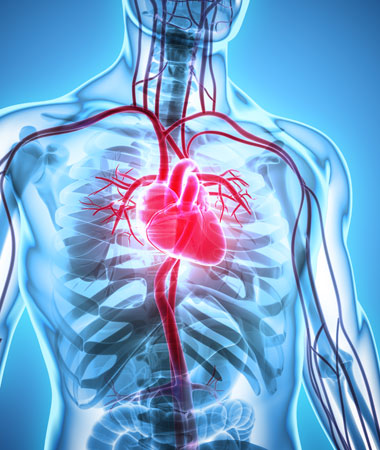
Normal aorta
Causes
Usually the wall of the aorta is very elastic and can stretch and shrink back as needed in order to adapt to the blood flow. However, some medical problems, such as high blood pressure and atherosclerosis (hardening of the arteries), weaken the artery walls. These problems, along with the wear and tear that naturally occurs with aging, can result in a weak aortic wall that bulges outward.
Aortic aneurysm is more common in elderly men. It is approximately found in 2-5% of men after the age of 50 and in 5-10% of men after the age of 65. The risk is increased in patients who have coronary artery disease or peripheral vessel disease. In addition, a family history of aortic aneurysm and tobacco use are risk factors for the development of an aortic aneurysm. Aortic aneurysm can be detected by an ultrasonography.
As noted, the risk factors include old age (men aged between 65-75 years), smoking, hypertension and a family history of aortic aneurysm.
Symptoms
Aortic aneurysms are usually asymptomatic. Sometimes a doctor may find them during exams, ultrasonography, or x-ray done for other reasons. Affected people often experience pain in the abdomen, chest, or back. The pain may be constant or may come and go. If an aneurysm ruptures, a patient may feel sharp or sudden pain due to internal bleeding. It often leads to death within minutes to hours.
An aortic aneurysm can also lead to other problems. Blood flow often slows in the bulging section of an aortic aneurysm, causing clots to form. If a blood clot breaks off, it may block aorta blood flow to other organs. At times, aortic aneurysm might cause pressure or local compression to adjacent organs.
Diagnosis
As aortic aneurysms are usually asymptomatic; a doctor may find them during annual physical examinations or screening tests. The American Association of U.S. Preventive Services Task Force (2005) recommends an ultrasound screening in the high-risk group mentioned below
- Ages 65 to 75 and has a history of smoking (*U.S. Preventive Services Task Force (2005)
- At least 60 years old and have a first-degree relative (for example, father or brother) who has had an aneurysm (**ACC/AHA)
For proper diagnosis, experts recommend computed tomography (CT) screening test for people who have a first-degree relative with a history of thoracic aortic aneurysm. The 256-slice CT scan is quick and efficient as it can be done in as quickly as five seconds and is able to produce more precise imaging while reducing the amount of radiation used.
Treatment
In asymptomatic patients, treatment of an aortic aneurysm is based on the size of an aneurysm, how fast it is growing, and the risk of rupture. If an aneurysm is large and fast-growing, a surgical treatment is indicated.
In patients who have symptoms such as chest pain, abdominal pain or compression of adjacent organs; surgery is highly recommended.
Small aneurysms rarely rupture and are usually treated with high blood pressure medicines. This helps lower blood pressure and stress on the aortic wall. In patients who are at risk of coronary artery disease, a doctor may suggest the patient to exercise more, eat a healthy diet, and stop smoking. If the patient has high cholesterol, a doctor may prescribe medicine to help lower cholesterol.
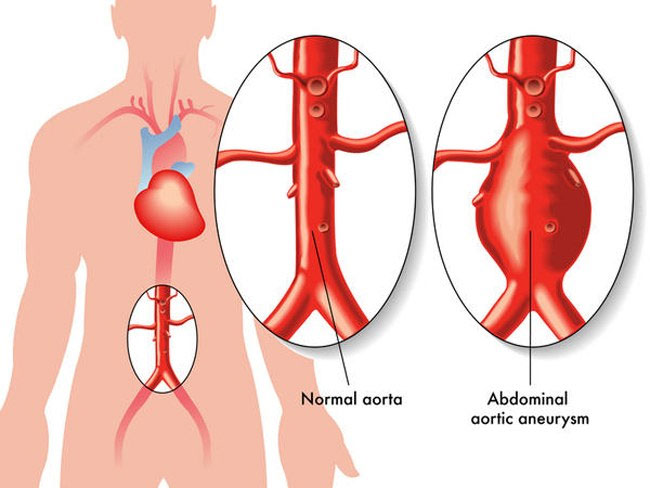
Open repair to remove an aneurysm and attach the graft to the aorta
Currently, there are two methods of aortic aneurysm repair called open repair and endovascular aneurysm repair. Endovascular aneurysm repair is increasingly popular since it is a less invasive procedure with a lower mortality rate while also providing long term efficacy compared to open repair.
“Although it is possible to repair a ruptured aortic aneurysm with emergency surgery, the risk is much higher and there are higher chances of complications where the mortality rate is more than 50%. However, if an aortic aneurysm is treated before rupture, the success rate of treatment is over 95%.”
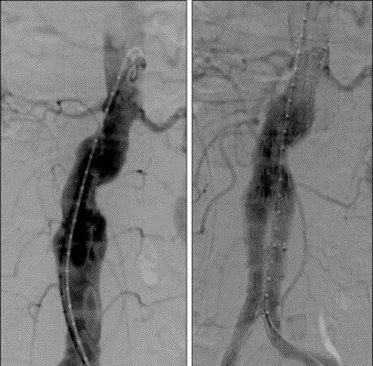
Endovasculary aneurysm repair (The graft reinforces the weakened section of the aorta to prevent rupture of the aneurysm.)
* U.S. Preventive Services Task Force (2005). Screening for Abdominal Aortic Aneurysm: Recommendation Statement (AHRQ Publication No. 05–0569-A). Rockville, MD: Agency for Healthcare Research and Quality. Also available online: http://www.ahrq.gov/clinic/uspstf/uspsaneu.htm
** Hirsch AT, et al. (2006). ACC/AHA 2005 practice guidelines for the management of patients with peripheral arterial disease (lower extremity, renal, mesenteric, and abdominal aortic): A collaborative report from the American Association for Vascular Surgery/Society for Vascular Surgery, Society for Cardiovascular Angiography and Interventions, Society for Vascular Medicine and Biology, Society of Interventional Radiology, and the ACC/AHA Task Force on Practice Guidelines (Writing Committee to Develop Guidelines for the Management of Patients With Peripheral Arterial Disease): Endorsed by the American Association of Cardiovascular and Pulmonary Rehabilitation; National Heart, Lung, and Blood Institute; Society for Vascular Nursing; TransAtlantic Inter-Society Consensus; and Vascular Disease Foundation. Circulation, 113(11): e463–e654.