


Multiple sclerosis (MS) is defined as a neurological disease which is typically chronic and progressive involving damages to the protective sheaths of nerve cells in the brain and spinal cord as well as optic nerve (central nervous system). Multiple sclerosis develops when the immune system malfunction destroys the protective sheath (known as myelin) that covers nerve fibers in the central nervous system. As a result, it leads to permanent damage or deterioration of the affected nerves.
Causes of multiple sclerosis
The exact cause of multiple sclerosis remains unknown. However, it is considered an autoimmune disease in which the body’s immune system attacks its own tissues. Contributing factors to multiple sclerosis often involve:
- Genetic alternations or family history of multiple sclerosis
- Environment or climate
- Certain viral infections such as Epstein-Barr virus (EBV)
- Low vitamin D levels
- Some autoimmune diseases
Occurrence of multiple sclerosis
Approximately 70% of patients are diagnosed with multiple sclerosis while in working age, during their 20s – 40s. Clinical researches have revealed that 3/4 of patients with multiple sclerosis experience reduced productivity, impaired cognitive and working abilities, forcing them to cut back their hours or even quit their jobs. If this condition is left untreated, greater than 30% of patients can potentially become long-term disabled within 20-25 years after the diagnosis was made as disease persistently progresses. Women are two times more likely as men are to develop multiple sclerosis. Moreover, approximately 1% of this condition runs in the family when one of the parents or siblings has had multiple sclerosis.
The estimated number of patients with multiple sclerosis worldwide has constantly increased to 2.5 million. Although multiple sclerosis prevalence has shown in every world region, it is more common in white people, particularly those of Northern European descent meanwhile Asian, African and native American descents tend to have the lowest risk.
Signs and symptoms of multiple sclerosis
Neuron is made up of a cell body and an axon which is the extension of the cell body. Most of the axons in the central nervous system are wrapped in myelin, a fatty substance rich in lipids and proteins. Myelin insulates and protects the axon, allowing for appropriate nerve transmission. Although myelin is present in the central nervous system and peripheral nervous system, only the central nervous system is affected by multiple sclerosis. When the protective myelin is destroyed by the immune system, the nerve fiber becomes exposed. As a result, the messages that travel along that nerve fiber during nerve transmission are blocked, causing a wide range of abnormal signs and symptoms.
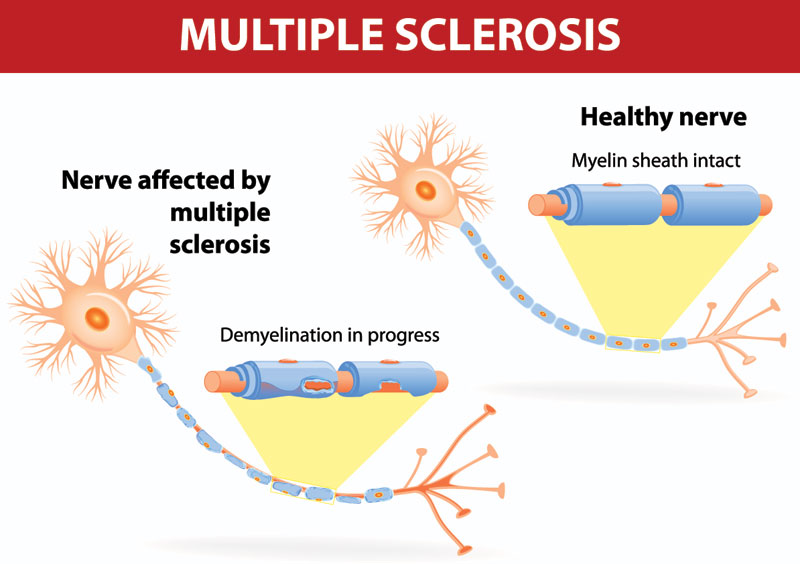
Most patients with multiple sclerosis experience a relapsing-remitting disease course. Relapses or the periods of new symptoms can develop over days or weeks. These relapses are typically followed by disease remission periods that can last months or even years without the worsening of a disease or an increase in its symptoms.
Over the course of the disease, signs and symptoms of multiple sclerosis may widely differ from person to person, depending on the affected nerve fibers. Common symptoms include:
- Unsteady gait, tremor, mobility problems, muscle spasms, stiffness and weakness
- Numbness or weakness in one or more limbs, tingling sensation or pain in parts of the body
- Electric-shock sensations in the neck and back while bending the neck forward
- Vision problems, sudden blurry vision, prolonged double vision and color-vision deficit
- Balance difficulties and lack of coordination, usually spontaneous and self-limiting
Diagnosis of multiple sclerosis
Since there arear no specific tests for multiple sclerosis, the differential diagnosis often relies on ruling out other conditions that might exhibit similar signs and symptoms. Besides a thorough medical history and neurological examination, tests and procedures involve:
- Blood tests to check for specific biomarkers
- Magnetic resonance imaging (MRI) scan to reveal affected lesions on the brain and spinal cord. In some cases, an intravenous injection of a contrast material might be administered.
- Lumbar puncture in which a small sample of cerebrospinal fluid is removed from the spinal canal for analysis. If multiple sclerosis develops, abnormalities in certain antibodies will be detected.
Diagnosis of multiple sclerosis can be more challenging in patients with unusual symptoms or progressive disease. Nevertheless, early detection and timely treatment substantially reduce disease severity while prolonging disease progression and minimizing the risk of dementia in the future.
Treatment of multiple sclerosis
There is currently no cure for multiple sclerosis. Treatment goals aim at managing relevant symptoms and speeding recovery from attacks as well as preventing relapses and slowing disease progression.
Depending on presenting symptoms, disease severity and relapsing-remitting disease course, several treatment options are available. Treatments during attacks include corticosteroids and plasma exchange which is often considered when symptoms are severe without adequate responses to given corticosteroids. Treatments for progression modification include oral and injectable disease-modifying therapies, including interferon beta and humanized monoclonal antibody medication. Due to advances in novel drug development, newer medications have emerged attempting to target specific parts of the immune system that play a major role in multiple sclerosis. Selecting the appropriate therapy principally depends upon careful consideration of various factors, including duration and severity, outcomes of previous treatments and other health issues.
See The Doctor’s Profile
Prevention of multiple sclerosis
Even though the exact cause of multiple sclerosis remains unknown, lifestyle remedies largely help to minimize the risk of developing this neurological condition. Recommendations include:
- Exercise: Regular exercise improves muscle strength, balance and coordination.
- Consume healthy diet: Some studies suggest that maintaining adequate levels of vitamin D may have a protective effect and lower the risk of developing multiple sclerosis.
- Stop smoking: Smoking is considered a viable environmental risk factor for multiple sclerosis, contributing to both increased disease susceptibility and more rapid progression.
- Get plenty of rest and manage stress.
Since manifestation multiple sclerosis may overlap with other neurological disorders, if any warning sign arises, immediate medical attention must be sought in order to receive timely and effective treatments before condition progresses.
Talk to Our Agent