

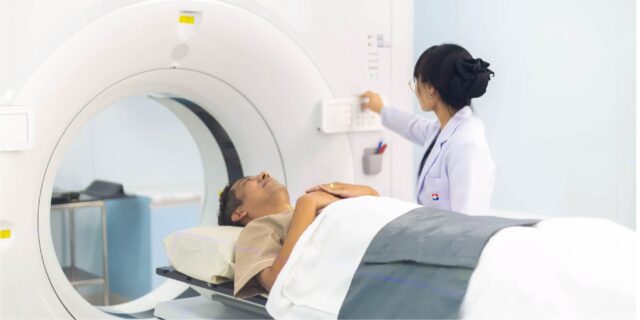
Radiation therapy (also called radiotherapy) uses high-energy wave similar to x-rays (like X-rays or electron beams) to kill or damage cancer cells. It can be external (from a machine outside your body) or internal (placed inside or near the tumor).
Linear Accelerator (LINAC) is the device most commonly used for external beam radiation treatments for patients with cancer. It delivers high-energy x-rays or electrons to the region of the patient’s tumor. LINAC is used for any part of the body as providing conventional radiation therapy, 3D-CRT (Three dimensions conformal radiation therapy), IMRT (Intensity Modulated Radiation Therapy) or VMAT (Volumetric Modulated Arc Therapy).
Moreover, the LINAC can create beams of electrons at several possible energy levels (4-20 MeV) which are ideal for treatment of shallow or surface malignancies. The important benefit of beams of electrons is that the amount of radiation will drop at a defined point. As such, appropriate selection of the energy level spares normal tissue surrounding the tumor by low energy radiation exposure.
External beam radiation therapy (EBRT)
The radiation passes through skin and other tissue to reach the tumor and nearby lymph nodes.
EBRT is given in small doses called fractions. An advanced type of EBRT called Volume matric arc therapy (VMAT). VMAT is also form of intensity-modulated radiation therapy (IMRT) that can sends various dosed of radiation toward a tumor across multiple smaller beam instead of using a single radiation beam. IMRT allows a high dose of radiation therapy to reach the tumor while limiting the amount that reaches the surrounding normal tissue. With IMRT it is possible to reduce radiation to important nearby organs and structures such as the spinal cord, optic nerve, brain stem, bowel, bladder and heart.
Brachytherapy
As known as internal radiation therapy, brachytherapy involved treatment with radioactive material placed inside the body.
Brachytherapy allows a high dose of radiation to be targeted at the tumor while limiting the amount delivered to surrounding normal tissue. Brachytherapy is often use in cervical and endometrium cancer.
The radioactive source used for this therapy is the Isotope Iridium 192. A radioactive material can travel into the instruments that have been placed in the body. This method is known as intracavitary brachytherapy. Sometimes, additional instruments (catheter, or thin hollow tubes) are placed in the tumor itself.
Process of radiation therapy
1. CT Simulation (CT-Sim)
CT-SIMULATOR is a computer x-ray to simulate treatment. Its performance likes an ordinary computer x-ray but using a flat table similarly in x-ray rooms because patient will be the same position as radiation therapy and an extra-large window is to support gripped devices during treatment.
Indications
- Patients who will be treated by LINAC or BRACHYTHERAPY
Benefits
- To determine the exact area and location to be treated
- To decrease error from incorrect area of radiation by choosing suitable gripped device and decrease time of position arrangement in an X-ray room.
- To plan for 3D irradiation to protect adjacent organs or tissues from radiation.
2. Contouring and prescription dose
Target delineation is the process of outlining target volumes (areas of cancer or at risk of cancer recurrence) and organs at risk (OARs) on CT simulation image. Radiation oncologist will write a prescription that outlines exactly how much radiation you will receive and to what part of your body.
3. Planning
This step of the radiation process involves the radiation oncologist and the medical physicist. Using the CT simulation images to design the field of radiation therapy treatment. The focus of treatment planning is to deliver a high dose of radiation to the tumor while limiting the dose received by surrounding tissue that is normal. This helps preserve normal tissue and reduces side effects of treatment. Treatment plans are customized for each patient and become the blueprint for treatment delivery. Developing the treatment plan may be a complex process aided by the use of computers that recreate your “virtual anatomy” and location of your cancer or tumor. It may take several days to complete the treatment planning process.
4. Image guided radiation therapy (IGRT)
The patient is placed in the position for treatment using immobilization devices that might be necessary for them. The image is taken before treatment; these images confirm that the area of the body being treated has not changed position.
5. Beam delivery
When you undergo external beam radiation therapy treatment, each session is painless, just like getting an x-ray. The radiation is directed at your tumor from a machine located away from your body, usually a linear accelerator (LINAC).
Reference:
NCCN guidelines for patients, cervical cancer 2025