
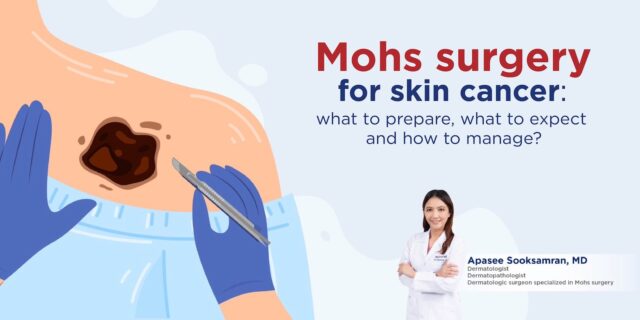
Mohs surgery is a precise surgical method that remove the skin layer by layer combined with microscopic mapping for a targeted removal of skin cancer. This procedure was developed by Dr. Frederic Mohs of the University of Wisconsin. It provides the greatest assurance of cancer removal along with the most conservative margins of removal. It has the highest cure rates for skin cancers, 97 to 99 percent for the first time skin cancers and 95 to 96 percent for cancers that recur.
Preparation before undergoing Mohs surgery
- The surgery can typically be completed in one day, and hospitalization may not be necessary.
- If local anesthesia is used during the surgery, allowing patients to eat normally without fasting before the procedure.
- Patients should inform the physician of any pre-existing conditions, such as heart conditions with pacemaker implantation, diabetes, high blood pressure, drug allergies, or other conditions that may pose risks during surgery
- Regular medications can be taken as usual, except for anticoagulant and antiplatelet medications. Consultation with a doctor is advised before discontinuing medications (Anticoagulant such as Warfarin; Antiplatelet such as Aspirin (ASA), Clopidogrel, Ticlopidine, Cilostazol, Ticagrelor. If advised to discontinue, it is recommended to stop at least 10 days before the surgery to avoid complications or potential risks during the procedure.
- Invite someone with you on the operating day, so that he can get you home because the doctor may give you sedative drug that might suppress your brain.
- Mohs surgery take time at least 4 hour or even longer. It is recommended to plan the entire day for performance.
- It is a good thing for you to leave your valuables at home.
- If you have removed the suture of skin biopsy for longer than months, please bring your clinical picture of the site that you need Mohs surgery. If possible, request the clinician who did skin biopsy for you so that Mohs surgery can be done on the precise location. Sometimes the lesion is distorted after scar taken places or sometimes scar is barely visible.
Possible side effect and how to manage?
- Scar Formation: Scars form whenever there is injury to the skin. Some scars are more noticeable than others. Some individuals are more prone to thickened or keloid scars. Scars in areas of high sebaceous gland concentration and activity such as the nose and forehead are more likely to widen and become depressed. Scar on high mobility area are prone to elevated or turn to hypertrophic scar or keloid. If you worry about the scar, you can request for pulse dye laser after remove the suture. Scar sheet and scar gel also help soften the scar and reduce itchiness.
- Pain: Post-operative pain will depend on the extent of surgery and also on the individual threshold. Pain medications may be taken before or after surgery depending as the doctor plan. With some pain medications that contain sedative ingredient such as opioid may impair important decision, thus, do not drive or operate machinery. Some pain medication such as ibuprofen can irritate the stomach, so, it is best to eat something solid before taking this medication.
- Bleeding: Bleeding after surgery can usually be controlled with pressure applied to the wound for fifteen to twenty minutes and with ice compresses. Some oozing is to be expected.
- Swelling: Various degrees of swelling will occur. Cold compresses on 20 minutes and off for 10 minutes for the first 24-48 hours will lessen swelling. For operation involving scalp or Face elevation of the head at 15-20 degrees while lying down or sleeping will help to reduce edema.
- Bruising: Bruising around the surgery site will resolve. With surgery of the anterior scalp, forehead or around the eyes, a black eye [periorbital ecchymosis] may develop within 72 hours after surgery. Sometimes the eye will look swelling. Cold compression in first 2days reduce swelling and bruising. Warm compression after 2-3 days of surgery help relieve bruising by enhancing lymphatic drainage and clearing off red blood cells under the skin by macrophages.
- Hematoma: This is a lump that forms under the skin from bleeding after the surgery. It represents a collection of blood which will subside overtime. Apply an ice pack wrapped in a towel help reduce any pain or swelling. However, if the hematoma is causing pain and become larger, come back to the hospital as soon as possible to release that hematoma.
- Infection: With any injury to the skin or surgery, infection is possible. An antibiotic ointment will be prescribed at the time of surgery and sometimes antibiotic tablets. Wound infections usually occur four days after the surgery. If you suspect an infection, come back to your doctor for appropriate antibiotic treatment.
- Numbness: It is common to have numbness in the area of surgery because there are always sensory nerves running through the skin. Usually this numbness will go away in six to twelve months. But in some instances, it may be permanent.
- Paralysis of Nerve: If a cancer extends into the area of a nerve that controls the movement of muscles, temporary or permanent paralysis may occur. The greatest areas of risk on the face are in the temple area where the nerve to the eyebrow and eyelid runs and on the lower cheek where the nerve to the lip runs. Just consult your doctor to find the cause and appropriate rehabilitation.
- Wound separation: In straightforward terms, this means the wound separates or pulls apart. This can happen anywhere, but it is most prone to occur when the wound overlies an area of muscle mass such as on the back or extremities. If a body movement seems to tug on the wound, stop the movement and relax. If it is large area of separation, a re-suture may be needed.
- Wound Healing: Not all skin wounds heal ideally. At times a skin repair, graft or flap may fail to heal well or the wound may seem to lift up or depress. This may affect part of the wound or the whole wound. Most often the wound will still heal adequately with treatment. Sometimes additional surgery are required. It takes 2-4 weeks for some areas and some complex wound to healed. If you notice the wound discoloration and delay healing, consider visit your doctor for proper treatment. High protein diet with oral vitamin C can fasten the healing process.
- Suture protruding: Normally, the subcutaneous suture is absorbable, our immune system can remove it by phagocytosis. But sometimes, our body try to eliminate it by trans epidermal elimination which leading to the protruding of this absorbable suture month to year after the operation. After the suture exposed to the air; the suture cannot dissolve itself even though it is absorbable suture. Thus, this issue can be fixed by cut the part of suture that is protruding out above the skin at hospital or clinic nearby you.
Reference
- Ruiz-Salas V, Sanmartin-Jiménez O, Garcés JR, et al. Complications Associated with Mohs Micrographic Surgery: Data from the Nationwide Prospective Cohort REGESMOHS. Dermatology. 2022;238(2):320-328. doi:10.1159/000517010
- Concilla A, Chavez AE. Mohs Micrographic Surgery Surgical Complication Management. [Updated 2024 May 2]. In: StatPearls [Internet]. Treasure Island (FL): StatPearls Publishing; 2025 Jan-. Available from: https://www.ncbi.nlm.nih.gov/books/NBK603734/– Prickett KA, Ramsey ML. Mohs Micrographic Surgery. In: StatPearls. Treasure Island (FL): StatPearls Publishing; July 25, 2023.