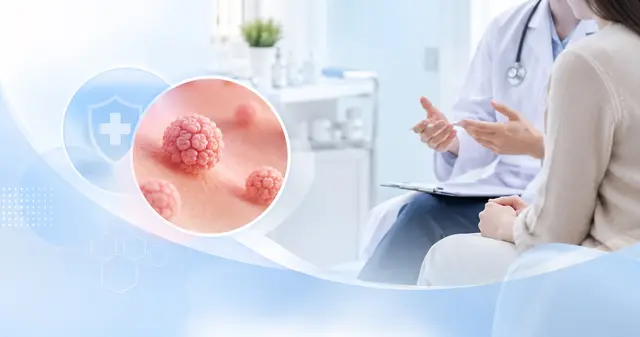
Genital warts are small growths caused by certain types of human papillomavirus (HPV). They can occur on or around the penis, vulva, groin, perineum or anus and may appear as a single small bump or multiple growths.
Although genital warts are benign, other conditions can sometimes look similar. An examination by a doctor is therefore useful before treatment—particularly if the diagnosis is uncertain or a lesion is dark, hard, ulcerated, bleeding or otherwise unusual. Diagnosis is usually based on clinical examination; routine HPV testing is not recommended simply to diagnose a genital wart. CDC
Several treatments are available, including prescription topical medicines, cryotherapy, chemical treatment and procedures such as surgical removal, electrosurgery or laser in appropriate cases. There is no single treatment that is best for every patient. Treatment should be selected according to the number, size and location of the warts, patient preference, potential adverse effects and clinical circumstances. CDC
What Are Genital Warts?
Genital warts, also called anogenital warts, are visible skin or mucosal growths caused by HPV infection.
The HPV types responsible for most genital warts are generally different from the high-risk HPV types most strongly associated with cancer. CDC guidance identifies HPV types 6 and 11 as responsible for approximately 90% of anogenital warts. CDC
This distinction is important because many patients understandably become concerned about cancer as soon as they hear the term HPV.
Having a genital wart does not mean that the wart will turn into cancer.
However, people can be exposed to more than one HPV type, and appropriate cervical cancer screening or other preventive care should still be followed according to individual recommendations.
What Do Genital Warts Look Like?
Genital warts can vary considerably in appearance.
They may be:
- small raised bumps;
- flat or slightly elevated lesions;
- skin-colored, pinkish or light brown;
- smooth or irregular;
- single or multiple;
- separate or clustered together; or
- occasionally larger growths with an uneven surface.
They may occur around the penis, foreskin, scrotum, vulva, vaginal opening, perineum or around the anus. Warts can also occur within parts of the anogenital tract. CDC
Most are not painful, although some can cause itching, irritation or discomfort depending on their size and location.
Is Every Bump in the Genital Area a Genital Wart?
No—and this is an important reason to obtain a medical diagnosis before trying to remove a lesion yourself.
Several benign or infectious conditions can resemble genital warts.
Depending on the appearance and location, possible alternatives can include normal anatomical structures, skin tags, molluscum contagiosum and other skin conditions. Secondary syphilis can also produce lesions that resemble genital warts. CDC
Applying wart-removal products without knowing the diagnosis may irritate sensitive genital skin and delay appropriate treatment.
Diagnosis first, treatment second.
What Causes Genital Warts?
Genital warts are caused by HPV.
HPV can spread through intimate skin-to-skin contact, including vaginal or anal sex, genital-to-genital contact without penetration, and sometimes oral sexual contact. CDC
Importantly, HPV can be present without visible warts.
This means someone can transmit HPV without knowing they have it.
Does Having Genital Warts Mean My Partner Was Unfaithful?
No.
It is generally not possible to determine when HPV was acquired or which partner transmitted it. HPV may be shared between partners and can remain clinically unnoticed for a period of time. Therefore, the diagnosis of genital warts should not be used as evidence that a partner has recently been unfaithful. CDC
This is worth explaining clearly because the diagnosis can otherwise create unnecessary anxiety between partners.
Are Genital Warts the Same as High-Risk HPV?
No.
HPV includes many different types.
Some are considered low-risk types and commonly cause genital warts. Other HPV types are classified as high-risk or oncogenic types because persistent infection can contribute to cancers of sites including the cervix, anus, penis, vulva, vagina and oropharynx. CDC
The HPV types that usually cause visible genital warts are different from the HPV types responsible for most HPV-associated cancers. CDC
However, this does not mean that someone with genital warts cannot also have another HPV type.
How Are Genital Warts Diagnosed?
In most cases, genital warts are diagnosed by clinical examination.
The doctor assesses:
- appearance of the lesions;
- number of lesions;
- location;
- size;
- duration;
- symptoms;
- previous treatment;
- whether the lesions are changing; and
- whether another diagnosis needs to be considered.
Routine HPV testing is not recommended for diagnosing genital warts, because the result does not confirm that a visible lesion is a wart and generally does not guide wart treatment. CDC
Do Genital Warts Need a Biopsy?
Usually not.
Typical genital warts can often be diagnosed clinically.
However, biopsy may be considered when the diagnosis is uncertain or when a lesion has unusual features such as:
- pigmentation;
- hardness;
- attachment to deeper tissue;
- bleeding;
- ulceration;
- worsening despite treatment; or
- failure to respond as expected.
The threshold for biopsy may also differ in immunocompromised patients. CDC
A persistent unusual genital lesion should therefore not automatically be treated repeatedly as a wart without reconsidering the diagnosis.
Do All Genital Warts Need Treatment?
Not necessarily.
Untreated genital warts may disappear spontaneously, remain unchanged or increase in size or number. Observation can therefore be reasonable for selected patients. CDC
Many patients nevertheless choose treatment because the warts are:
- increasing in number;
- causing irritation;
- located where they are easily traumatized;
- cosmetically concerning;
- affecting sexual confidence; or
- causing significant anxiety.
The decision should be individualized.
What Treatments Are Available for Genital Warts?
There is no single best treatment for every genital wart.
The choice depends on the location, size and number of lesions, as well as patient preference, potential adverse effects and the treating clinician’s experience. CDC
Broadly, treatment can be divided into medicines applied by the patient and treatments performed by a healthcare professional.
Cryotherapy
Cryotherapy uses very cold liquid nitrogen or a cryoprobe to freeze the wart.
It is a commonly used clinician-administered treatment for external genital warts. CDC
Advantages
It can be performed during a clinic visit and is useful for many external lesions.
Limitations and side effects
Treatment can cause pain, burning, blistering or swelling. More than one treatment session may be necessary.
The treated area subsequently heals as the damaged wart tissue separates from the skin.
Prescription Topical Treatment
Certain medicines can be applied directly to appropriate external genital warts.
Recommended patient-applied options in CDC guidance include imiquimod, podofilox and sinecatechins. The appropriate medicine and regimen depend on the individual patient and lesion. CDC
Imiquimod
Imiquimod works by modifying the local immune response.
Treatment takes place over time rather than immediately removing the lesion.
Local reactions can include redness, irritation, erosion, burning or discomfort. CDC
Other topical treatments
Other patient-applied options may be appropriate in certain circumstances, but availability varies between countries and healthcare settings.
Prescription medicines intended for genital skin should be used according to medical instructions.
Do not use ordinary over-the-counter wart-removal products intended for hands or feet on genital skin unless specifically instructed by a healthcare professional.
Chemical Treatment
A clinician may use a chemical such as trichloroacetic acid (TCA) to destroy wart tissue in appropriate locations.
TCA is included among clinician-administered treatment options in CDC guidance. CDC
Because these chemicals can injure surrounding normal tissue if incorrectly applied, this is a treatment performed by a healthcare professional rather than a home treatment.
Surgical Removal, Electrosurgery and Laser
Procedural removal may be considered for selected lesions.
Options recognized in clinical guidance include surgical excision, curettage, electrosurgery and laser treatment. CDC
These approaches can be particularly useful in selected patients depending on the size, number and location of the lesions.
Advantages
A visible lesion can often be physically removed during treatment rather than waiting for several weeks of topical therapy.
Limitations
Depending on the procedure, patients may experience:
- pain or tenderness;
- temporary swelling;
- superficial wounds;
- bleeding;
- pigment changes; or
- scarring.
Removing the visible wart also does not guarantee that another wart will never appear.
The appropriate procedure should therefore be selected after examination rather than assuming that laser treatment is automatically the best option.
Is CO₂ Laser the Best Treatment for Genital Warts?
Not necessarily.
Laser is one of several procedural options for genital warts, but no single treatment has been shown to be ideal for every patient. CDC
A few small external warts may be suitable for cryotherapy or another treatment, while numerous, large, recurrent or anatomically difficult lesions may require a different approach.
Treatment should therefore be based on the individual lesion and patient, rather than choosing a device before the diagnosis and examination.
What Happens After Genital Wart Treatment?
Recovery depends on the treatment used.
After a destructive procedure, the treated skin may become:
- red;
- swollen;
- tender;
- blistered;
- superficially eroded; or
- temporarily darker or lighter.
A small superficial wound may develop as treated wart tissue separates.
Patients should follow the specific wound-care instructions provided for their procedure.
General principles often include keeping the area clean, avoiding unnecessary friction or picking at healing tissue, and returning for assessment if there is increasing pain, marked swelling, spreading redness, pus or another concerning change.
Can Genital Warts Come Back After Treatment?
Yes.
This is one of the most important expectations to discuss before treatment.
Treatment removes or destroys visible warts, but it does not reliably eradicate HPV from surrounding tissue. Consequently, new or recurrent warts can appear after apparently successful treatment. CDC guidance specifically notes that available treatments may reduce visible disease without necessarily eliminating HPV infectivity. CDC
Recurrence does not automatically mean that treatment was performed incorrectly or that the patient has acquired a new infection.
Further treatment may be needed if lesions return.
Does Treatment Cure HPV?
There is currently no treatment that simply eliminates HPV itself from the body.
Treatment is directed at the visible warts or other disease caused by HPV. In many people, the immune system eventually suppresses or clears detectable infection over time. CDC
This distinction helps explain why a wart can be successfully removed but another wart can subsequently appear.
Should I Have an HPV Test If I Have Genital Warts?
Not simply to confirm a genital wart.
CDC guidance states that HPV testing is not recommended for the diagnosis of anogenital warts because it does not confirm the diagnosis and does not guide wart management. CDC
HPV testing has a different role, particularly in cervical cancer screening and management according to age and screening guidelines.
Patients should therefore distinguish between:
diagnosing a visible genital wart
and
HPV testing used as part of cervical cancer prevention.
They are not the same clinical question.
Should I Be Tested for Other Sexually Transmitted Infections?
Having genital warts does not automatically mean that another sexually transmitted infection is present.
However, a consultation provides an opportunity to review sexual health and decide whether screening for other infections is appropriate based on individual risk, symptoms and sexual history.
This is particularly relevant if there are symptoms not typical of genital warts, such as:
- genital ulcers;
- urethral or vaginal discharge;
- painful urination;
- pelvic or testicular pain; or
- other new genital lesions.
Some infections can also produce lesions that resemble warts, making correct diagnosis important. CDC
Can I Have Sex If I Have Genital Warts?
HPV can be transmitted to sexual partners.
Using condoms can reduce the risk of HPV transmission, but cannot eliminate it completely because HPV can infect genital skin that is not covered by the condom. World Health Organization
It is sensible to avoid sexual activity that causes pain, friction or trauma to recently treated skin until the area has healed.
Patients should also follow any treatment-specific instructions because some topical medicines can affect condoms or other barrier contraceptives. CDC
Does My Partner Need Treatment?
A partner does not automatically require wart treatment if they have no visible lesions.
Partners may already share HPV despite only one person developing visible warts. CDC
If a partner develops a new genital lesion or has another sexual-health concern, they should be examined.
Appropriate routine cervical screening should continue according to standard recommendations for people who have a cervix.
What About HPV Vaccination?
HPV vaccination helps prevent new infections with vaccine-covered HPV types and is an important component of HPV-related disease prevention.
However, vaccination is preventive—it is not a treatment for an existing genital wart or an existing HPV infection. World Health Organization
Whether vaccination is appropriate for an individual depends on factors including age, previous vaccination and relevant national recommendations and should be discussed with a healthcare professional.
Should I Shave If I Have Genital Warts?
It is reasonable to avoid shaving directly over affected genital skin while visible warts are present.
Shaving can traumatize lesions and may potentially spread HPV to adjacent skin. The IUSTI patient guidance specifically advises avoiding shaving of affected genital areas for this reason. IUSTI
Trimming without traumatizing lesions may be preferable when grooming is necessary.
Genital Warts During Pregnancy
Pregnancy changes which treatments are appropriate.
Certain patient-applied treatments are unsuitable during pregnancy, and treatment decisions need to consider the location and extent of disease as well as pregnancy itself. CDC
Patients who are pregnant or could be pregnant should therefore tell their doctor before starting any medication or procedure for genital warts.
When Should a Genital Lesion Be Evaluated Promptly?
Arrange a medical assessment if:
- you are unsure whether a lesion is a wart;
- the lesion is dark or unusually pigmented;
- it is hard or fixed to deeper tissue;
- it ulcerates or repeatedly bleeds;
- it is rapidly enlarging;
- treatment has repeatedly failed;
- lesions are worsening despite appropriate therapy;
- you are immunocompromised; or
- you have additional symptoms suggesting another genital infection.
A lesion in the genital area should not automatically be assumed to be HPV simply because it resembles photographs of genital warts online.
What to Expect During a Genital Wart Consultation in Phuket
A consultation usually starts with a confidential discussion about when the lesions appeared, whether they have changed, previous treatments, symptoms and relevant medical and sexual history.
The doctor then examines the affected area.
In many cases, the diagnosis can be made clinically. If the lesion is atypical or the diagnosis remains uncertain, further testing or biopsy may be considered.
The next step is to choose treatment based on factors such as:
Location → Number → Size → Previous treatment → Patient preference → Potential adverse effects
Some patients may be suitable for prescription treatment at home.
Others may benefit from clinician-administered treatment such as cryotherapy or another procedure.
And occasionally, the most appropriate first step is not treatment at all, but confirming that the lesion is actually a genital wart.
Genital Warts Treatment for Tourists and International Patients in Phuket
For tourists and international patients, the basic diagnostic and treatment principles are the same.
However, your travel schedule can influence treatment planning.
If you are leaving Phuket soon, tell your doctor your departure date. Some treatments require repeat sessions or follow-up, whereas others involve a healing period after the procedure.
It may also be useful to bring information about:
- previous genital wart treatments;
- medications already used;
- previous biopsy results if applicable;
- relevant medical conditions;
- allergies; and
- HPV vaccination history.
The goal is to choose a treatment plan that is medically appropriate while also allowing realistic follow-up.
Frequently Asked Questions
Are genital warts cancer?
Typical genital warts are benign. The HPV types that most commonly cause genital warts are different from the HPV types responsible for most HPV-associated cancers. CDC
Does every genital wart need to be removed?
No. Some warts can resolve without treatment. Treatment may be chosen because lesions persist, grow, cause symptoms or are bothersome to the patient. CDC
What is the fastest treatment for genital warts?
There is no single “fastest” or best treatment for everyone. Procedural treatments can physically remove visible lesions relatively quickly, but the appropriate method depends on the number, size and location of the warts and does not eliminate the possibility of recurrence.
Is cryotherapy effective for genital warts?
Cryotherapy is an established clinician-administered treatment for external genital warts. Some patients require repeated treatments, and temporary pain, blistering or local inflammation can occur. CDC
Can genital warts be removed with a laser?
Laser is one of the procedural treatment options for selected genital warts. It is not automatically preferable to cryotherapy, topical therapy or other procedures. CDC
Will genital warts come back after removal?
They can. Treatment removes visible warts but does not necessarily eradicate HPV from surrounding tissue, so recurrence is possible. CDC
Do genital warts mean I have high-risk HPV?
Not necessarily. The HPV types that most commonly cause genital warts are considered low-risk types and differ from the types responsible for most HPV-associated cancers. CDC
Do I need an HPV test to confirm genital warts?
Usually no. Routine HPV testing is not recommended to diagnose genital warts. Diagnosis is generally clinical. CDC
Can I transmit HPV after my warts have disappeared?
Removal of visible warts does not prove that HPV has been completely eliminated. The precise duration of transmissibility after warts resolve cannot be determined for an individual patient. CDC
Do condoms completely prevent genital HPV?
No. Condoms reduce the risk but cannot provide complete protection because uncovered genital skin can still transmit HPV. World Health Organization
Can tourists get genital warts treated in Phuket?
A genital lesion can be assessed while you are travelling. If treatment requires repeated visits or wound follow-up, discuss your departure date with the treating doctor so that an appropriate plan can be made.