


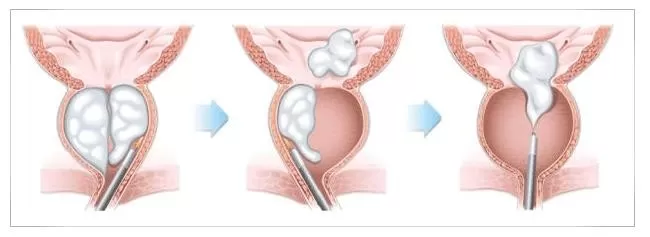
Holmium Laser Enucleation of the Prostate (HoLEP) was developed in New Zealand in the late 1990s. This minimally invasive procedure is typically performed under general anesthesia. The prostate is accessed internally via the urethra (endoscopically), eliminating the need for external incisions. Using a Holmium laser, the obstructive inner portion of the prostate is completely removed, providing significant relief from urinary obstruction. In most cases, only one HoLEP procedure is needed in a patient’s lifetime. The regrowth rate after HoLEP is extremely low—only 0.7% of patients require re-operation within 10 years, compared to 10–15% after TURP (Transurethral Resection of the Prostate), and an even higher rate with green light laser surgery.
Diagram showing the complete removal of the obstructive inner part of the prostate that is achieved with HoLEP
After HoLEP, the removed prostate tissue is sent for microscopic examination. In approximately 8% of cases, this analysis reveals previously undetected prostate cancer.
HoLEP is among the most well-researched procedures for Benign Prostatic Hyperplasia (BPH). As of December 2014, 16 randomized controlled trials—the highest standard of clinical research—have been published. Compared with the previous “gold standard” TURP, HoLEP offers several key advantages:
- Less bleeding
- Fewer blood transfusions
- Shorter catheterization time post-surgery
- Shorter hospital stays (90% of patients can leave the hospital without a catheter the next day; some may not require overnight admission at all)
Meta-analyses of these trials show that HoLEP provides superior symptom relief and improved urinary flow rates compared to all other endoscopic BPH procedures. Average symptom score improvements range from 70–80%, and urinary flow rate improvements of up to 600% have been reported.
HoLEP is also highly effective for patients in urinary retention. Of those who were dependent on catheters before surgery, 98% regained the ability to urinate independently afterward. This is a higher success rate than seen with green light laser or TURP. Unlike other procedures, HoLEP is suitable for prostates of any size.
Who is suitable for HoLEP?
1. Experience moderate to severe BPH symptoms:
- Weak urinary stream
- Incomplete bladder emptying
- Stop-and-start urination
- Straining to begin urination
- Increased frequency or urgency
- Sleep disruption due to nighttime urination (nocturia)
- Complications from an enlarged prostate
2. Seek an alternative to TURP
3. Have failed minimally invasive treatments
4. Have prostate anatomy unsuitable for other procedures
5. Have not responded to, or do not wish to take, medication
6. Want to restore their quality of life prior to BPH symptoms
What are the advantages of HoLEP?
HoLEP is a definitive surgical treatment for Benign prostatic hyperplasia (BPH) for the relief of bothersome urinary symptoms:
- Effective for prostates of all sizes
- Durable symptom relief with low re-treatment rates
- Rapid recovery with minimal bleeding
- Eliminates the need for lifelong medication
How is HoLEP performed?
- Performed under general or spinal anesthesia
- Utilizes a small cystoscope and Holmium laser
- The obstructive lobes of the prostate are enucleated (shelled out)
- The remaining cavity allows improved urinary flow
- Procedure duration varies from 20 minutes to 4 hours depending on prostate size
- Most patients are discharged within 1–2 days postoperatively
What to expect after HoLEP?
- Most recovery occurs at home
- Light activity can resume within 3–5 days
- Full recovery may take up to 4 weeks; avoid strenuous activity
- Common temporary side effects:
- Burning or discomfort during urination
- Blood in the urine (may persist for 2–3 weeks)
- Urinary urgency or frequency
- Difficulty controlling the urge to urinate
- Temporary urinary incontinence (resolves within 3 months with pelvic floor exercises)
- Retrograde ejaculation (dry ejaculation) occurs in ~90% of cases; permanent but harmless
HoLEP outcomes
- Immediate improvement in urinary flow, pressure, and bladder emptying
- Urinary frequency, urgency, and nocturia may take up to 3 months to resolve
Post-operative care instructions
What to expect:
- You will wake up with a catheter in place. This helps the bladder drain any residual blood from the surgical site.
- Once the catheter is removed, you should notice improved urinary flow, bladder pressure relief, and more complete bladder emptying.
- It is common to see blood in the urine for up to two weeks’ post-surgery; in some cases, it may persist longer or appear intermittently.
- A burning or stinging sensation during urination may occur and typically lasts 2–3 weeks. This discomfort does not usually indicate an infection.
- Urinary frequency, urgency, and nocturia (waking at night to urinate) may take up to three months to fully resolve. In some cases, mild symptoms may persist.
- Temporary urinary incontinence (leakage) can occur but typically improves within three months with the help of pelvic floor muscle exercises.
- Retrograde ejaculation (dry ejaculation) is common (seen in approximately 90% of cases). It is a permanent but harmless outcome of the surgery.
Return to activity:
- Driving: Avoid driving for at least 24 hours after surgery, or until you feel safe and comfortable to do so.
- Work: Plan to take 4–5 days off work, or longer depending on the physical demands of your job.
- Lifting: Refrain from lifting heavy objects for 2 weeks’ post-procedure.
- Physical Activity: Gentle walking is encouraged and beneficial for recovery. However, avoid strenuous exercise, heavy exertion, and straining during bowel movements for 2 weeks.
- Sexual Activity: Avoid sexual activity for at least 2 weeks after the procedure to allow for complete healing.