3 Steps for Self-Breast Cancer Examination Every woman is at risk of developing breast cancer, which is a silent threat commonly ranked as the number 1 cancer found in Thai women. Early detection can help prevent the spread of cancer and increase the chance of a complete cure.
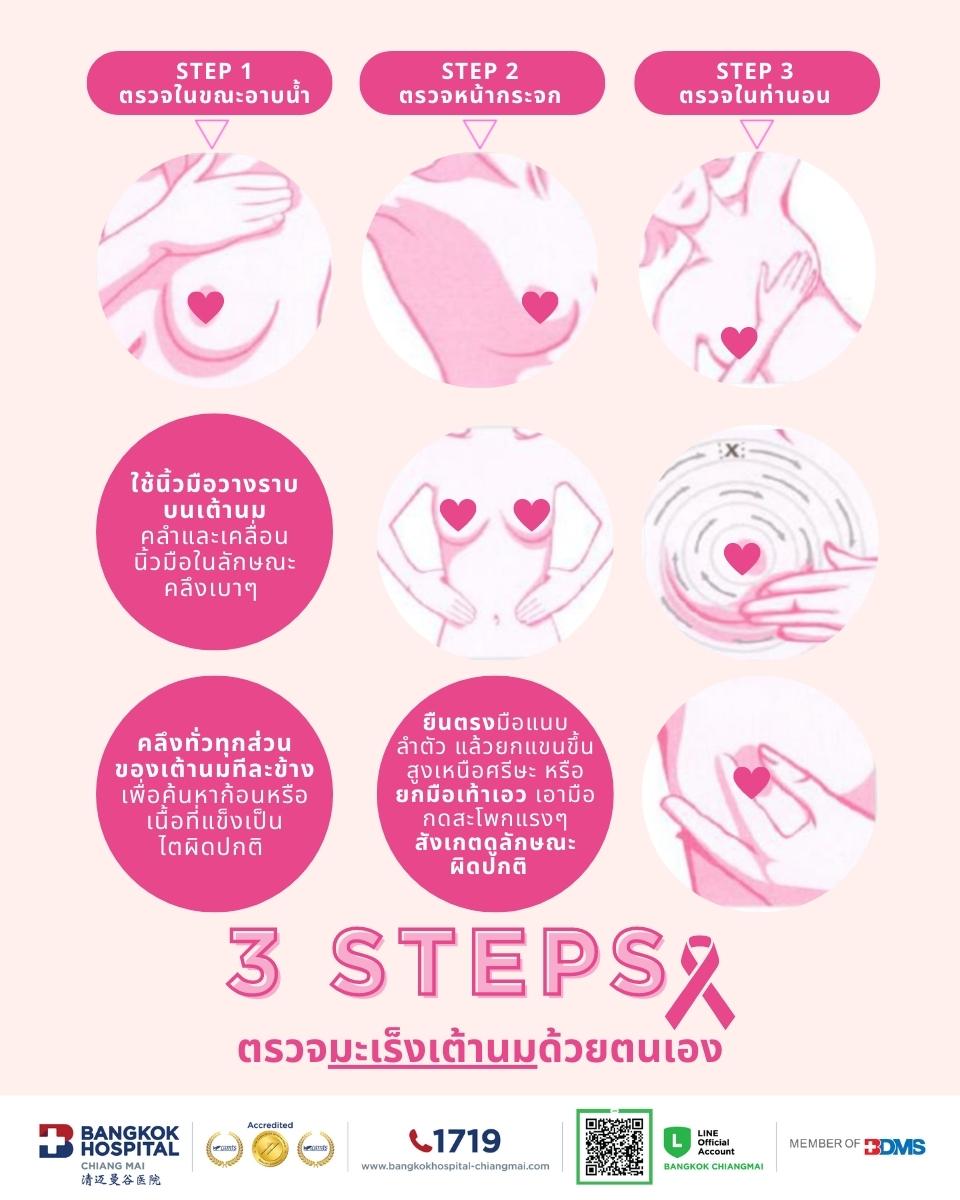
Step 1: Examination in the shower
Place your fingers flat on your breast, palpate, and move your fingers in a light circular motion over all parts of the breast one side at a time in order to detect any lumps or abnormal hard tissue.
Step 2: Examination in front of a mirror
a. Stand with arms at your sides, then raise your arms high above your head. Observe the appearance of both breasts. Raising your arms can make it easier to spot abnormalities. b. Place hands on hips and press down firmly to contract chest muscles, and observe for any unusual characteristics.
Step 3: Examination while lying down
Lie down with one hand placed under your head, and use the other hand to thoroughly palpate all parts of the breast one side at a time. Start from the outer area and the top of the breast (from X in the image), and move in concentric circles towards the breast area. Try to check every part, then gently squeeze the nipple with your thumb and index finger to see if there is anything unusual that comes out.
The area where breast cancer is most frequently found
The upper outer part of the breast, so special attention should be given to this area during the examination. Also palpate under the armpit and above the collarbones on both sides to check for enlarged lymph nodes.
How to care for your breasts
Self-breast examination once a month, about 1 week after menstruation
Breast examination by a medical doctor once a year
Breast examination by mammogram and ultrasound once a year for women over 40 years old
Self-breast examination to prevent and detect cancer in its early stages for Thai women. It is recommended to do a self-breast examination once a month, on the 7th to 10th day after menstruation. If unsure about the examination or suspect any abnormalities, immediately consult a doctor.
Abnormalities that require immediate medical consultation
Finding an unusual hard lump or tissue
Discharge of lymph fluid or blood from the nipple
Dimpling of the breast skin
Nipple retraction
The two breasts are not at the same level
An unusual difference in size and shape of the breasts






 3 Steps for Self-Breast Cancer Examination Every woman is at risk of developing breast cancer, which is a silent threat commonly ranked as the number 1 cancer found in Thai women. Early detection can help prevent the spread of cancer and increase the chance of a complete cure.