
The smoke from forest burning in the February to April period every year has been causing health problems to the people in the north for many years. The health problems from the smoke range from skin reactions causing rashes, conjunctivitis affecting the heart disease to respiratory diseases such as aggravated allergic rhinitis, asthma attacks, exacerbated emphysema, etc. The combustion results in both small and large particles, but the particles that impact the respiratory system are those smaller than 10 microns (particulate matter: PM10) since they can penetrate the lower respiratory tract. Apart from PM10, there are also PM2.5 particulates (particles smaller than 2.5 microns), which are even smaller and similarly affect the body.
Therefore, when the smoke season arrives, we should prepare to deal with the smoke. The recommended course of action depends on the Air Quality Index (AQI), which is derived from calculations based on the general atmospheric quality standards of air pollutants, including 1-hour average ozone gas, 1-hour average nitrogen dioxide gas, 8-hour average carbon monoxide gas, 24-hour average sulfur dioxide gas, and particles smaller than 10 microns or 2.5 microns over 24 hours. The level of PM10, PM2.5, or the Air Quality Index that begins to affect public health and the practical guidelines depend on each country’s specifications. The World Health Organization has set the lowest achievable PM10 level averaged over 24 hours at 50 µg/m³. In the United States, the level of PM10 over 24 hours that begins to affect health is set at 150 µg/m³. In Thailand, the 24-hour average PM10 level that begins to affect health is set at 120 µg/m³.
Air Quality Index levels and guidelines from the Ministry of Public Health and the Pollution Control Department in 2015 are divided into 5 levels based on PM10 as shown in the table
(The Pollution Control Department of Thailand has not yet included PM2.5 levels in the assessment)
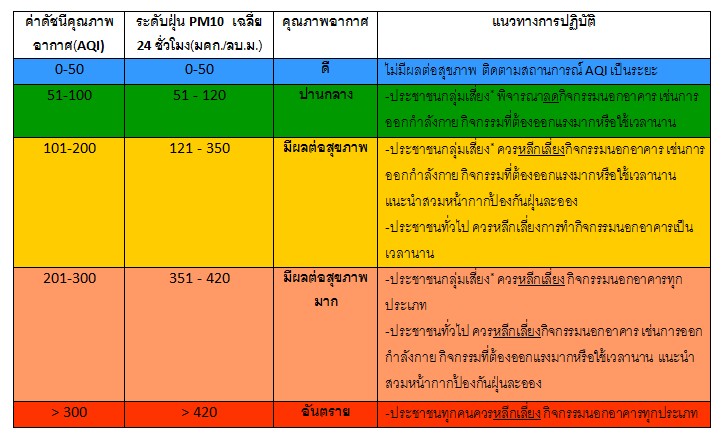
At-risk groups* include patients with respiratory diseases such as asthma, emphysema, heart disease patients, young children, the elderly, and pregnant women.
Air Quality Index levels and guidelines of the United States from www.epa.gov are divided into 6 levels as shown in the table
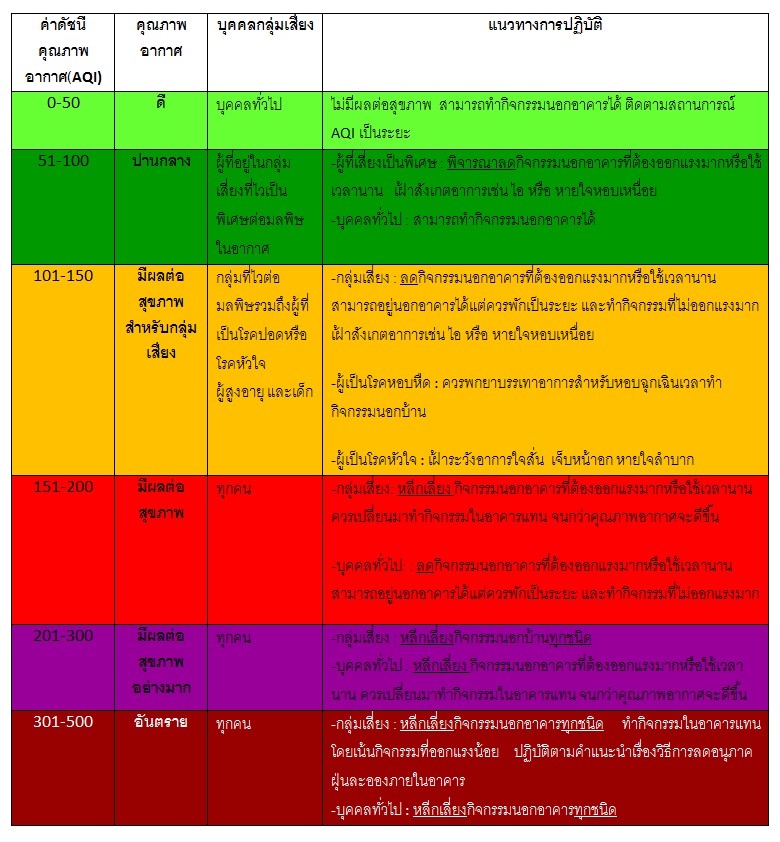
From the recommendations, we can see similarities. If the air quality starts to impact health, outdoor activities requiring exertion should be reduced or avoided, such as exercising, brisk walking, or running, as these activities lead to faster breathing, which increases inhalation of particulates or pollutants. If possible, activities should be moved indoors, like indoor exercises. If it is necessary to engage in outdoor activities on days when the air quality is at a level affecting health, especially for at-risk groups, wearing a particulate respirator mask is advised. If possible, use an N95 mask as it can filter PM2.5 particulates (filters at least 95% of particulates larger than 0.3 microns). While inside buildings, reduce indoor dust by closing windows, using air conditioning that circulates indoor air instead of bringing in outside air, or consider using air purifiers.
Note
- PM10 levels and air quality can be updated from pcd.go.th (Pollution Control Department) or the air4thai application (Android & iOS) * PM2.5 is not used in air quality assessment.
- To monitor air quality based on PM2.5 levels, follow aqicn.org (a private organization with international cooperation based in Beijing) or use the Airquality application (Android) or Air visual application (Android & iOS).
- If there are abnormal symptoms such as nasal congestion, runny nose, chest tightness, easy fatigue, cough, or difficulty breathing, consult a doctor.
References Guidelines for monitoring air pollution risk areas, Ministry of Public Health 2015, WHO 2005, Air Quality index US EPA 2014, www.epa.gov
Dr. Sompop Mahattanapark
Respiratory and Critical Care Physician
Bangkok Hospital Chiang Mai Tel. 0-5208-9823