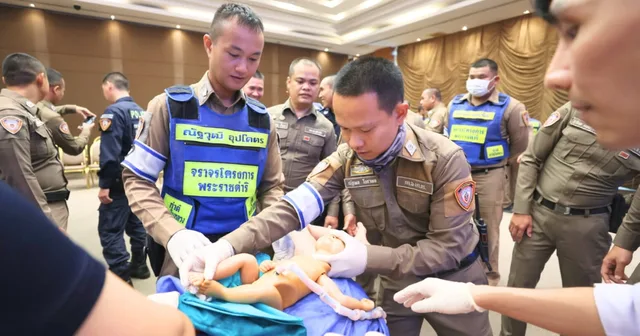
Bangkok Hospital, in collaboration with the Traffic Police Division, successfully hosted the 10th annual training program on “Basic First Aid and Emergency Childbirth” for officers under the Royal Initiative Traffic Project. The program, held on September 21, 2025, aimed to strengthen the readiness of frontline officers in providing lifesaving assistance during emergencies—including care for accident victims, patients in critical conditions, and expectant mothers in labor prior to hospital transfer. Training modules included first aid fundamentals, cardiopulmonary resuscitation (CPR), and the use of Automated External Defibrillators (AEDs).
Dr. Ekkit Surakarn, Deputy Director of Bangkok Hospital, expressed that the hospital is honored to spearhead this initiative for the tenth consecutive year. He emphasized that the training covers crucial aspects of emergency response, including basic life support, first aid, emergency childbirth, and neonatal care before hospital admission. A dedicated team of physicians and healthcare professionals delivered knowledge through lectures, demonstrations, and hands-on practice to ensure participants are well-prepared to manage real-life emergencies with confidence and efficiency.
Providing specific guidance on emergency childbirth, Dr. Weerawit Prawattanakrilert, Obstetrician at the Bangkok Women’s Health Center, explained that rapid assessment and immediate preparation are vital when delivery is imminent. Key steps include evaluating contraction patterns, rupture of membranes, and the mother’s urge to push. He stressed that essential items such as sterile gloves, suction bulbs, and clean linens are critical for ensuring newborn safety, and highlighted the importance of maintaining infant warmth and airway clearance. If sterile equipment is not available, umbilical cord cutting should be deferred until hospital transfer. However, in cases where birth is unavoidable within minutes and relocation is unsafe, emergency delivery procedures must be promptly undertaken to protect both mother and child.
Underscoring the life-saving significance of first aid, Dr. Somjintana Iamsanpang, Director of the Emergency Department, highlighted that immediate intervention in cases of unconsciousness or cardiac arrest is crucial. High-quality chest compressions at 100–120 per minute, combined with timely AED use, can increase survival rates two- to threefold. She emphasized that empowering traffic police officers and first responders with these skills greatly enhances community resilience and emergency preparedness.
The opening ceremony was presided over by Pol. Col. Jirukrit Jarunaphat, Deputy Commander of the Traffic Police Division, together with Pol. Col. Prateep Srirangpairoj, Superintendent of Traffic Operations Division 6 (Royal Initiative Traffic Operations). Both leaders, along with their teams, actively participated in the training.
Now in its tenth times, the program continues to deliver outstanding outcomes, equipping officers with vital competencies that translate into tangible benefits for the broader community.