



Hernia is not a health problem that occurs only in men. Women and children can also face this condition. If warning signs are ignored, it may lead to life-threatening complications. Today, we will take you through the causes, symptoms, and treatment methods that help patients return to normal life quickly and safely.
What is a hernia (Hernia), and why do internal organs move abnormally?
A hernia (Hernia) is a condition in which organs within the abdominal cavity—most commonly the small intestine or fatty tissue—move through a pathway or an abnormally weakened muscle wall to another position, appearing as a bulge. This hernia is like an inner tire ballooning through a tear in the outer tire. The protruding organ may become trapped, causing pain and posing danger if not treated properly.
What causes hernias? A closer look at causes and everyday risk factors
Many people wonder what causes a hernia. In fact, this condition can result from congenital abnormalities as well as age-related muscle degeneration. A key trigger is persistently increased intra-abdominal pressure, and hernias are caused by important factors including:
- Accumulated straining: from chronic constipation or an enlarged prostate that requires straining to urinate
- Lifestyle behaviors: routinely lifting heavy objects or overexercising
- Lung abnormalities: chronic cough from emphysema or heavy smoking
- Physical condition: overweight/obesity, pregnancy, or ascites from liver disease
- Genetics: congenital weakness of the abdominal wall, or natural openings that do not fully close in premature infants
Common types of hernias found in men, women, and children

Hernias come in several types depending on the location. Each type has different risks and distinctive characteristics, as follows:
Groin and upper thigh hernia (Inguinal & Femoral Hernia)
This is the most common type. In men, an inguinal hernia is often found, while in women it is commonly found as a hernia in the upper thigh area, slightly lower than the groin.
Umbilical hernia (Umbilical Hernia)
Common in infants whose abdominal wall has not fully closed, and in adults with risk factors such as obesity or multiple pregnancies.
Incisional and diaphragmatic hernia (Incisional & Diaphragmatic Hernia)
Occurs at a previous surgical incision where the muscles have weakened, or at the diaphragm, causing the stomach to move up into the chest. This can lead to a feeling of tightness or fullness similar to acid reflux.
What are the symptoms of a hernia, and where are bulges commonly found?

Observing hernia symptoms in the early stage can be difficult if the lump is small. Over time, hernia symptoms become more apparent, especially with exertion. Common locations and warning signs include:
- Found in the groin: a soft bulge can be felt in the groin crease or scrotum, often more obvious when coughing or sneezing
- Found at the navel: a protruding or bulging navel, or a lump around the navel; common in children and women
- The bulge goes in and out: in the early stage, the bulge often disappears when lying flat and protrudes again when standing or straining
- A dull aching sensation: sharp twinges or a dull ache in the affected area, especially when moving
Make it clear! Regular abdominal pain vs hernia symptoms—how are they different?
Often, a hernia has symptoms similar to general abdominal pain. But if you observe carefully, you will notice clear differences that help you recognize hernia symptoms more easily. Key differences include:
- Nature of the pain: regular abdominal pain is often crampy or twisting across the abdomen, but hernia symptoms cause a dull ache localized to where the lump is
- Presence of a bulge: a hernia has a distinct palpable bulge, often related to abdominal pressure, while general abdominal pain does not have a lump
- Response to posture: symptoms from a hernia often improve when lying down, while abdominal pain from other causes usually does not change with posture
Understanding the danger of an incarcerated hernia—an emergency that requires urgent surgery
Many people may wonder, can a hernia go away on its own? The truth is that, except for umbilical hernias in some young children, hernias in adults cannot resolve on their own and tend to grow progressively larger. The most dangerous condition is an incarcerated hernia (Incarcerated Hernia), in which the intestine cannot be pushed back into place and becomes constricted until its blood supply is cut off (Strangulated Hernia), leading to intestinal necrosis, bloodstream infection, and death if emergency surgery is not performed immediately.
How is a hernia treated? What methods are used in treatment today?
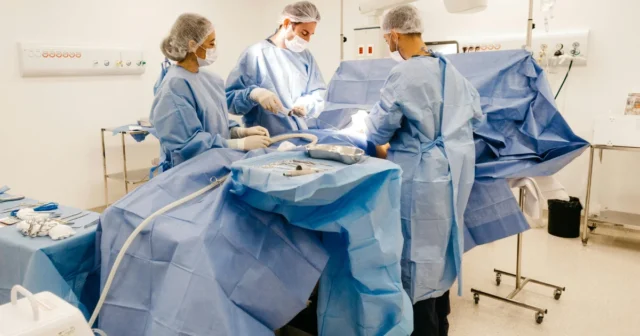
Once a hernia is diagnosed, the next question is how it is treated. Currently, surgery is the only method with effective results. The doctor focuses on repairing the torn muscle wall and reinforcing it with mesh to reduce the chance of recurrence. There are two hernia surgery methods:
Open hernia repair with mesh placement
This is the traditional surgery. An incision is made at the affected area to push the organ back and repair it with sutures. This method is suitable for patients with limitations for general anesthesia because local anesthesia can be used. However, it may involve more postoperative wound pain and a longer recovery period.
Minimally invasive laparoscopic hernia surgery and robotic surgery
Laparoscopic surgery and robotic-assisted surgery (Robotic-Assisted Surgery) allow the surgeon to see a clear, magnified 3D image and access complex areas precisely. The incisions are very small—only a few millimeters—reducing postoperative pain and helping patients recover and return to normal work within just 1–2 days.
Hernia prevention guidelines and self-care after treatment
Although surgery can treat it, behavior adjustments to reduce intra-abdominal pressure are important to prevent hernia symptoms from recurring. Basic self-care guidelines include:
- Control weight: to reduce fat pressure on the abdominal wall
- Adjust bowel habits: eat fruits and vegetables and drink clean water to prevent constipation
- Quit smoking: reduce chronic coughing that affects muscle strength
- Lift properly: use leg strength instead of bending your back and straining your abdomen
If you notice an abnormal bulge or have a dull ache in the groin area, you should not ignore it, as it may lead to complications that are difficult to control. The Surgery Center, Bangkok Hospital is ready to care for you with a team of specialized expert surgeons, together with precise robotic-assisted surgery, even in hard-to-reach and complex areas, helping reduce pain and accelerate recovery so you can access treatment standards that emphasize safety and long-term quality of life.
- Find a doctor: https://www.bangkokhospital.com/th/bangkok/doctor
- Make an appointment: https://www.bangkokhospital.com/th/bangkok/appointment/step1
- Contact us: https://www.bangkokhospital.com/th/bangkok/contact
Frequently asked questions about hernias
Can a hernia go away on its own if it is mild and there is no pain?
In adults, hernias cannot go away on their own because they are a physical abnormality involving a tear or weakening of the muscle wall. Only umbilical hernias in some infants may close on their own between ages 2–5. If left untreated in adults, symptoms often worsen and there is a risk of dangerous incarcerated bowel.
If a bulge can be felt but there is no pain, how urgently should it be treated?
Even if a hernia has no pain in the early stage, leaving it untreated is a risk because we cannot predict when the intestine will become trapped. Consulting a surgeon early to plan treatment will make surgery easier.
How is robotic-assisted hernia surgery better than conventional surgery?
Robotic-assisted surgery (Robotic-Assisted Surgery) enables surgeons to operate with high precision in hard-to-reach and complex areas through a high-resolution, magnified 3D view. Advantages include very small incisions, reduced injury to surrounding tissue, faster recovery, less wound pain, and a quicker return to normal life compared with open surgery.
Do women really have a chance of developing a hernia, and where is it usually found?
Yes. Women can develop hernias as well, although less commonly than men. The types commonly found in women are femoral hernia (Femoral Hernia), which is lower than the groin, and umbilical hernia (Umbilical Hernia), especially in women who have had multiple pregnancies or are overweight.
After hernia surgery, is there a chance it will recur?
It can recur if the original risk factors remain, such as chronic coughing, constipation, or frequent heavy lifting. However, modern surgery using reinforcing mesh together with laparoscopic or robotic-assisted techniques can greatly reduce the recurrence rate.