ERAS : Enhanced Recovery After Surgery
Surgery Center at Bangkok Hospital Headquarters places emphasis upon ERAS (Enhanced Recovery After Surgery) program designed to improve the recovery process throughout patient’s journey. Conducted prior to, during and after surgery, the ultimate goal of ERAS is to achieve a fast recovery while minimizing pre- and postoperative complications. This significantly leads to a shorter hospital stay and a quick return to daily life and activities with a full range of motion.
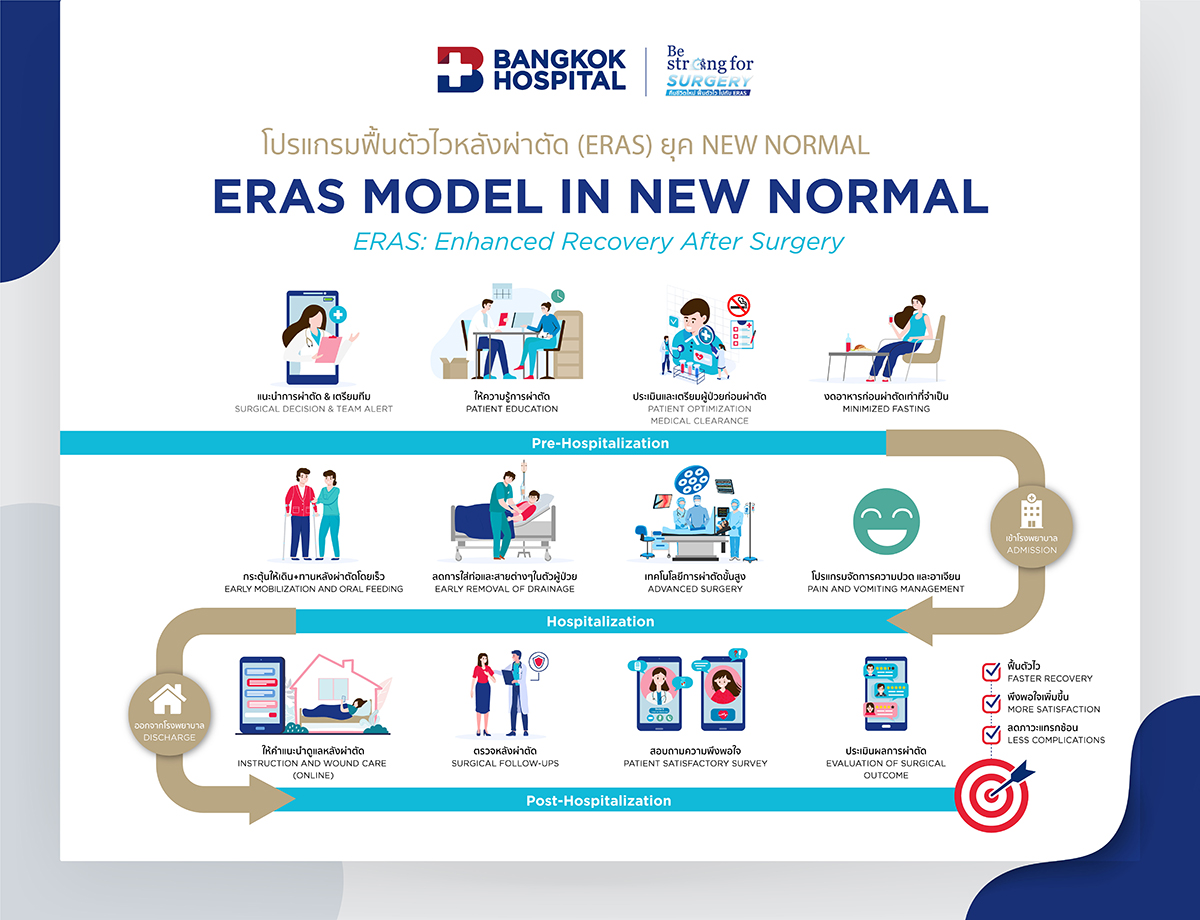
The ERAS Program – An accelerator of rapid recovery after surgery
Enhanced Recovery after Surgery Program or ERAS refers to patient-centered, multidisciplinary team developed pathways for surgeries to reduce the patient’s surgical stress, promote early mobilization, re-establish oral feeding, optimize physiologic function and alleviate pain or discomfort. Supported by cutting-edge technology in surgery and appropriate surgical approaches, the ERAS Program is conducted by a multidisciplinary team, consisting of surgeons, rehabilitation and nutrition specialists, physiotherapists, nurses and pharmacists highly specialized in surgical care. Surgical planning will be thoroughly discussed among different specialists where patients and families are involved to mutually design treatment procedures that meet patient’s preferences and needs.
1. Prior to surgery
- Medical history taking, physical examination and additional investigation will be conducted to make a definite treatment plan. All information and instructions will be explained to the patients and family members or their caregivers by the surgeons and nurses specialized in surgical care.
- In high-risk patients, e.g. elderly patients or patients with multiple underlying diseases that could affect the surgical outcome, surgical planning will be further discussed among different specialists in order to design the best possible procedure suitable for each individual.
- Pre-operative assessment will be conducted and relevant care, e.g. treatment of hematological problems such as anemia, nutrition support, quitting smoke, blood sugar control and weight control will apply, ensuring a physical fitness prior to surgery.
- Subsequently, medical clearance conducted by the internist is the next step to evaluate patient’s conditions before performing surgery, ensuring that the patients are deemed healthy enough for a proposed surgery.
- Preoperative anesthesia evaluation and pain management will be planned by an anesthesiologist.
- Different exercises emphasizing on deep breathing, coughing and pre-rehabilitation programs to strengthen the muscles and reduce the risk of postoperative complications will be introduced to each individual under close supervision of rehabilitation specialists.
- The pharmacist needs to review all current medications and supplements that might affect patient’s safety during surgery.
- To maintain a normal physiological function, fasting will be required as minimal as possible.
- Before surgery, all necessary instructions will be explained to the patients and their families by the surgeon to obtain best possible surgical outcomes.
2. During surgery
- Surgical planning made by a multidisciplinary team.
- Advanced technology in minimally invasive surgery results in less pain, fewer postoperative complications and faster recovery time.
- Cutting-edge surgical equipment and devices, e.g. laparoscopy with three-dimensional (3D) HD vision system and 4K ultra-high definition as well as the indocyanine green (ICG) fluorescence imaging technology can clearly view the boundary of lesion and adjacent organs during the operation, leading to less damages to the surrounding tissue.
- Concerning pain control and prevention of undesired effects after surgery, the anesthesiologist manages pain that widely varies from person to person by using multimodal analgesia while reducing side effects of anesthesia and morphine drugs.
- Other surgery-related issues, including nausea and vomiting induced by anesthesia, optimal body temperature and fluid administration will be efficiently managed by a multidisciplinary team.
3. After surgery
- Pain management program and techniques used to relieve stress
- Prevention of postoperative nausea and vomiting
- Monitored and advised by nutrition specialists, early oral feeding should be applied as soon as possible, enabling an improved bowel movement and a rapid recovery.
- Rehabilitation team advocates early mobilization starting on the first day after surgery to counteract catabolic changes and maintain muscle strength while minimizing the chance of blood clot formation, leading to an increased risk of venous thrombosis – blockage of a vein caused by blood clot (thrombus) and respiratory complications.
- Prior to hospital discharge, postoperative instructions, including wound care and home medications will be given. It is important that the patients need to follow post-operative appointments as scheduled, enable the surgeon to monitor surgical outcome and check on recovery. For emergencies, patients can reach the hospital around-the-clock via given contact.
ERAS program is considered a multimodal perioperative care pathway designed to achieve early recovery after surgical procedures. Adhering to international standard of Bangkok Hospital, the key elements of ERAS are comprised of patient and family education, general health optimization prior to operation, pre-rehabilitation, minimal fasting, multimodal analgesia with appropriate use of opioids, early mobilization, early removal of urinary drainage, quick initiation of oral feeding and fast recovery. Apart from excellent surgical outcome with less postoperative complications, patient’s quality of life and a quick return to normal activities are taken into the consideration.