Endovascular repair for aortic aneurysm (or aortic dissection)
What is EVAR OR TEVAR
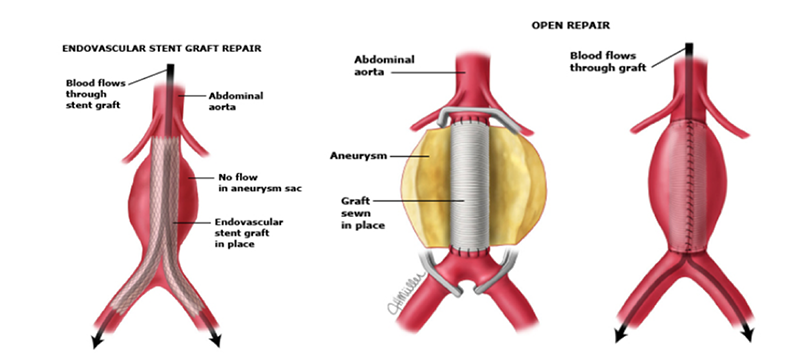
EVAR or TEVAR is a minimally-invasive (without a large abdominal incision) procedure performed to repair an abdominal aortic aneurysm.
The procedure involves the placement of an expandable stent graft within the aorta to treat aortic disease without operating directly on the aorta.
Technological advancement and more operator experience is likely to prove that this technique is safer than open repair and patient anatomy limitation will be less.
Pre-procedure evaluation
Pre-procedure evaluation include CT scan for detail information of the anatomy of the aorta that include the area of abnormality, branches vessels, femoral arteries.
Procedure
The procedure is carried out in a sterile environment under x-ray fluoroscopic guidance.
- It may be performed in an operation room, radiologic department or in catheterization laboratory.
- It is usually carried out by a vascular surgeon, and an interventional radiologist, or interventional cardiologist.
- The procedure can be performed under general, regional (spinal or epidural) or even local anesthesia.
- The usual approach is from the femoral or iliac arteries where a cut down will be made or percutaneous technique is used.
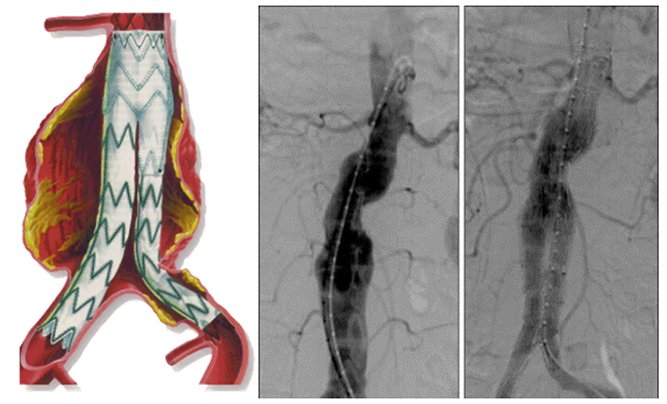
- With the use of special endovascular instruments, along with X-ray images for guidance, a stent-graft will be inserted through the femoral artery and advanced up into the aorta to the site of the aneurysm.
- A stent-graft is a long cylinder-like tube made of a thin metal framework (stent), while the graft portion is made of various materials such as Dacron or polytetrafluoroethylene (PTFE) and may cover the stent. The stent helps to hold the graft in place.
- The stent-graft is inserted into the aorta in a collapsed position and placed at the aneurysm site. Once in place, the stent-graft will be expanded (in a spring-like fashion), attaching to the wall of the aorta to support the wall of the aorta. The aneurysm will eventually shrink down onto the stent-graft.
Risks of the procedure
- Damage to surrounding blood vessels, organs, or other structures by instruments
- Kidney damage
- Limb ischemia (loss of blood flow to leg/feet) from clots
- Groin wound infection
- Groin hematoma (large blood-filled bruise)
- Bleeding
- Endoleak (continual leaking of blood out of the graft and into the aneurysm sac with potential rupture)
- Spinal cord injury
There may be other risks depending on your specific medical condition such as allergic to or sensitive to medications, contrast dyes, iodine, or latex. Be sure to discuss any concerns with your doctor prior to the procedure.
What can I do to help operation be successful?
Lifestyle changes
If you smoke, try to stop smoking now. There is strong evidence that stopping smoking several weeks or more before a general anesthetic reduces your chances of complications.
Medications
- You should continue your normal medications. However, if you are on Warfarin (or any other blood thinning medication) you will need to stop taking it before your operation. Make sure your surgeon is aware you are on Warfarin and follow advice about stopping it.
- If you are on hormone replacement therapy or the oral contraceptive pill, it may be advisable to stop these medications before your operation. If stopping the contraceptive pill, make sure you use an alternative form of contraception.
- Important Note: Before stopping any medication, you should always ask the advice of your surgeon or doctor.
How soon will I recover?
The EVAR and TEVAR is only a minimal invasive procedure that does not involve large open incision. Compared to open surgery, you should recover more quickly and will be able to go home in about 3 to 5 days. There is also less pain and less complication.
Since individual patient is different, sometime by several factors, the doctor will determine which surgical intervention is most appropriate, either open repair or EVAR.
You have been found to have an aneurysm of your aorta. Your surgeon has recommended the procedure to treat this condition. However, the decision is yours as to whether to proceed with an operation or not. If you have any questions that are not answered by this document, you should ask your surgeon or any member of the healthcare team.



.jpeg)