


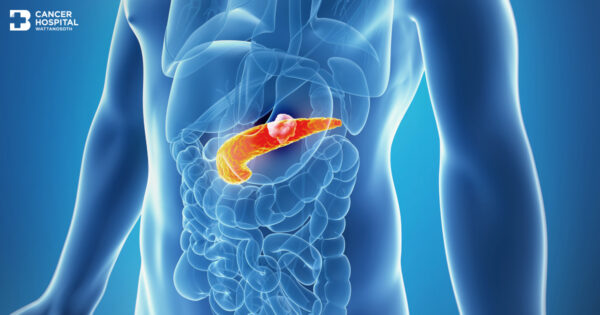

What is pancreatic cancer, what are the symptoms, how prevalent is the disease, and what risk factors contribute to developing this disease? Before understanding pancreatic cancer, it’s essential to know the location and function of the pancreas to better comprehend the symptoms and progression of the disease.
The Function of the Pancreas
The pancreas is an organ located in the upper abdomen, behind the stomach, and adjacent to the beginning of the small intestine. The head of the pancreas serves as a passageway for the bile duct from the liver. The primary function of the pancreas is to produce digestive juices to break down proteins, carbohydrates, and fats. These digestive juices are secreted at the end of the bile duct into the small intestine to further digest food. Another important function of the pancreas is to produce the hormone insulin, which helps lower blood sugar levels, and the hormone glucagon, which helps regulate the body’s sugar balance.
 Location of the pancreas in the body
Types of Pancreatic Cancer
Pancreatic cancer comes in various types, with the majority being pancreatic ductal adenocarcinoma, arising from the cells of the pancreatic duct. A smaller percentage originates from cells that produce hormones, or some are characterized by fluid-filled cysts.
Symptoms of Pancreatic Cancer
The symptoms of pancreatic cancer are divided based on the location of the tumor:
- Tumors located in the head of the pancreas are in the pathway of the bile duct. Hence, patients will experience symptoms of bile drainage obstruction, leading to yellowing of the skin and eyes, dark urine, fatigue, reduced appetite, weight loss, greasy stools due to the inability to digest fats. Initially, there may be no abdominal pain, but as the tumor grows and affects nearby nerves, abdominal pain may occur. In some cases, the patient may experience significant vomiting if the tumor is large enough to compress the beginning of the small intestine and obstruct food passage.
- Tumors located in the body and tail of the pancreas are not near the bile duct. In the early stages, patients often do not show symptoms. Symptoms begin when the tumor is large or when the disease has spread. Patients may experience fatigue, reduced appetite, weight loss, and abdominal pain due to the tumor pressing on nerves. Ascites may occur due to the cancer spreading to the peritoneal lining.

Because tumors in the head of the pancreas can easily obstruct the bile duct and cause jaundice, patients tend to seek medical attention early and tumors are often detected while still small. Conversely, tumors in the tail of the pancreas may not show symptoms until they are large or have spread. Therefore, the prognosis for patients with tumors in the tail of the pancreas is generally less favorable. Additionally, some patients may also experience diabetes or have a history of acute pancreatitis before the cancer diagnosis.
Chances of Developing Pancreatic Cancer
Pancreatic cancer is more common in individuals over the age of 45, with a ratio of 14.8 per 100,000 people, which is very low. Hence, when patients exhibit symptoms such as jaundice, fatigue, weight loss, they should always consider more common diseases such as cirrhosis, hepatitis from various causes, liver cancer, or other conditions causing bile duct obstruction like gallstones, bile duct cancer, etc.
However, the likelihood of developing pancreatic cancer increases in patients who have breast cancer with BRCA genes, a family history of pancreatic cancer, smoking habits, and a diet high in animal fats and meat.
Diagnosis and Treatment of Pancreatic Cancer
Patients often come with symptoms of jaundice, fatigue, weight loss, and chronic abdominal pain. To differentiate from other diseases, it’s essential for patients with these symptoms to visit a doctor for a history taking, physical examination, and initial laboratory tests such as blood cell counts and liver function tests. If the characteristics match with bile duct obstruction, the doctor may order further examinations such as an ultrasound, CT scan, and consider biopsy on a case-by-case basis.
Regarding treatment, the physician will first assess the stage of the disease based on radiographic images. If it’s possible to completely remove the tumor surgically, that will be considered. However, if the tumor cannot be fully resected, chemotherapy and supportive care will be considered on an individual basis.