

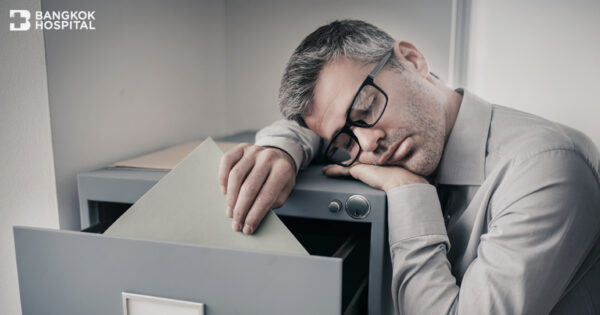
Feelings of drowsiness or not getting enough sleep, or falling asleep spontaneously, are not a laughing matter. These symptoms could be a warning sign of narcolepsy. Pay attention to them, otherwise you could
put yourself into a dangerous situation when driving or working with machinery.
Dr. Jakrin Loplumlert, a specialist in neurology, epilepsy, and sleep disorders at the Bangkok Neuroscience Center, Bangkok International Hospital, has said that drowsiness is a major problem nationwide because it causes accidents with motor vehicles. Drowsiness can result from sleep deprivation, having said that many who suffer from drowsiness are not aware of this. The condition can affect life and property in much the same way as drunk driving. Most importantly, there is no testing for drowsiness, like alcohol testing for drivers.
Statistics indicate that most motor vehicle accidents occur from 4:00 a.m. to 6:00 a.m., a period when people are apt to feel sleepy. Another period when people feel sleepy is from 2:00 p.m. to 3:00 p.m., which reduces work performance and increases the chances of nonperformance or failure, especially in work that requires high precision.
Sleep deprivation can be caused by additional responsibilities at work. Also,the chronic use of social networking venues such as Line and Facebook make many people, especially teenagers, sleep late. Superficially, these may seem like easy problems to fix, but in practice behavior modification is difficult to effect in teenagers, office workers, and elderly people. For the most part,people should sleep at least seven to eight hours each night, depending on their age. Insufficient sleep leaves people sleepy and drowsy when they wake up. And even if they sleep a sufficient number of hours, people don’t feel refreshed upon awakening if they don’t go to sleep at the proper time. The
problem of daytime sleepiness can be due to a variety of physical disorders.
Sleepiness is not a result of “being lazy”, as many people think, but rather can possibly be due to abnormal brain functions that cause drowsiness or a tendency to fall asleep, specifically the lack of neurotransmitters in the brain called hypocretins, rendering the brain unable to control its normal sleep cycle. Sometimes, people fall asleep while driving or studying. The condition is usually found in children and adolescents. There may be other symptoms
as well, such as sleep paralysis, a feeling of being conscious but unable to move even while being aware of one’s surroundings, hypnagogic hallucinations, and auditory hallucinations. Other symptoms include sudden weakness in the arm and leg muscles, which may occur when a patient is in an emotional state (e.g. laughter).
If the above symptoms occur, see a doctor. Narcolepsy can be detected by examining the way that you sleep or fall into a drowsy state. Additional testing can help to ensure the accuracy of the diagnosis and facilitate development of an effective treatment plan. According to Dr. Jakrin, examinations should begin with an assessment of a patient’s history, followed by the patient wearing an Actigraphy watch for one to two weeks to monitor sleeping and waking patterns and to make sure that the patient does not behaviorally experience sleep disorder(s) (including lack of sleep) which could potentially result in excessive daytime somnolence. This data will help the doctor calculate the efficiency of the patient’s sleep in detail. The doctor will then administer a nighttime sleep test, allowing the patient to sleep just like at home. The test measures brain waves, breathing, oxygen levels, and other indicators to detect any disorders such as sleep apnea, a serious sleep disorder associated with heavy snoring that occurs when a person’s breathing is interrupted during sleep; sleep apnea is a cause of drowsiness during the day. The sleep test ensures that the patient actually sleeps at least six to seven hours during the night of the test. After the nighttime sleep test, the patient will be tested during five daytime naps. The naps, which take place in a sleep lab, occur every two hours. The doctor will monitor how many minutes it takes for the patient to fall asleep. If it takes less than eight minutes for a patient to fall into a sleep that includes dreaming, on at least two of five occasions, the result is considered abnormal drowsiness which may be secondary to narcolepsy.
Treatment can control the symptoms to the degree that they do not become aggressive and affect the patient’s lifestyle. Sleep disorder can be treated by the use of stimulant medicine to make the patient alert. Medicine must be administered under a physician’s control. The doctor may have to help the patient adjust his or her routines by scheduling sleeping to occur at least seven to eight hours per night, adding naps during the day to reduce drowsiness. Patients may be asked to not drink alcohol or smoke, and to avoid any activities that are dangerous when the symptoms occur such as driving or working with machines. Currently, narcolepsy cannot be prevented.
The best approach is to carefully observe one’s own sleeping habits and complaints. If any of the above-mentioned symptoms are found, a patient should see the doctor for treatment.