


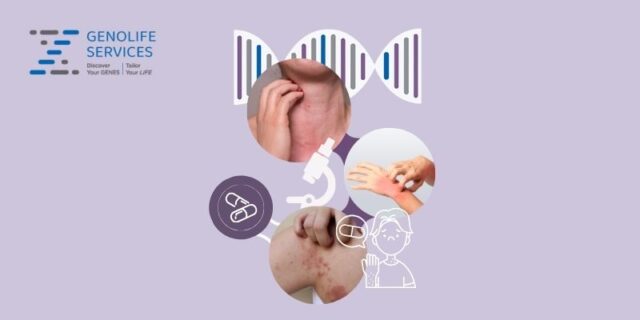
HLA-B*58:01 Pharmacogenomic Panel
Why Genotyping Before the First Dose Matters

Clinical risk
Severe cutaneous adverse reactions (SCAR: SJS, TEN, DRESS) develop in ≈ 0.1 – 0.4 % of new allopurinol users, yet case-fatality can exceed 20 %.

Genetic prevalence
HLA-B*58:01 occurs in 10 – 15 % Han-Chinese, ≈ 12 % Korean, ≈ 6 – 16 % Thai, ~6 % Japanese, ≈ 3 – 4 % African-American, and < 1 % European populations.

Effect size
Carriers face ≥ 70-fold higher odds of allopurinol-induced SJS/TEN compared with non-carriers.

Guideline consensus
CPIC and the American College of Rheumatology (ACR 2020) advise HLA-B*58:01 testing for patients of Southeast-Asian or African-American ancestry before starting allopurinol.
Who Should Be Tested?
- All Han-Chinese, Thai, Korean, or other SE-Asian patients – Because: Highest allele prevalence & SCAR risk
Your Journey with Genolife Services
We guide you through every step, from counselling to creating a health safety plan.
 |
Pre-test CounsellingUnderstand benefits, limits, and alternatives. |
 |
Sample CollectionA simple 2 mL EDTA blood draw. |
 |
Expert InterpretationReviewed by a multidisciplinary team of specialists. |
 |
Post testdescription for family screening |
Contact us for a consultation with our Genetic Counselor/Pharmacogenomics Specialist about the Allopurinol Hypersensitivity Screen or other genetic tests.
References
- Hershfield MS et al. CPIC Guideline for HLA-B Genotype and Allopurinol Dosing. Clin Pharmacol Ther. 2013.
- Saito Y et al. CPIC guideline update review, 2015.
- NCBI GeneReviews®. Allopurinol Therapy and HLA-B*58:01 Genotype. 2020 update.
- ACR Gout Management Guideline. 2020.
- Somkrua R et al. Meta-analysis: OR ≈ 74 for SJS/TEN in HLA-B*58:01 carriers. Pharmacoepidemiol Drug Saf. 2011.
- Puangpetch A et al. HLA-B allele diversity in Thais: 16 % HLA-B*58:01. Hum Immunol. 2015.
- Tassaneeyakul W et al. Allopurinol-induced SJS/TEN and HLA-B*58:01 in Thai patients: sensitivity 100 %, specificity 87 %. Clin Pharmacol Ther. 2009.