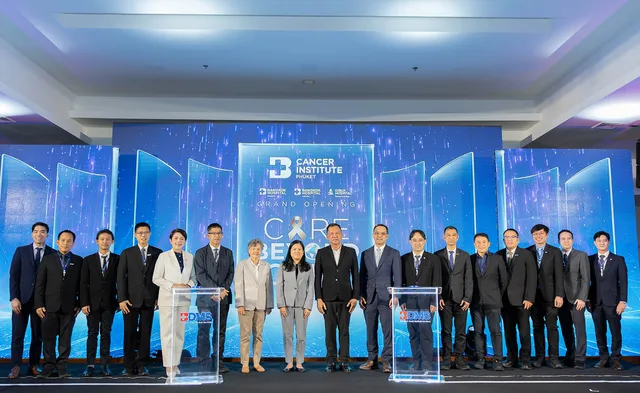


PHUKET, Thailand – In a significant advancement for cancer care across the globe, leading private healthcare providers in Phuket have launched a new front in the fight against colorectal cancer, integrating artificial intelligence and liquid biopsy technologies into routine screening. The initiative was unveiled during the annual “Dress in Blue Day” campaign on March 6, underscoring a commitment to early detection and world-class treatment. This local effort comes at a critical time, as global data reveals a shifting and increasingly complex picture for the disease worldwide.
Bangkok Hospital Network in Phuket, including Bangkok Hospital Phuket, Bangkok Hospital Siriroj, and Dibuk Hospital, marked the occasion with medical staff donning blue attire—the international symbol of colon cancer awareness. The event served as a platform to introduce cutting-edge diagnostic tools that promise to redefine patient outcomes.
Leading the initiative were key figures from the network’s leadership. The opening was presided over by Dr. Lalita Kongseeha, Assistant CEO, BDMS Group 6 and Hospital Director of Bangkok Hospital Phuket and Dibuk Hospital, alongside Dr. Piriya Atisook, Hospital Director of Bangkok Hospital Siriroj. They were joined by Professor Dr. Art Hiranyakas, Director of Phuket Cancer Institute, who detailed the technological advancements and their implications for patient care.
A Global Threat Intensifies
Medical experts at the institute highlighted the urgent need for such advanced measures. Colorectal cancer is now the second-most commonly diagnosed cancer in Thailand for both men and women, a trend driven by modern dietary habits and lifestyle factors. However, this local statistic is mirrored by a concerning global trajectory.
According to the most recent Global Burden of Disease (GBD) 2021 study, the number of new colorectal cancer cases worldwide has more than doubled, skyrocketing from approximately 916,000 in 1990 to over 2.19 million in 2021—a staggering increase of 139.38%. While mortality rates have declined in high-income nations thanks to improved screening and treatment, the incidence is rising sharply in middle-income regions, with experts pointing to dietary westernization, obesity, and sedentary lifestyles as key drivers.
Adding to the urgency is the rapid rise of early-onset colorectal cancer in adults under 50. The global incidence rate for this group has increased from 3.96 per 100,000 in 1990 to 5.37 per 100,000 in 2021. Alarming projections suggest that by 2030, incidence rates could rise by up to 90% for those aged 20-34. “It’s clear that colorectal cancer can no longer be called an old person’s disease,” a leading expert from the American Cancer Society has noted, a sentiment echoed by oncologists worldwide.
“The traditional perception of this as a disease of the elderly is changing rapidly,” stated Professor Dr. Art Hiranyakas of the Phuket Cancer Institute. “The rise in incidence among younger populations globally is a wake-up call. Here in Thailand, the increasing prevalence is driven by the consumption of processed foods, low-fiber intake, alcohol, and smoking. We strongly urge that individuals aged 45 and over, those with a family history of the disease, and patients with chronic intestinal inflammation undergo regular screening.”
Global Innovation Deployed Locally
In response to these alarming trends, the institute has deployed a suite of international-standard technologies designed to detect malignancies at their most treatable stages. The centerpiece of this new screening protocol is a dual-pronged approach:
- AI-Assisted Colonoscopy: The integration of artificial intelligence allows for real-time analysis during endoscopic procedures. The system acts as a highly sensitive second observer, flagging polyps and lesions that are minuscule or morphologically subtle, thereby significantly increasing the adenoma detection rate and preventing progression to cancer.
- Liquid Biopsy (ctDNA): Moving beyond traditional tissue biopsies, the institute is utilizing circulating tumor DNA (ctDNA) testing. This advanced blood test can identify genetic mutations associated with tumors from a simple blood draw, enabling highly accurate detection of colorectal and other common cancers in their earliest stages without the need for invasive tissue sampling.
Comprehensive and Personalized Care
These screening innovations are part of a broader, holistic strategy that extends to treatment. The institute is also pioneering Precision and Personalized Medicine, tailoring treatment plans based on an individual’s genetic profile to maximize efficacy. Furthermore, for rectal cancer patients, specialists are performing Sphincter Preserving Surgery, a technique that maintains quality of life by avoiding a permanent colostomy.
The facility’s commitment to comprehensive care also includes “advanced screening for anal canal cancer”, utilizing High-Resolution Chromoanoscopy and Anal PAP smears to detect cellular abnormalities early.
Elevating Phuket’s Medical Hub Status
The introduction of these advanced technologies marks a strategic move to position Phuket not just as a premier tourist destination, but as a world-class medical hub. By offering cutting-edge cancer care, the network aims to serve both the local population and a growing number of international patients seeking high-quality medical tourism options.
“The integration of AI and ctDNA technology into our screening programs represents a quantum leap in our ability to combat this disease,” added Dr. Lalita Kongseeha. “Our mission is to provide the highest standard of care, shifting the focus from treatment to prevention and early, accurate detection. This is about building a sustainable, healthier future for our community and beyond.”
Bangkok Hospital Network in Phuket and its Phuket Cancer Institute continue to champion public awareness and access to modern medical technology as the cornerstones of their effort to reduce the global burden of colorectal cancer.