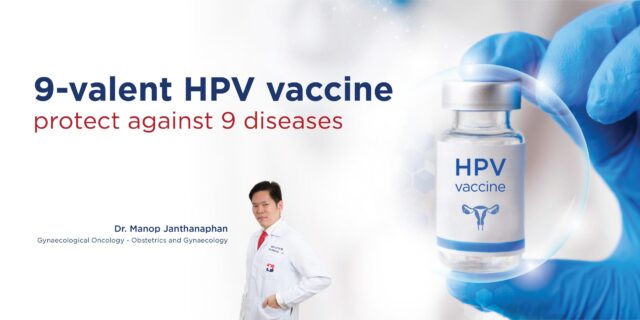
Currently, there are 3 types of HPV vaccines available: 2-valent, 4-valent, and 9-valent vaccines
Effectively prevents non-cancerous HPV infections, including genital and anal warts, cervical cancer, anal cancer, vaginal cancer, and penile cancer
Recommended for women and men aged 9-45 years
Two doses with 6-week interval between the first and second doses
Vaccine efficacy
Provide 99%* protection against cervical cancer induced by HPV-16 and HPV-18
Provide 90%* protection against cervical cancer induced by other HPV types
Provide 90%* protection against genital warts.
Safety
Certified by the Food and Drug Administration (Thai FDA) of Thailand and other countries
There are only a few side effects, most of which are mild, such as pain, swelling, redness at the injection site, fever, muscle pain, and headache
Advantages
Comprehensive protection against cancer and other diseases induced by HPV
Requires 2 doses only with 6-week interval between the first and second doses
Great efficiency and safety
Disadvantages
More expensive than the 2-valent HPV vaccine
No data on long-term effects available
There may be side effects after the injection which are pain, swelling, and redness at the injection site
Recommended for
Girls aged 9 – 14 years should get 2 doses of this HPV vaccine with 6-week interval between the first and second doses
Women and men aged 15 – 45 years can get this HPV vaccine at their doctor’s discretion
Conclusions
Choosing the right HPV vaccine type for each patient is a decision made by doctors
HPV vaccination is the best way to prevent cervical cancer and other diseases caused by HPV, however it is not 100% preventable
You should use additional methods to prevent HPV infection such as regular vaginal examination, using condoms during each sexual intercourse, and refraining from smoking




![[Bangkok Hospital Siriroj - Phuket] HPV Gardasil Vaccine 9 Strains (3 Doses)](https://static.bangkokhospital.com/uploads/2026/07/HPV-Gardasil-Vaccine_OBG-BSI-2026-9-strains-Cover-02_resized-73-44-300x300.jpg)


![[Bangkok Hospital Siriroj - Phuket] HPV Gardasil Vaccine 9 Strains (3 Doses)](https://static.bangkokhospital.com/uploads/2026/07/HPV-Gardasil-Vaccine_OBG-BSI-2026-9-strains-Cover-02_resized-73-44-card_optimized.webp)