

Understanding Gingivitis
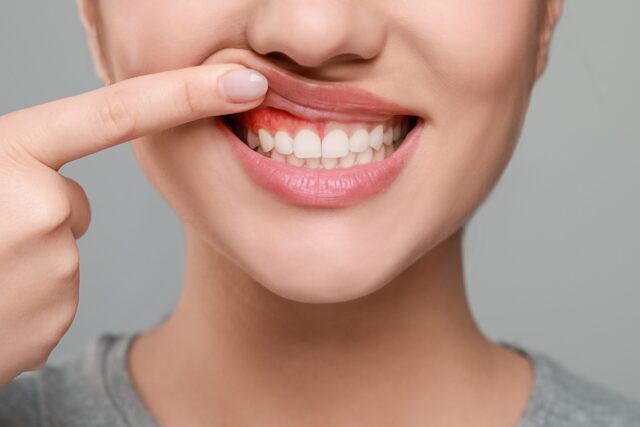
Gums are part of the periodontal tissues that serve to anchor the teeth to the jawbone and support the force during chewing. Healthy gums are pink, have smooth edges, are not swollen, and do not bleed. Gingivitis affects up to 80% of the population, often without symptoms. Characteristics of gingivitis include red gums, possibly slightly swollen, and can be easily observed as “bleeding when brushing teeth,” which most people believe results from brushing too hard or using a toothbrush with bristles that are too stiff.
Causes of Gingivitis
The cause of gingivitis is “plaque,” which is formed from the accumulation of germs mixed in the saliva on the tooth surface. Plaque appears as a soft white deposit and is often invisible in small amounts because its color blends with the teeth. If plaque is left undisturbed, minerals accumulate to form “calculus or tartar,” which promotes further plaque accumulation. The germs adhering to calculus produce toxins, which provoke an inflammatory response in the gums. If gingivitis is left untreated in some patients, it can become “periodontitis,” which was formerly known as pyorrhea and is the primary cause of tooth loss in adults.
Treating Gingivitis
Gingivitis can be easily treated by scaling (cleaning the tartar) along with improving brushing techniques and using appropriate supplemental tools to prevent new plaque buildup, which causes the disease. Most people should have tartar removed every 6-12 months.
Understanding Periodontitis
The characteristic of periodontitis is that the gums do not adhere to the teeth and are accompanied by bone destruction supporting the teeth. This can be detected by probing the gingival sulcus, known as “periodontal pocket,” resulting from germs producing toxins that excessively stimulate the body’s response, causing destruction of the gums and bones anchoring the teeth. In its early stages, periodontitis often has no symptoms. Observable signs are similar to gingivitis, i.e., red gums that are slightly to moderately swollen with bleeding when brushing. As the disease progresses and the bone supporting the teeth are significantly destroyed, you may find receding gums, loose teeth, or teeth shifting out of their original positions, pus formation, and bad breath, or large swollen gums known as periodontal abscesses. When these symptoms occur, treatment becomes complicated, time-consuming, and costly, and in some cases, it may not be possible to save the teeth.
Treating Periodontitis
When periodontitis occurs, involving bone resorption, the treatment process becomes more complex and can be divided into three phases:
- Initial or disease control phase, involves scaling and root planing, which may require multiple treatment sessions to complete the entire mouth depending on the depth of the periodontal pockets and the amount of subgingival calculus.
- Corrective phase, in severe cases, initial treatment may not completely remove all subgingival calculus, requiring surgical intervention in some areas. In suitable cases, bone grafting can be performed as part of the periodontitis treatment.
- Maintenance phase, the final phase, as the cause of periodontitis is germs from saliva accumulating on the teeth. Even after treatment is completed, without regular care, the disease can easily recur. Therefore, after treatment, the patient should have tartar scaled regularly to prevent recurrence. Most patients with a history of periodontitis should have scaling every 3-6 months.
Impact of the Disease on Gum Health
Periodontitis results from the body’s response to germs in plaque. Factors affecting immunity increase the risk of periodontitis. Significant factors include diabetes and smoking. Diabetic patients are up to 2 times more likely to have periodontitis than non-diabetic patients, and if diabetic patients have poor blood sugar control, they are 11 times more likely to develop periodontitis compared to normal patients. Similarly, smoking also increases the risk. However, if patients can control blood sugar levels well and reduce or quit smoking, the chance of successful periodontitis treatment increases.