

How Important Is COVID-19 Immunity Testing, and Is It Necessary?
“COVID-19 immunity testing—also known as COVID antibody testing, immunity level testing, or measuring antibody levels in the body after COVID-19 vaccination—raises many questions. Is it necessary to get tested? When is the best time to check immunity after vaccination to obtain the most stable results? Does receiving the vaccine mean you will not get infected with COVID-19 at all?
These questions often arise from concerns among people who have received the COVID-19 vaccine and are seeking reassurance, peace of mind, reduced anxiety, and the confidence to return to normal daily life.”
Table of Contents
- What Is COVID-19 Immunity Testing?
- The Importance of COVID-19 Immunity Testing
- Types of COVID-19 Immunity Tests
- How to Prepare Before COVID-19 Immunity Testing
- Common Misunderstandings About COVID-19 Immunity Testing
- Cost of COVID-19 Immunity Testing

What Is COVID-19 Immunity (Antibody) Testing?
COVID-19 immunity testing, or COVID-19 antibody testing, is a blood test used to measure the level of immunity that the body has against the COVID-19 virus. It is generally recommended to be performed after full recovery from infection or at an appropriate interval after vaccination, and may also be repeated after a certain period of time has passed.
Importance of COVID-19 Immunity Testing
Testing immunity after vaccination is important because it helps determine how much immune protection remains in the body, how significantly immunity has declined over time, and how effectively the body can respond to the disease. The severity of COVID-19 infection varies among individuals, and immunity levels after recovery may also differ.
Although there is currently no international standard defining the exact antibody level considered sufficient or clearly indicating when booster vaccination is required, immunity testing still provides valuable information for assessing individual immune status.
Types of COVID-19 Immunity Testing After Vaccination
Binding Antibody Testing
This test detects IgG and IgM antibodies. Rapid tests are commonly used and provide quick results, reported as Positive or Negative. Some test kits can distinguish between IgG and IgM separately, while others report combined results, depending on the type of test kit used.
Neutralizing Antibody Testing
This test measures the ability of antibodies to neutralize the virus. It evaluates antibody activity by testing against live virus (PRNT) or virus-like particles that simulate the virus (pVNT).
The results of neutralizing antibody tests (NAb) are reported as a percentage of inhibition (% inhibition) by comparing serum-containing wells with control wells that do not contain serum. The result reflects the maximum dilution level at which antibodies can prevent the virus from entering cultured cells.
How Should You Prepare Before COVID-19 Immunity Testing?
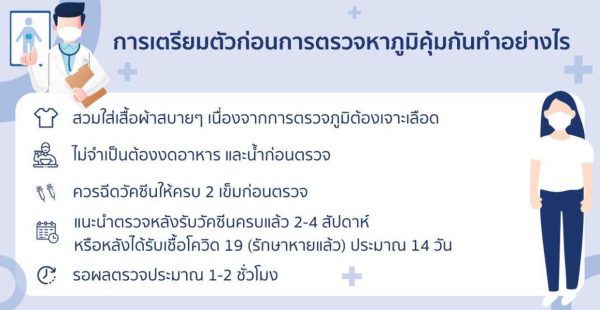
Preparation for COVID-19 immunity testing involves a simple blood test. There is no need to fast or restrict food and water intake prior to the test. Test results are usually available within 1–2 hours.
Recommendations:
It is advised to complete two doses of COVID-19 vaccination before testing. If immunity testing is desired, it is recommended to undergo testing 2–4 weeks after vaccination, with 4 weeks being the most beneficial for stable results.
For individuals receiving a booster dose when antibody levels are already high, testing can be performed after vaccination, with an additional follow-up test recommended at 12 weeks.
At present, there is no standardized guideline specifying the exact timing for immunity testing. However, based on research references, testing is often conducted at 0, 2, 4, 8, 12, 16, and 24 weeks. Testing at 4, 12, and 24 weeks after the second dose or booster dose is considered appropriate—not too early, not too late, and not excessively frequent—depending on the testing methods available at each medical facility.
Common Misconceptions About COVID-19 Immunity Testing
-
The more frequently immunity is tested, the faster immunity declines
This is incorrect. Immunity naturally declines over time depending on each individual’s body, and the rate of decline varies from person to person. Immunity testing is merely a snapshot at a specific point in time and does not affect the speed at which immunity decreases. -
Immunity testing should be done immediately after vaccination
In reality, there is no need to rush. In some cases, antibody levels may not have risen yet. After vaccination, the body first produces short-term antibodies (IgM), followed later by long-term antibodies (IgG). As a result, antibody levels usually increase significantly around 2 weeks after vaccination, and then gradually decline over time. -
Why do people vaccinated with the same vaccine on the same day have different antibody levels?
This is because the human body varies greatly in terms of age, sex, immune response capacity, underlying medical conditions, lifestyle behaviors, and other factors. These differences lead to varying levels of immunity after vaccination. -
Dietary supplements such as vitamin C, zinc, or vitamin D can significantly increase or prolong immunity and cause falsely elevated test results
Currently, there is no clear evidence that dietary supplements interfere with blood tests for immunity levels or can definitively increase or extend immunity after vaccination. -
High immunity levels increase the risk of lymphoma
This is not true. In fact, the Lymphoma Research Foundation still recommends COVID-19 vaccination for patients with lymphoma.