Understanding UCEP Rights
UCEP (Universal Coverage for Emergency Patients)
UCEP is a government healthcare policy designed to protect patients experiencing critical emergency conditions, allowing them to receive treatment at the nearest hospital without upfront payment until they are out of critical condition and can be safely transferred, for a period of up to 72 hours.
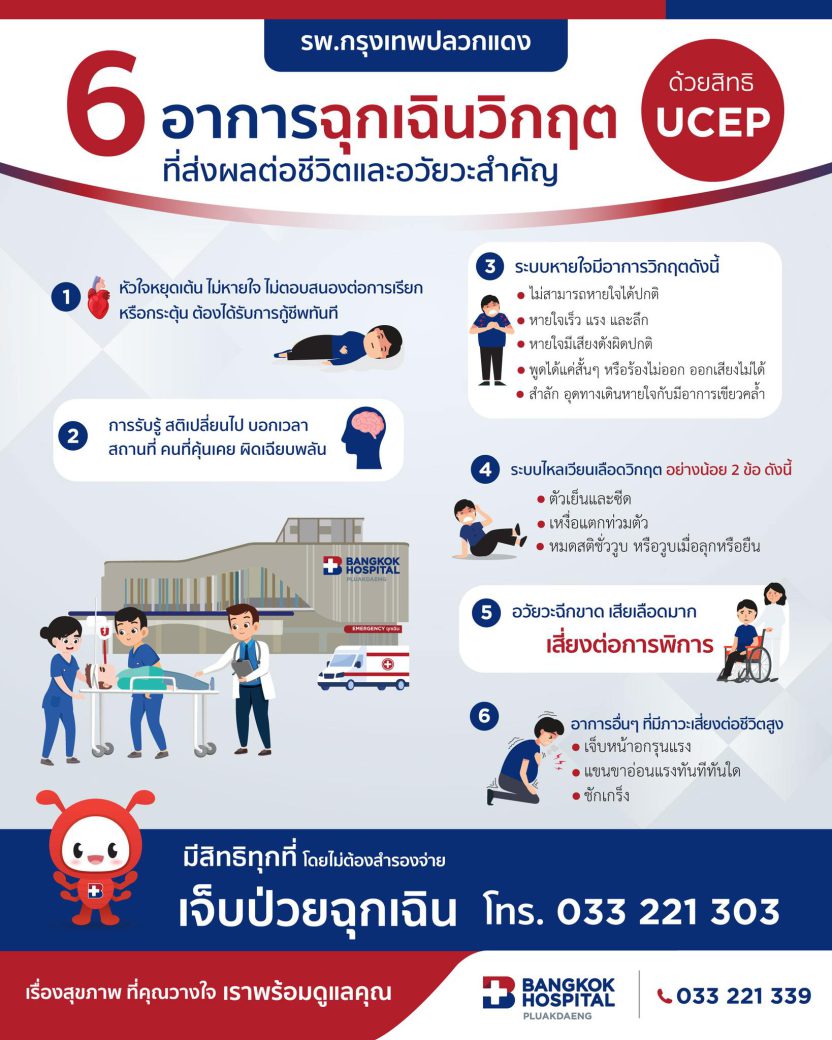
Six Critical Emergency Conditions Affecting Life and Vital Organs (UCEP)
These include:
-
Unconsciousness, unresponsiveness, or not breathing
-
Rapid breathing, severe shortness of breath, labored breathing with abnormal sounds
-
Decreased consciousness, cold sweats, cold body
-
Sudden, severe chest pain
-
Sudden weakness on one side of the body, slurred speech, acute seizures that do not stop
-
Other life-threatening conditions affecting the respiratory system, circulatory system, or brain
If you experience any of these symptoms, please refer to the information below or contact us for consultation regarding UCEP rights at
Tel: 033 221 303 – Bangkok Hospital Pluak Daeng
The 6 Critical Emergency Conditions (UCEP)
Condition 1:
Cardiac arrest, not breathing, unresponsive to calls or stimulation — requires immediate resuscitation
Condition 2:
Sudden change in consciousness — unable to correctly identify time, place, or familiar people
Condition 3: Critical respiratory conditions, including:
-
Inability to breathe normally
-
Rapid, forceful, deep breathing
-
Abnormal loud breathing sounds
-
Able to speak only short phrases or unable to speak or vocalize
-
Choking or airway obstruction with bluish discoloration
Condition 4: Critical circulatory conditions (at least 2 of the following):
-
Cold and pale skin
-
Profuse sweating
-
Fainting or dizziness when standing or walking
Condition 5:
Severed limbs or severe blood loss, which may result in permanent disability
Condition 6:
Other life-threatening conditions, such as:
-
Severe chest pain
-
Sudden limb weakness
-
Continuous seizures