


As we age beyond 50, visual disturbances such as blurriness, haziness, or faded colors may begin to affect daily life. Needing more light to see clearly may also become more common. These could be early signs of cataracts. Early detection and timely intervention by an experienced ophthalmologist can significantly restore visual clarity and quality of life.
Bangkok Hospital Phitsanulok Cataract Surgery Services

Preoperative Evaluation
-
Comprehensive eye examination by an ophthalmologist, including biometric measurements such as corneal curvature and axial eye length, is performed prior to pupil dilation. These measurements are crucial for selecting the most suitable intraocular lens (IOL) tailored to the patient’s eye condition.
-
A detailed dilated eye exam is performed to assess the cataract and retina condition. The ophthalmologist will also provide information regarding IOL options that match the patient’s lifestyle and visual needs.
-
Medical history and current medications will be reviewed. Certain medications, particularly blood thinners, may need to be paused before surgery (e.g., Aspirin, Plavix, Pletaal, Warfarin, Heparin). An internal medicine consultation may be arranged if required.
Cataract Removal Procedure
Phacoemulsification with Intraocular Lens Implantation
Currently the most widely used technique, this outpatient procedure takes approximately 30 minutes. It is performed under local or topical anesthesia—no general anesthesia or overnight hospital stay is required.
Surgical Steps:
-
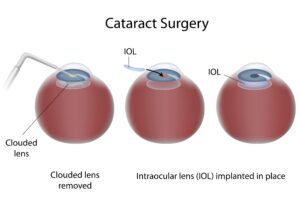
A tiny incision (about 2.4–3 mm) is made at the edge of the cornea.
-
A high-frequency ultrasound probe is inserted to emulsify and remove the cloudy lens.
-
A foldable intraocular lens is then implanted into the lens capsule to restore clear vision.
-
The incision is self-sealing in most cases, requiring no stitches.
-
Vision typically improves by the next day, allowing patients to resume daily activities.
-
Patients must avoid getting water in the eye for 2–4 weeks and follow strict post-operative care, including prescribed medications and eye drops.
Types of Intraocular Lenses (IOLs)
Modern IOLs are foldable and can be inserted through a small corneal incision. There are two main categories:
For patients without astigmatism:
-
Monofocal IOLs – Provide clear vision at one fixed distance (usually far). Reading glasses are needed for near tasks.
-
Multifocal IOLs – Allow for clear vision at multiple distances, reducing the need for glasses.
Types of Multifocal IOLs:
-
Bifocal / EDOF (Extended Depth of Focus): Offer clarity at either far and near or far and intermediate distances, depending on the model.
-
Trifocal IOLs: Provide continuous vision at far, intermediate, and near distances, offering greater independence from glasses.
Preoperative Instructions
-
Cataract surgery is typically performed on an outpatient basis. No hospital stay is needed.
-
Wear comfortable, easy-to-remove clothing.
-
Wash your face and shampoo your hair before arriving.
-
At the hospital, eye drops will be administered to dilate the pupil, numb the eye, and prevent infection. Local anesthesia may be applied via drops or injection. Sedation or general anesthesia is available if the patient is anxious.
-
Surgery lasts about 15–30 minutes in a sterile operating room. Patients remain conscious but relaxed and pain-free. You may notice bright lights or pressure but will not feel sharp pain.
-
After surgery, patients are monitored in a recovery room for about 30 minutes before being discharged.
Postoperative Care
-
Wear protective sunglasses or windproof glasses to avoid eye rubbing and accidental impact.
-
Wear an eye shield during sleep for at least 2 weeks to prevent accidental rubbing.
-
Avoid direct trauma to the eye.
-
Keep water out of the eye for at least 2 weeks as advised by your doctor.
-
Use sterile saline and cotton to clean around the eye instead of washing the face.
-
Avoid self-washing your hair. Have someone assist you while lying on your back with your eyes closed.
-
Follow the ophthalmologist’s instructions for cleaning and applying medications.
-
Attend all scheduled follow-ups: Day 1, Week 1, Month 1, Month 3, Month 6, and annually thereafter.
-
Avoid heavy lifting.
-
Be cautious with coughing, sneezing, or straining during bowel movements.
Possible Side Effects
-
Infection: Although rare, postoperative infection can occur. Strict hygiene and medication compliance greatly reduce this risk.
-
Macular Edema: Swelling at the central retina may develop after 1–2 weeks, causing temporary blurring or image distortion. It is treatable and usually resolves.
-
Posterior Capsular Opacification: Over time, the capsule holding the IOL may become cloudy, affecting vision. This condition can be quickly and painlessly corrected using YAG laser, restoring clear vision.
📍 For more information, please contact:
Ophthalmology Department, 4th Floor
Bangkok Hospital Phitsanulok
Tel: 0-5505-1724 ext. 4205–4206