

Risk Factors Most skin cancers are caused by exposure to ultraviolet (UV) radiation from the sun. Other potential causes include:
- Fair skin, having less pigment (Melanin)
- Spending considerable time in the sun without using any protection with sunscreen or clothing
- Living in sunny and warm climate or living at high elevation
- Having many moles or abnormal moles (dysplastic nevi)
- A family history of skin cancer
- A weakened immune system, includes people living with HIV/AIDS
- Cumulative exposure to radiation for a long time
- Exposure to certain chemicals substances such as arsenic
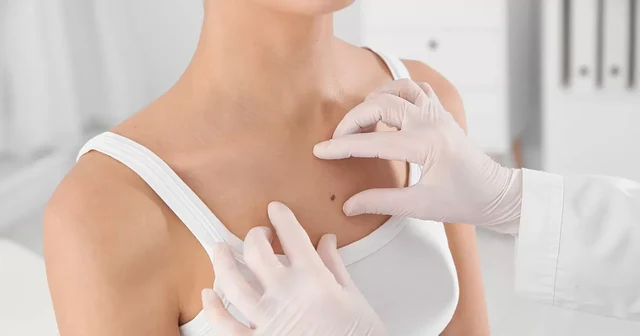
Symptoms and warning signs Skin cancer may initially appear as a nodule, rash or irregular patch on the surface of the skin and can develop anywhere on the body which can be seen with the naked eye. The type of skin cancer can be classified as followings: Basal cell carcinoma: A basal cell carcinoma may appears as a pale patch of skin or a waxy translucent bump, blood vessels or an indentation in the center of the bump, brownish scar or flesh-colored lesion and bleeding or scabbing sore that gradually develops and becomes chronic wounds. Squamous cell carcinoma: The Squamous cell carcinoma may appears as a firm pink or red nodule, rough, lesion as patches continue to develop slowly and becomes chronic wounds. Melanoma Cell carcinoma: The melanoma cell carcinoma may appears as a mole that changes in color, size or feel or one that bleeds, a rough small lesion with an irregular border and portions that appear red, pink, white, blue or blue-black and can be a painful lesion that itches or burns. Diagnosis Initial screening by self-examination: If you find anything suspicious, for example, have any new or unusual growths of the nodule, changes in the size, shape, or color of an existing spot or have chronic wounds on sun-exposed skin, you should consult a dermatologist. Medical diagnosis: The dermatologist may look at your skin to determine whether your skin changes are likely to be skin cancer. Dermatologist may remove the suspicious-looking skin for lab testing (Skin biopsy). A biopsy can determine whether you have skin cancer, if the dermatologist determines your symptoms are suspicious you may have additional tests to determine the extent (Stage) of the skin cancer. When your skin cancer is confirmed by biopsy-, the dermatologist will recommend the treatment options that best suited to type and stage of your skin cancer. Treatments The treatment options of a skin cancer or a precancerous skin lesion will vary and depending on the type of skin cancer, the stage, the size, the depth and location of the lesions. There are many methods to treat skin cancer as following: Electrodessication and Curettage (ED&C) For superficial non-melanoma skin cancers, ED&C provides high cure rates with minimal scarring. Because cancer cells scrape away more easily than normal tissue, a trained dermatologist can scrape away the cancerous cells, using a tool called a curette and leave only normal skin behind. With this method, the dermatologist will mostly do it 2-3 times to make sure all the cancer cells have gone. Cryosurgery The dermatologist may destroy some small or early skin cancer by freezing them with liquid nitrogen. when it thaws it may leave some white spots on the skin After 1 month, the dead tissue will slough off. Excisional surgery This method of skin cancer treatment is appropriate for any type. The dermatologist will excise the cancerous tissue and a surrounding margin of healthy skin. If the surgical removal is a big area. the dermatologist may cover the area with a skin graft taking skin from another part of the body.